
THE SHORT ANSWER
ABM tiers allocate time and production effort across target companies. They describe a service decision rather than a ranking of impressive logos. A large potential contract warrants intensive work only when need, access and delivery fit are credible. Specify what additional treatment each tier actually triggers before selecting accounts.
For the broader picture of how target customers, channels and sales handoffs work together, read the pillar guide B2B demand generation: from attention to qualified pipeline.
Define the treatment behind each tier
Describe three workable levels through tangible services. Individual treatment might include account research, a coordinated contact plan and an adapted business case. A group tier brings together companies facing a similar task and uses a shared specialist format. A broader tier provides scalable resources and monitors credible indications of need. The labels matter less than the treatment. If every company receives identical advertising and email, you have segmentation but not differentiated service. State which activities stop when a company changes tier and which commitments still need to be fulfilled. This prevents internal classification changes from creating a confusing external experience. Explore this further in the guide Account engagement: distinguish activity from credible demand.
Separate suitability, need and access
Use a selection sheet containing company ID, relevant use case, economic scope, confirmed trigger, accessible roles and likely implementation effort. Distinguish established information from assumptions. A large organisation may be unsuitable if required integrations are missing or nobody owns the problem internally. A smaller company may have a much clearer task. Do not assign the highest tier on revenue or headcount alone. Record the business rationale and the unresolved assumption that would change the decision if disproved. Lack of access is a research task in its own right rather than evidence that the company has no relevant demand.
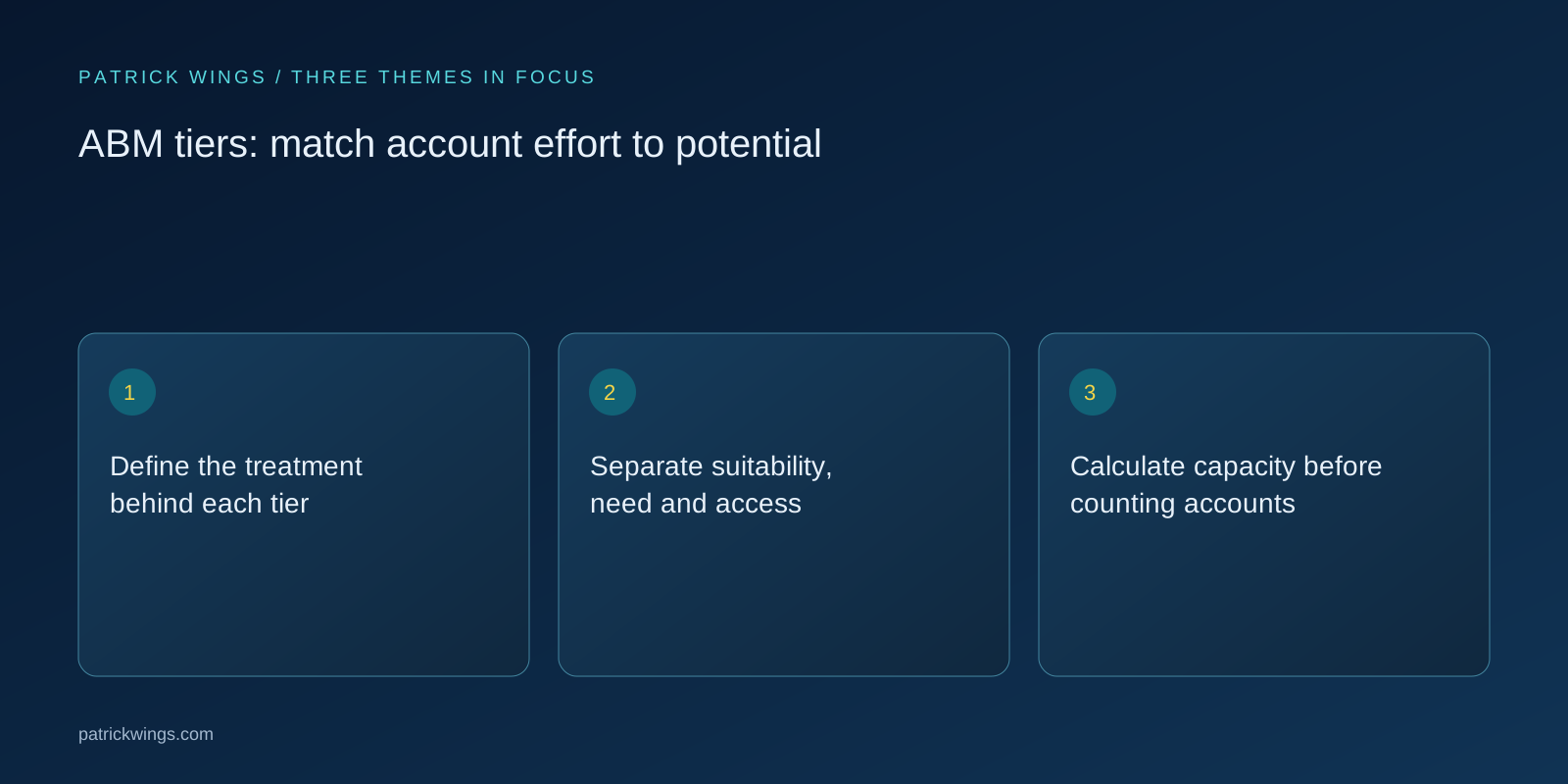
Calculate capacity before counting accounts
Estimate effort for each service with sales and specialist colleagues. Include research, coordination, production and follow-up. With a hypothetical weekly capacity of twelve hours, three accounts requiring four hours each can consume the whole allocation. Renaming twenty additional desired logos does not make them fit into that tier. Reserve time for existing opportunities and unexpected questions too. Start with a portfolio that can actually receive the promised attention. The constraint is rarely whether you can mark another company in the CRM; it is the quality of individual preparation and the conversations and materials that must follow that preparation. Explore this further in the guide Account-based marketing: develop target accounts together.
Work through a hypothetical portfolio
An invented IT supplier considers thirty suitable companies. Four have confirmed modernisation projects and accessible operational contacts. Eight share a use case but have no agreed project plan yet. The remainder initially receive useful standard resources. The supplier schedules individual conversations for the first four and a shared technical session for the next eight. These numbers illustrate work allocation only; they are not a recommended fixed tier distribution. What matters is whether each chosen format addresses the next unresolved question and whether the team can deliver the promised help within the planned period without displacing other commitments.

Make tier changes explainable
Define promotion, reduction and exit conditions. A confirmed project with an appropriate contact may justify more attention. Repeated advertising exposure alone does not. A delayed timetable can warrant lighter treatment without making the company fundamentally unsuitable. Recheck classifications after reorganisations and decide whether subsidiaries require separate treatment. HubSpot provides ways to manage target companies and associated activities, but the commercial rationale for a service tier remains your decision. Avoid automated moves that ignore an active customer conversation or an agreed pause in communication. Record the reason and responsible person so an unexplained score change cannot quietly redirect the relationship.
Review service quality rather than tier size
During reviews, compare promised support with work actually delivered. Examine resolved requirements, relevant roles reached, useful next steps and hours spent. A growing top tier is not progress if preparation becomes thinner. Check whether intensive treatment of accounts with unclear demand consumes resources needed by other suitable companies. The account owner explains the next classification while marketing checks content delivery capacity. Maintain a small waiting list with explicit entry reasons rather than an indefinitely expanding priority list. The model then remains a practical allocation of scarce attention, and an account can move between levels without acquiring a permanent prestige label.
INTERACTIVE / FROM READING TO ACTION
Three checkpoints for your implementation
Choose a checkpoint and track your reading progress. Checks are neither saved nor sent and do not score your business.
CHECKPOINT 01
Calculate capacity before counting accounts
Estimate effort for each service with sales and specialist colleagues.
Explore in the article ↗CHECKPOINT 02
Work through a hypothetical portfolio
An invented IT supplier considers thirty suitable companies.
Explore in the article ↗CHECKPOINT 03
Make tier changes explainable
Define promotion, reduction and exit conditions.
Explore in the article ↗Frequently asked questions
How many ABM tiers are useful?
Use few enough that each receives distinct, deliverable treatment. Three is a working model, not a requirement.
Does company size justify the top tier?
No. Relevant need, access and deliverable support must justify additional work.
When should tiers change?
When confirmed conditions change or at agreed reviews, rather than after every click.
How can I put “Define the treatment behind each tier” into practice?
Describe three workable levels through tangible services. Individual treatment might include account research, a coordinated contact plan and an adapted business case. A group tier brings together companies facing a similar task and uses a shared specialist format.
What matters when working on “Separate suitability, need and access”?
Use a selection sheet containing company ID, relevant use case, economic scope, confirmed trigger, accessible roles and likely implementation effort. Distinguish established information from assumptions. A large organisation may be unsuitable if required integrations are missing or nobody owns the problem internally.