

THE SHORT ANSWER
AI office hours give teams a dependable place to investigate concrete work cases together. Their value comes from more than repeated product demonstrations. A useful session resolves a question, improves a workflow or identifies a boundary. That requires suitable cases, approved material and a simple route for turning lessons into guidance, tests or an issue owned by the appropriate person afterwards.
To connect individual AI applications with reliable marketing operations, read the pillar guide AI transformation in B2B marketing: from individual prompts to reliable operations.
Set an explicit purpose for office hours
Describe the questions the session should address. Possibilities include improving an input, reviewing an uncertain output or clarifying permitted use. Separate technical incidents and binding approvals that require another route. Microsoft includes office hours as a practical support format during adoption. For your implementation, participants must know what kind of help to expect. A meeting that tries to provide training, support, governance decisions and idea collection simultaneously quickly loses a clear assignment and places unrealistic demands on the facilitator, particularly when several cases need different specialist knowledge.
Prepare cases through a short intake
Ask for the task, intended result, observed problem and an approved example. Participants do not need to arrive with a perfect prompt. A concrete difference between expectation and output is enough to begin. Check in advance whether personal or confidential details must be removed before group discussion. If a case is understandable only with material unsuitable for that audience, choose another channel or a suitable synthetic example. Preparation saves meeting time and prevents spontaneous screen sharing from exposing more information than the learning purpose requires or the participants are authorised to review.
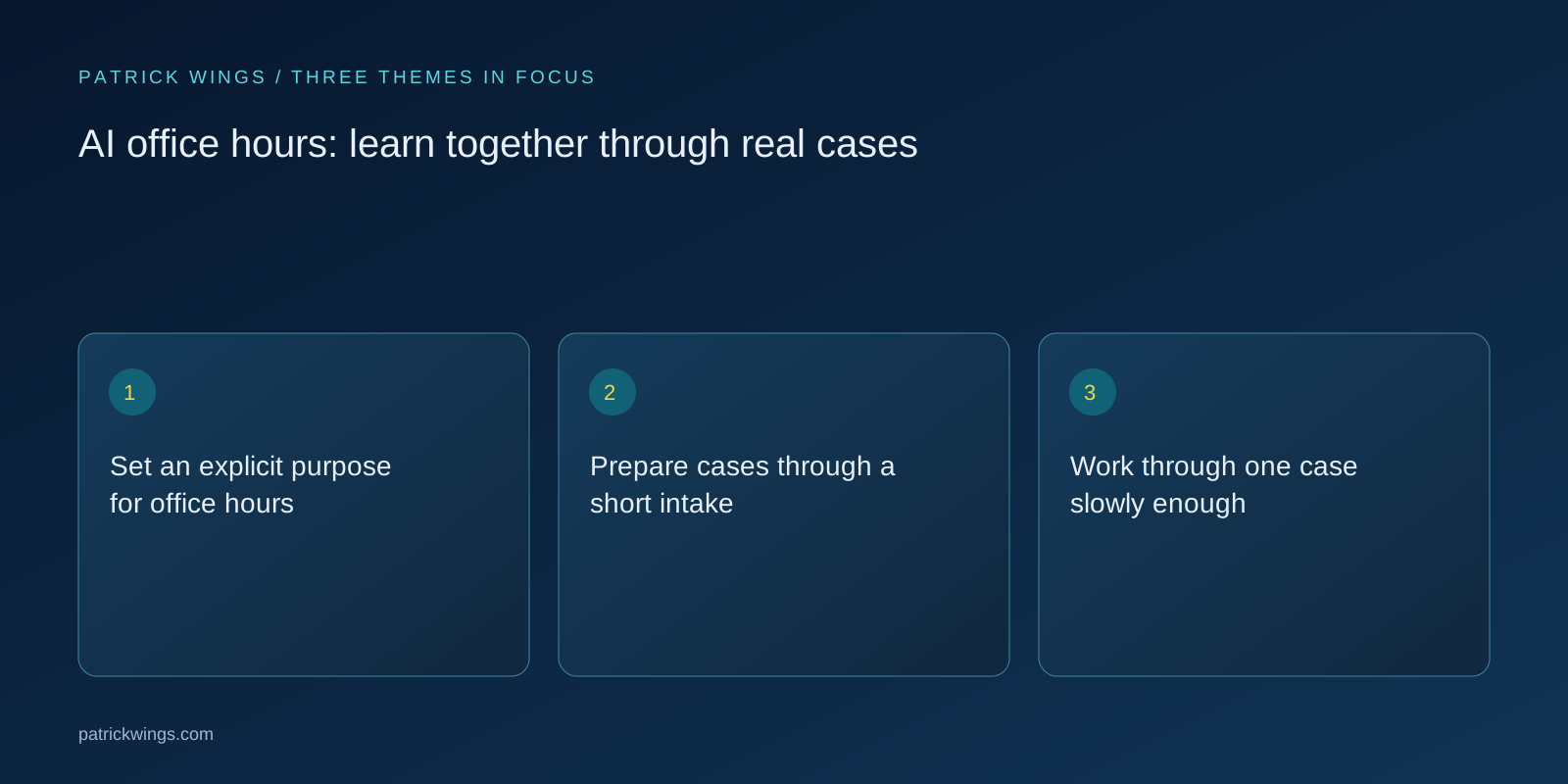
Work through one case slowly enough
Let the person presenting the case explain the work context first. Then examine the input, sources and output in that order. Avoid changing every component simultaneously. One targeted adjustment makes its effect easier to see. Ask the group how they recognise a usable result. This builds shared judgment rather than implying that success depends on a secret wording trick. If the cause remains unclear, record the unresolved investigation need instead of ending the session with an unsupported explanation that may later become an accepted rule in the team’s guidance.
Improve a hypothetical research brief together
Imagine a colleague receiving a confident market overview from an agent with unclear evidence. During office hours, separate requested facts from intended conclusions. Require a supporting passage for each finding and an unresolved state where evidence is unavailable. The group then checks one concrete comparison against its original source. This does not establish that the agent now researches reliably in general. It produces a better briefing structure and a test case that helps the team examine source support more deliberately when similar tasks arise in ordinary work. Explore this further in the guide Prompt engineering and AI workshops: improve the work, not prompt length.

Turn results into small reusable aids
After each case, record the task, tested change, observed effect and remaining limits. A short case note can be more useful than a lengthy recording. Remove unnecessary personal details and state the environment in which the lesson applies. Transfer confirmed failures into the test collection and recurring questions into maintained guidance. People who could not attend then benefit too. Avoid an uncontrolled collection of isolated prompts without purpose or context, since their continuing validity and appropriate use become difficult to assess when tools, sources or business processes later change.
Hand over unresolved work with ownership
Not every case can be resolved during the session. A source problem may need a subject owner, an access failure technical support and a new approval question the appropriate decision maker. For each handoff, formulate a concrete investigation task with the information required and intended result. Name an owner and report the status back later. Without this transfer, office hours become a recurring venue for the same unresolved problems. Also prevent a learning question from casually becoming a production change whose consequences nobody has assessed or agreed to own.
Assess value through resolved friction
After several sessions, ask whether the discussed tasks work better in everyday use. Which questions recur, and which errors appear less often? Check that the resulting aids remain understandable and current. Attendance alone measures reach. A small session can be valuable if it reduces recurring review effort or stops an unreliable use early. Adapt frequency and duration to actual demand. When case material is scarce, a targeted individual session can be more useful than a recurring event without a concrete work occasion or a clear reason for colleagues to attend. Explore this further in the guide Everyday AI adoption: identify friction rather than force usage.
INTERACTIVE / FROM READING TO ACTION
Three checkpoints for your implementation
Choose a checkpoint and track your reading progress. Checks are neither saved nor sent and do not score your business.
CHECKPOINT 01
Work through one case slowly enough
Let the person presenting the case explain the work context first.
Explore in the article ↗CHECKPOINT 02
Improve a hypothetical research brief together
Imagine a colleague receiving a confident market overview from an agent with unclear evidence.
Explore in the article ↗CHECKPOINT 03
Turn results into small reusable aids
After each case, record the task, tested change, observed effect and remaining limits.
Explore in the article ↗Frequently asked questions
Who should facilitate?
Someone able to investigate the task systematically and recognise boundaries. They need a reliable specialist handoff, not every answer themselves.
Must sessions be recorded?
No. An approved case note may suffice and can be easier to sanitise and maintain.
How do we avoid mere product demonstrations?
Start with a concrete task, examine an observed difference and record a result or a clear next investigation assignment.
How can I put “Set an explicit purpose for office hours” into practice?
Describe the questions the session should address. Possibilities include improving an input, reviewing an uncertain output or clarifying permitted use. Separate technical incidents and binding approvals that require another route.
What matters when working on “Prepare cases through a short intake”?
Ask for the task, intended result, observed problem and an approved example. Participants do not need to arrive with a perfect prompt. A concrete difference between expectation and output is enough to begin.