
THE SHORT ANSWER
AI can help organise substantial information around a specific research question. The bottleneck often shifts, however, from collection to verification and interpretation. For SaaS, IT and technology companies, a useful research result makes clear which statement is supported, which interpretation has been added and which information is still missing. Fluent summaries alone are not enough.
To connect individual AI applications with reliable marketing operations, read the pillar guide AI transformation in B2B marketing: from individual prompts to reliable operations.
Define a decision rather than a collection exercise
“Analyse the competition” can produce substantial prose with little practical value. Ask which providers serve a defined use case, which integration requirements are documented publicly or how a particular segment is addressed. Specify market, time period and required output. A comparison matrix, source log or list of unresolved questions may be more useful than a long report. State which decision the work will support. This gives you a way to judge whether research is sufficient or has gathered information that does not address the actual problem.
Establish an understandable source hierarchy
Vendor documentation can establish publicly stated capabilities, but does not automatically prove implementation quality. Financial reports, academic publications and original studies answer different questions. Reviews can provide signals, but require context and do not represent all users. Decide which kind of evidence each claim needs. An AI summary should not itself become evidence for an external assertion. Trace important information to a verifiable location and inspect whether it supports the specific statement. Source quality depends on the question, not simply on whether a page looks authoritative.
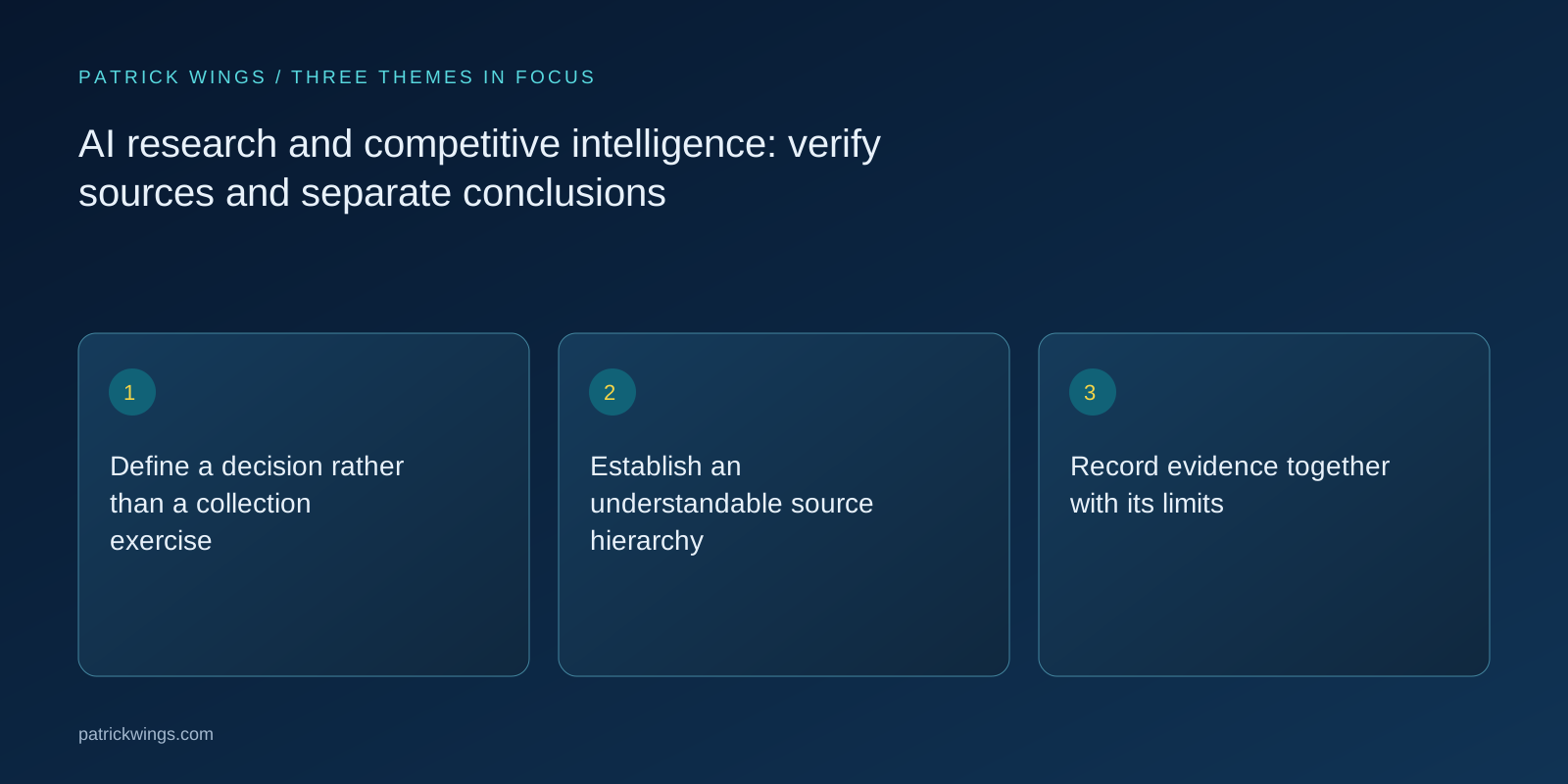
Record evidence together with its limits
Capture URL, title, check date and the relevant claim. Add conditions such as plan dependency, regional scope or a limited study period. Comparisons without those details can falsely equate different offers. Missing public information is a knowledge gap rather than proof that a capability does not exist. Make the research process flag such cases explicitly. When sources conflict, preserve both positions with context rather than automatically treating the newest or most persuasive wording as definitive. A responsible result can contain unresolved uncertainty. Explore this further in the guide AI agents in marketing: which tasks can be bounded usefully.
Separate observations, interpretations and recommendations
An observation might be that a competitor published a new integration page. An interpretation might be that the subject is becoming more important to its positioning. Neither proves a strategic shift or growing market demand. Keep those layers separate in the output. Only then propose a possible action for your own business. Readers can challenge the inference without discarding the underlying evidence. The distinction also reveals where expert discussion should supplement research, instead of allowing an attractive narrative to make every subsequent recommendation appear more certain than it is.

Limit ongoing monitoring to meaningful changes
As an illustrative design, an agent could repeatedly inspect selected sources and present changes for assessment. Define what counts as meaningful: a revised offer, changed pricing or newly documented integrations. A navigation update need not trigger an alert. Avoid duplicate notifications and retain both the baseline and observed change. The agent should not bypass protected areas or collect data outside permitted conditions. Respect access requirements and specify when a person takes over interpretation. Useful monitoring reduces noise as well as identifying information worth considering.
Evaluate research through decision quality
Check whether the output answers the original question, contains important evidence and communicates uncertainty. Do not merely count sources or generated pages. A short, dependable finding can be more valuable than an apparently comprehensive report built on weak foundations. Test deliberately outdated and contradictory materials. Include verification and correction effort when comparing with the previous approach. Use feedback from actual decisions to improve future briefs. Technology can support judgment, but it does not automatically assume your market knowledge or responsibility for acting on the conclusion. Explore this further in the guide SaaS knowledge and support agents: reliable answers need maintained foundations.
INTERACTIVE / FROM READING TO ACTION
Three checkpoints for your implementation
Choose a checkpoint and track your reading progress. Checks are neither saved nor sent and do not score your business.
CHECKPOINT 01
Record evidence together with its limits
Capture URL, title, check date and the relevant claim.
Explore in the article ↗CHECKPOINT 02
Separate observations, interpretations and recommendations
An observation might be that a competitor published a new integration page.
Explore in the article ↗CHECKPOINT 03
Limit ongoing monitoring to meaningful changes
As an illustrative design, an agent could repeatedly inspect selected sources and present changes for assessment.
Explore in the article ↗Frequently asked questions
Is an AI summary itself a source?
Verifiable external claims need underlying evidence. A summary can help organise and interpret that material.
What does missing competitor information mean?
Initially, only that it was not found or publicly documented. It does not prove a capability is absent.
Should monitoring report every change?
No. Define meaningful events and a review process. Excessive low-value alerts make interpretation harder.
How can I put “Define a decision rather than a collection exercise” into practice?
“Analyse the competition” can produce substantial prose with little practical value. Ask which providers serve a defined use case, which integration requirements are documented publicly or how a particular segment is addressed. Specify market, time period and required output.
What matters when working on “Establish an understandable source hierarchy”?
Vendor documentation can establish publicly stated capabilities, but does not automatically prove implementation quality. Financial reports, academic publications and original studies answer different questions. Reviews can provide signals, but require context and do not represent all users.