
THE SHORT ANSWER
Investigate demo no-shows as a process signal before assuming the buyer lacks interest.
For the broader picture of how target customers, channels and sales handoffs work together, read the pillar guide B2B demand generation: from attention to qualified pipeline.
Read absence as a process signal
Investigate demo no-shows as a process signal before assuming the buyer lacks interest. Absence can result from calendar problems, unclear value, the wrong time zone or changed priorities. Connect the meeting promise, preparation and easy rescheduling so suitable people can actually attend a useful conversation. Explore this further in the guide Demo pages that set useful expectations before the conversation.
Inspect the path from advertising promise to calendar entry. Did the person understand whether they booked a product tour, needs discussion or brief answer? What duration was promised? Confusion can begin at booking. More reminders cannot repair it when the actual meeting still serves a different purpose from the one originally advertised.
Distinguish booking states precisely
Define booked, confirmed, cancelled, rescheduled and missed without notice separately. Record booking source, waiting time and promised meeting value. A rescheduled appointment is not a permanently lost opportunity. Repeated bookings by one person must not silently inflate the denominator used to report attendance or acquisition performance.
Assign a stable booking ID and connect rescheduled appointments with the original booking. Store timestamps, time zone, status changes and promised purpose. A supplier cancellation must remain separate from a customer cancellation. Without these categories, an attendance rate may misrepresent your own lack of availability as lack of buyer interest in the offer. Explore this further in the guide Sales capacity: match campaigns to actual follow-up capacity.
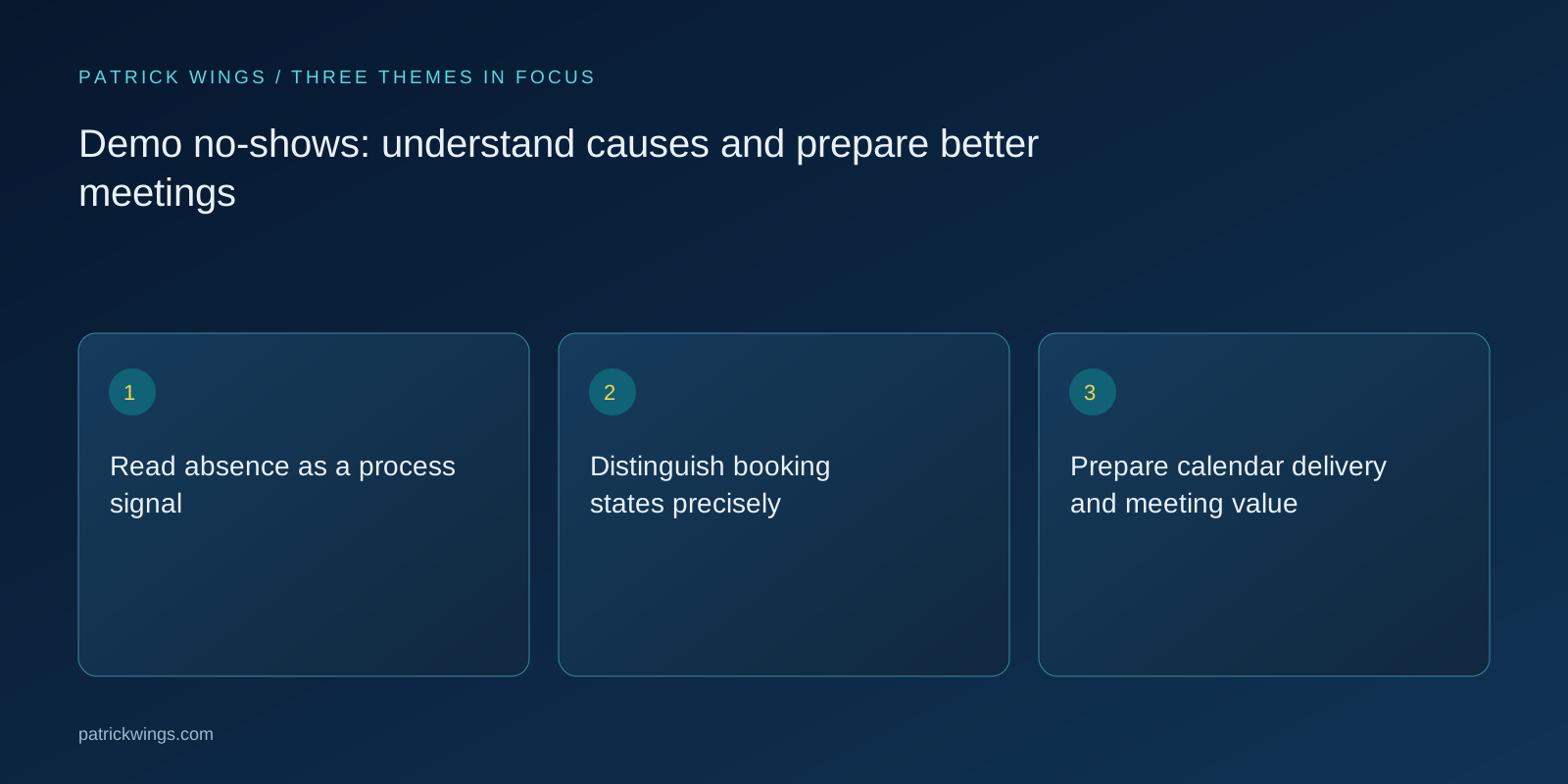
Prepare calendar delivery and meeting value
Test calendar links, time zones, joining details and confirmations on different devices. State the agenda, required preparation and responsible person. Make cancellation and rescheduling straightforward. Reminders should provide orientation; additional messages do not repair an unclear meeting purpose or a technically broken invitation.
Test invitations, video links, rescheduling and mobile calendar import. Explain the agenda so participants know what preparation is needed and what they should understand afterwards. A technical assessment needs the appropriate specialist. If that person becomes unavailable, offer an explicit alternative rather than a generic substitute meeting unable to address the question originally promised.
Expose the denominator in an example
An invented team receives forty bookings. Eight are rescheduled in advance, four cancelled and six missed without notice; twenty-two initially take place. Attendance rates differ depending on the denominator. Report the categories and later replacement appointments separately rather than compressing several different events into one deceptively simple success metric.
For the invented forty bookings, keep rescheduled appointments linked through their eventual result. Four cancellations and six missed meetings represent different causes. Add whether cancellation was straightforward and whether a replacement booking occurred. Only then can you identify whether calendar handling, expected value or changed priority is the main unresolved issue behind the observed absence.

Identify unsuitable booking paths
A compulsory calendar booking immediately after a casual content download can produce poor attendance. Long waits and the wrong meeting specialist also matter. Avoid closing an entire acquisition source or imposing more qualification before understanding which causes are actually present in the underlying missed appointments.
Check whether a simple download automatically pushes people towards a calendar. Those bookings may express a different intent from explicitly requested demos. Separate these routes in reporting. Also inspect whether waiting time reflects unavailable expertise. Another qualification hurdle could exclude suitable people without solving that staffing problem or making the promised meeting any easier to attend.
Review attendance with suitable conversations
Compare similar booking cohorts by waiting time, offer and source. Ask selected people respectfully about the cause and inspect genuine project suitability. Better attendance accompanied by a sharp fall in suitable conversations may be a poor trade-off; attendance rate alone is not a sufficient commercial objective.
For each booking route, review initial attendance, later replacement attendance and genuinely useful conversations. A higher attendance rate can result from fewer bookings. Examine which suitable cases no longer book. Selected voluntary feedback provides causal clues but cannot fully explain every absence or establish one universal reminder rule for all audiences and meeting purposes.
Manage cancellation, cover and review
Assign responsibility for booking, reminders and substantive preparation. After an absence, a useful check-in with an easy rescheduling option is often appropriate. Record when to defer the case so an unresolved situation does not trigger an unlimited series of automated attempts to force another appointment.
After a missed demo, the owner receives context and a bounded, appropriate follow-up task. Record renewed appointment wishes and stop automated reminders for cancelled meetings. Marketing reviews booking promises, operations checks calendar behaviour and sales prepares the substance. When problems recur, test the affected path specifically instead of automatically rebuilding the entire acquisition programme around an unverified explanation.
INTERACTIVE / FROM READING TO ACTION
Three checkpoints for your implementation
Choose a checkpoint and track your reading progress. Checks are neither saved nor sent and do not score your business.
CHECKPOINT 01
Prepare calendar delivery and meeting value
Test calendar links, time zones, joining details and confirmations on different devices.
Explore in the article ↗CHECKPOINT 02
Expose the denominator in an example
An invented team receives forty bookings.
Explore in the article ↗CHECKPOINT 03
Identify unsuitable booking paths
A compulsory calendar booking immediately after a casual content download can produce poor attendance.
Explore in the article ↗Frequently asked questions
Are reschedules no-shows?
Not automatically. Separate advance changes from absence without notice.
Should we send more reminders?
Check delivery, meeting value and appropriate frequency first.
Should one missed meeting end the case?
No. A respectful clarification can reveal an appropriate next step.
How can I put “Read absence as a process signal” into practice?
Investigate demo no-shows as a process signal before assuming the buyer lacks interest. Absence can result from calendar problems, unclear value, the wrong time zone or changed priorities. Connect the meeting promise, preparation and easy rescheduling so suitable people can actually attend a useful conversation.
What matters when working on “Distinguish booking states precisely”?
Define booked, confirmed, cancelled, rescheduled and missed without notice separately. Record booking source, waiting time and promised meeting value. A rescheduled appointment is not a permanently lost opportunity.