
THE SHORT ANSWER
Build paid media experiments around a testable hypothesis and a decision agreed beforehand.
For the broader picture of how target customers, channels and sales handoffs work together, read the pillar guide B2B demand generation: from attention to qualified pipeline.
Write a falsifiable hypothesis
Build paid media experiments around a testable hypothesis and a decision agreed beforehand. A test is more than a second advert in the account. It needs one defined change, a useful comparison and an explanation of what the team will do with different outcomes.
A useful hypothesis names audience, change and expected mechanism. For example, technical evidence should reduce unresolved integration questions. This is more precise than a new advert should work better because the review can examine whether that particular uncertainty actually declined. Explore this further in the guide Campaign retrospectives: turn results into testable changes.
Match design to the question
Specify audience, changed variable, primary outcome and protective criteria. Distinguish tactical variant comparisons from tests of additional advertising impact. Google’s documentation separates experiments and lift studies accordingly. Choose a design that answers the question rather than whichever platform function currently seems easiest to activate.
Choose the allocation unit too. Randomising colleagues separately can create mutual influence in a shared purchase. Consider account allocation or disclose the limitation. The design should protect the possibility of an understandable answer rather than merely produce a convenient reporting number.
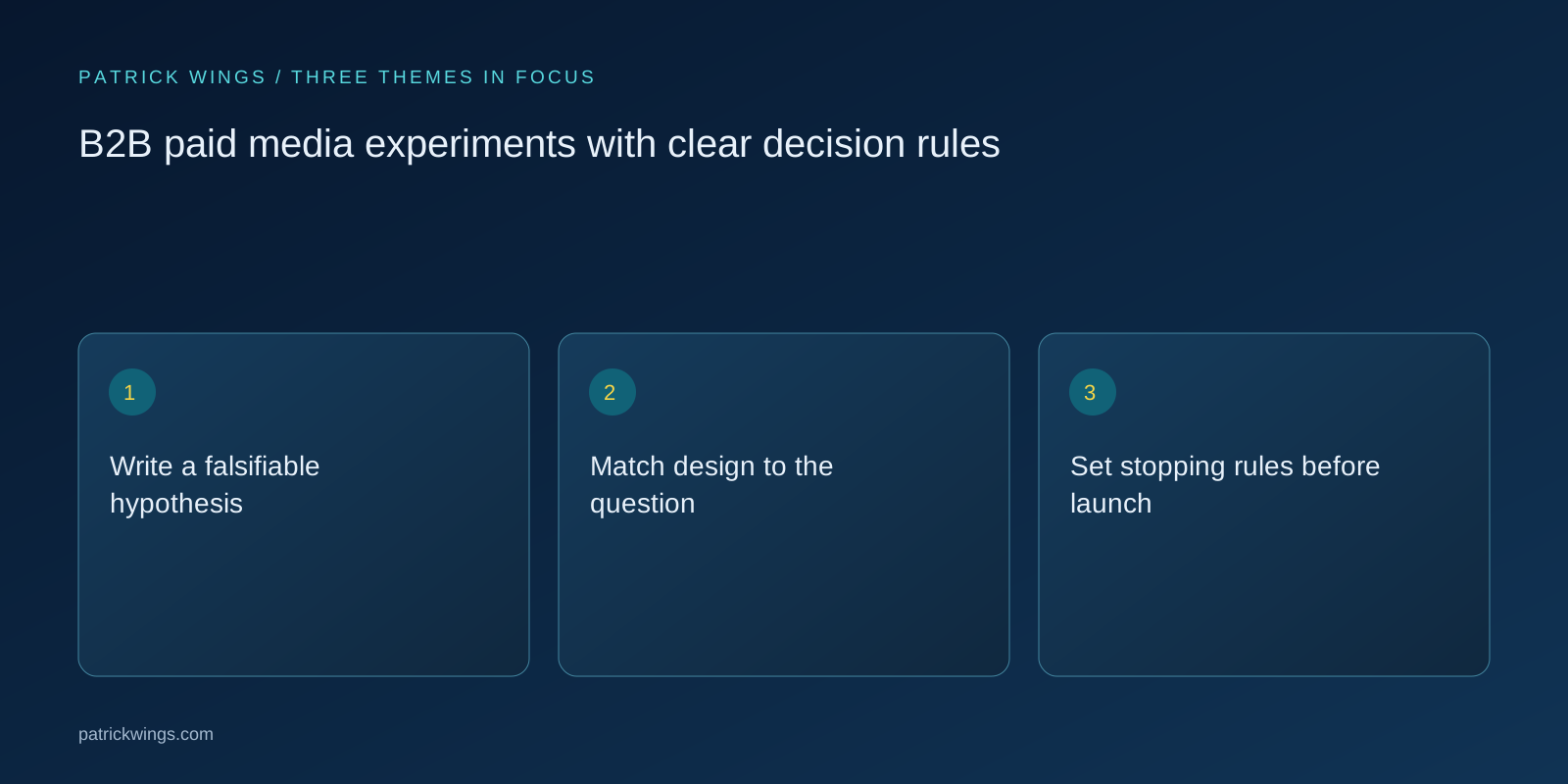
Set stopping rules before launch
Before launch, verify tracking, comparability and possible overlap. Estimate duration from expected events and reporting delay. Record spending limits and stopping conditions. A technical failure may justify a safety stop; an encouraging interim number is not a sound reason to bring the winner decision forward.
Record technical stop conditions, spending ceiling and commercial decision criteria before launch. A failed form means a disrupted experiment. Quietly shortening the analysis to a coincidentally strong week must not replace the evaluation period the team originally agreed.
Downloads versus conversations
An invented supplier tests a technical guide against a demo invitation on the same destination. Both variants receive bounded exposure. Ten downloads and three demo requests are different events, so compare subsequent suitable conversations rather than immediate submission rates alone. The appropriate evaluation follows the original commercial objective. Explore this further in the guide B2B paid media budgets: plan learning costs and sales capacity.
A guide may produce more early contacts while a demo produces fewer immediate requests. Use identical later suitability criteria. If the team also changes its follow-up script, the difference can no longer be attributed cleanly to the next step offered in the advert.

Avoid post-hoc winners
Several simultaneous changes make a positive result difficult to explain. Different sales handling can create an apparent creative effect too. Small counts cannot support every desired segmentation. Accept an unresolved result rather than repeatedly searching additional slices after the test until an attractive difference eventually appears somewhere.
Preserve all planned variants and outcomes, including disappointing results. If ten post-hoc segment checks reveal one positive difference, treat it as another hypothesis. Validate it independently rather than presenting it as confirmed success of the experiment’s original question.
Integrity, outcome and applicability
Check experiment integrity before interpreting the business result. Report absolute counts, observation time and relevant uncertainty alongside relative changes. Choose between adoption, targeted further testing and rejection. A variant may perform better locally without already being suitable for every country, offer or spending level.
The conclusion includes conditions, observed events and side effects. More conversations may require longer qualification. State that trade-off and whether available sales capacity can support it at the next stage, instead of promoting volume alone as the winning outcome.
Keep a complete experiment register
Keep hypotheses, configuration, changes and conclusions in a test register. Assign one person to the decision and another to challenge the business interpretation. The register should improve future choices; an archive of successful screenshots that omits failed or inconclusive tests cannot serve that purpose.
Link each follow-up experiment to the unresolved issue it addresses. This reveals systematic learning rather than repeated investigation of the same question. Keep rejected approaches searchable so another team does not unknowingly repeat an identical test without its earlier context.
INTERACTIVE / FROM READING TO ACTION
Three checkpoints for your implementation
Choose a checkpoint and track your reading progress. Checks are neither saved nor sent and do not score your business.
CHECKPOINT 01
Set stopping rules before launch
Before launch, verify tracking, comparability and possible overlap.
Explore in the article ↗CHECKPOINT 02
Downloads versus conversations
An invented supplier tests a technical guide against a demo invitation on the same destination.
Explore in the article ↗CHECKPOINT 03
Avoid post-hoc winners
Several simultaneous changes make a positive result difficult to explain.
Explore in the article ↗Frequently asked questions
How many variants should we test?
Only as many as the evidence, budget and clear question can support.
When can we stop?
For predefined safety reasons or under the agreed decision rule.
What if results are inconclusive?
Document uncertainty and continue only when further learning is worth its cost.
How can I put “Write a falsifiable hypothesis” into practice?
Build paid media experiments around a testable hypothesis and a decision agreed beforehand. A test is more than a second advert in the account. It needs one defined change, a useful comparison and an explanation of what the team will do with different outcomes.
What matters when working on “Match design to the question”?
Specify audience, changed variable, primary outcome and protective criteria. Distinguish tactical variant comparisons from tests of additional advertising impact. Google’s documentation separates experiments and lift studies accordingly.