
THE SHORT ANSWER
Evaluate brand campaigns separately from acquiring people who do not yet know you. They can simplify access to your offer, but often capture demand created elsewhere. Assess their additional value through search intent, organic alternatives and bounded tests.
For the broader picture of how target customers, channels and sales handoffs work together, read the pillar guide B2B demand generation: from attention to qualified pipeline.
Clarify the task behind brand searches
Someone searching for your name may want a demo, a login, an invoice or a job. These tasks do not automatically belong in the same acquisition assessment. Collect typical brand queries and map them to useful destinations. Decide which tasks the campaign should actually serve. A brand campaign may guide visitors towards a current product page or explain a specific offer. It should not portray every navigational click as newly created demand. Record its intended role so later reporting does not transform a useful navigation aid into an apparently exceptional growth engine. This also helps colleagues choose suitable landing pages for different searches.
Separate brand from other demand
Distinguish brand terms from generic solution searches in your reporting. Otherwise, an increasing share of inexpensive brand conversions can conceal weaknesses in broader acquisition. Investigate which campaigns, recommendations or events might have created that demand. The final click cannot fully reveal those causes. Also examine existing customers and employees where your evidence permits a meaningful distinction. Report appropriate new enquiries, existing relationships and uncertain cases separately. Small B2B teams often learn more from inspecting a handful of actual enquiries than from presenting one impressively low blended conversion cost. Use those cases to improve the categories rather than forcing everything into acquisition.
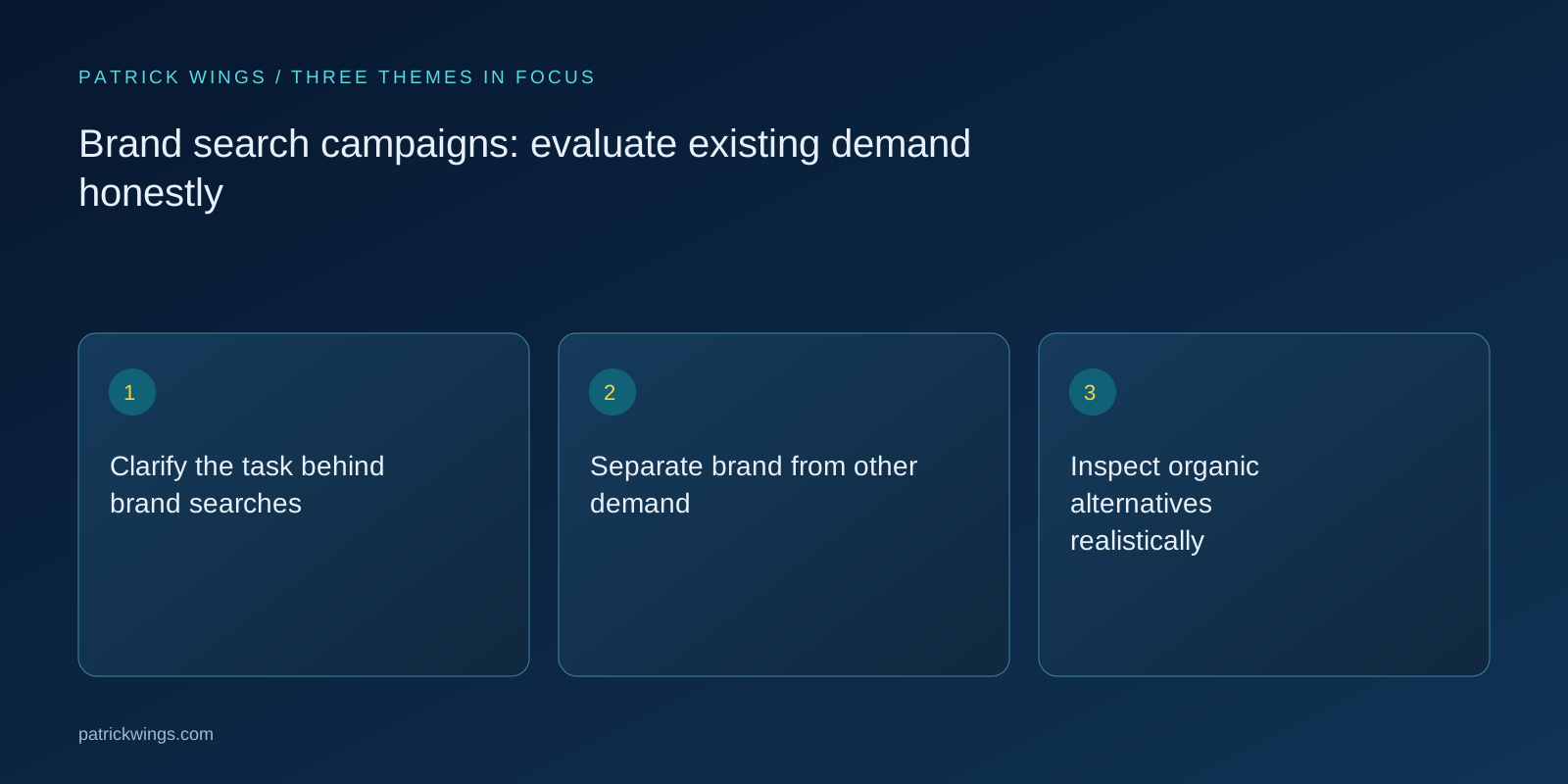
Inspect organic alternatives realistically
Review search results for important brand queries on relevant devices and in relevant markets. Is there an obvious organic route to the correct page? Are confusing alternatives or competing offers visible? Your own snapshot does not establish general advertising impact, but it can generate useful test questions. Check whether the advertised page is actually more helpful than the organic result. A demo form is an unsuitable replacement for a visitor seeking support. Repair obvious navigation problems first. Paying indefinitely to compensate for an unclear website can create unnecessary costs and frustrating experiences, particularly for customers who already know exactly what they need. Explore this further in the guide B2B incrementality: what difference does advertising make?.
Plan an illustrative suspension test
Imagine a SaaS team receiving 40 brand-related enquiries per observation period. It wants to understand whether advertising creates additional conversations or mainly replaces organic journeys. Forty is an invented teaching figure. Design a bounded test using reasonably comparable periods or suitable regions if volume supports that separation. Evaluate total appropriate enquiries across paid and organic routes together. If paid enquiries decline while organic enquiries rise similarly, substitution is one plausible explanation. However, a single short test with few events does not justify a precise estimate of long-term impact. Define in advance what degree of uncertainty would still permit a useful budget decision.

Document common sources of distortion
A simultaneous product launch, trade show or press mention can materially change brand searches. Do not compare such periods with ordinary weeks without explanation. Landing page changes, tracking failures and different sales availability also affect interpretation. High platform return measures attributed revenue, which is not necessarily additional revenue. Equally, a small brand campaign contribution does not prove that every other channel independently created demand. Keep observation separate from interpretation. When evidence is weak, describe plausible explanations and identify the next testable question. That is more useful for budgeting than a precise-looking success rate whose underlying assumptions nobody has examined.
Make the budget decision through purpose
Regularly inspect whether the campaign fulfils its specific navigation or acquisition purpose, which tasks it serves and where unnecessary duplication occurs. Allow an explicit margin for uncertainty. A small business may choose a limited brand presence to guide visitors towards a clear offer even when additional impact cannot be measured precisely. That is a defensible choice when its reasoning is transparent. It differs from claiming that low brand CPL proves the scalability of the entire marketing programme. Set a review date and revisit the campaign's role when awareness, competition or organic visibility changes materially. Preserve the distinction in management reporting as well as campaign operations. Explore this further in the guide Measuring GEO and AEO: what AI visibility tells you about your business.
INTERACTIVE / FROM READING TO ACTION
Three checkpoints for your implementation
Choose a checkpoint and track your reading progress. Checks are neither saved nor sent and do not score your business.
CHECKPOINT 01
Inspect organic alternatives realistically
Review search results for important brand queries on relevant devices and in relevant markets.
Explore in the article ↗CHECKPOINT 02
Plan an illustrative suspension test
Imagine a SaaS team receiving 40 brand-related enquiries per observation period.
Explore in the article ↗CHECKPOINT 03
Document common sources of distortion
A simultaneous product launch, trade show or press mention can materially change brand searches.
Explore in the article ↗Frequently asked questions
Are brand campaigns always necessary?
No. Their value depends on search tasks, organic alternatives and additional impact.
Can brand be included in overall CPL?
A blended figure can supplement reporting but should not replace separate brand and non-brand views.
How long should a test run?
Long enough to consider relevant variation and the sales cycle; small volumes limit certainty.
How can I put “Clarify the task behind brand searches” into practice?
Someone searching for your name may want a demo, a login, an invoice or a job. These tasks do not automatically belong in the same acquisition assessment. Collect typical brand queries and map them to useful destinations.
What matters when working on “Separate brand from other demand”?
Distinguish brand terms from generic solution searches in your reporting. Otherwise, an increasing share of inexpensive brand conversions can conceal weaknesses in broader acquisition. Investigate which campaigns, recommendations or events might have created that demand.