
THE SHORT ANSWER
Content usability concerns whether people can use a resource to complete their task. Positive opinions about design or long time on a page do not answer that question. For SaaS and IT content, observe concrete activities: finding prerequisites, explaining a distinction or completing a worksheet correctly. A small qualitative study can expose comprehension problems that internal approval overlooks. It examines practical use rather than asking participants whether they like the resource or consider the writing professional.
To see how this step fits into your content strategy, read the pillar guide B2B content marketing: From useful expertise to qualified demand.
Choose an observable reader task
Start by describing what a reader should be able to do after using the resource. “Understand the article” is too broad. A more useful task is finding relevant system prerequisites and explaining which remain unresolved in a particular situation. The task should fit the resource’s actual purpose. An overview need not enable a complete implementation. Before testing, define what successful use would look like. Criteria might include correct interpretation, a defensible next step and recognition of a significant limitation. Keep these separate from preferences about tone, colors or the apparent professionalism of the design. Explore this further in the guide Test messaging before rewriting your website.
Select relevant people and situations
Invite people who match the intended audience or perform comparable tasks. Colleagues often already know the organization’s terminology and assumptions. Their feedback is useful, but it does not replace observation with outsiders. Consider differences in expertise, language and reading situation. A worksheet on a large monitor is used differently from a quick reference on a phone. Explain that the resource is being tested, not the participant’s ability. Arrange consent, recording and retention through the appropriate research process. Avoid collecting sensitive information that is unnecessary for the question the study is designed to answer. Explore this further in the guide B2B workbooks that turn information into decisions.
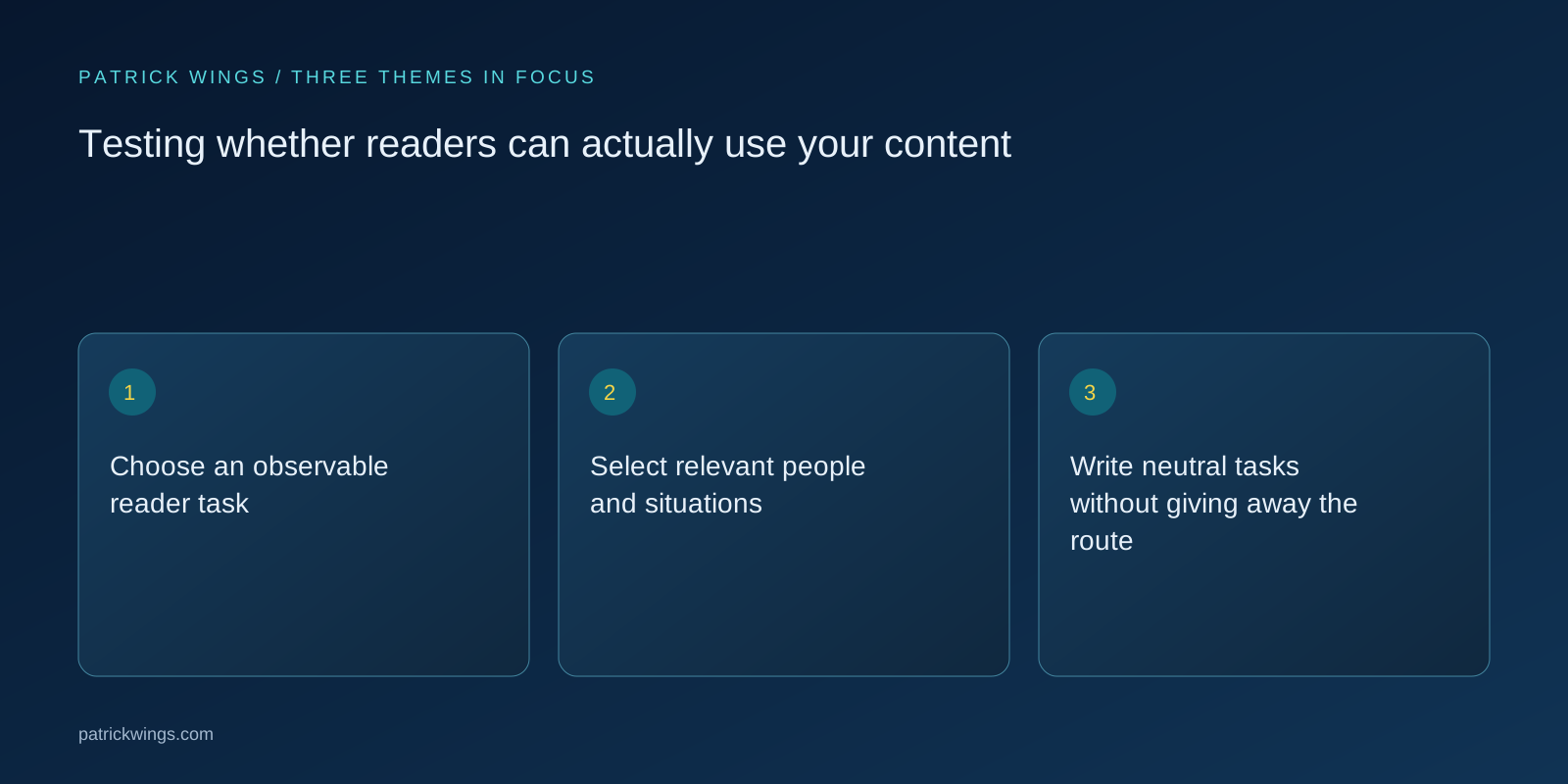
Write neutral tasks without giving away the route
Describe a believable situation and desired outcome without naming the location of the answer. “Open the prerequisites section” tells you little about whether the structure is understandable. A better task allows the participant to find the relevant information independently. Invite thinking aloud where useful, but do not fill every pause with an explanation. If someone gets stuck, note it and decide deliberately when assistance is needed. Assistance changes what the observation means. Record whether the task was completed independently or only after a specific prompt, rather than counting both outcomes as equivalent success.
A hypothetical guide evaluation
Imagine an IT provider testing an integration guide. Participants are asked to identify unresolved preparation questions for a described system environment. One person misses that an example applies only to a particular product edition. This suggests a problem with the placement or wording of that boundary. The team revises the passage and tests it again with an appropriate task. This hypothetical example shows how an observation can lead to a concrete edit. It does not establish a statistical error rate or imply that one session fully validates the guide for every audience and situation.

Separate observation from interpretation
First record what happened: searched terms, chosen routes, specific misunderstandings and assistance required. Interpret those observations afterward. A long pause may indicate confusion, but it may also reflect careful reading. Ask open follow-up questions instead of suggesting the cause. Prioritize problems by the task they obstruct and the seriousness of the consequences. Misunderstanding applicability can matter more than an awkward sentence. Keep concrete examples so editors can understand why a change was prioritized and which assumption it is intended to test. This prevents the report from becoming a list of unsupported impressions about what readers probably wanted.
Review content, presentation and access together
A comprehension issue can result from missing context, unclear sequence or inaccessible presentation. Examine headings, links, image descriptions and the relationship between a graphic and its explanation. Tables and PDFs may raise reading-order or mobile-use concerns. A usability study does not replace a systematic accessibility assessment, although it can reveal obstacles in actual use. Involve specialists and people with relevant usage experience where appropriate. Do not assume that adding more text solves every problem. A more precise label, clearer limitation or different sequence may be more effective than another long paragraph explaining the same point.
Recheck the original question after editing
Prioritize changes that affect the chosen task. Record the problem, edit and expected improvement together. A further session should examine whether the revised resource answers the question more clearly without revealing the route to the answer. Small qualitative samples identify potential problems and explanations; they do not provide a representative success rate for all visitors. Combine findings with other evidence where useful, keeping its limitations explicit as well. Content usability then becomes an ongoing editorial learning process rather than a one-time approval badge assumed to cover every later revision, audience change or newly added section.
INTERACTIVE / FROM READING TO ACTION
Three checkpoints for your implementation
Choose a checkpoint and track your reading progress. Checks are neither saved nor sent and do not score your business.
CHECKPOINT 01
Write neutral tasks without giving away the route
Describe a believable situation and desired outcome without naming the location of the answer.
Explore in the article ↗CHECKPOINT 02
A hypothetical guide evaluation
Imagine an IT provider testing an integration guide.
Explore in the article ↗CHECKPOINT 03
Separate observation from interpretation
First record what happened: searched terms, chosen routes, specific misunderstandings and assistance required.
Explore in the article ↗Frequently asked questions
How does testing differ from editorial approval?
Approval usually checks subject accuracy and organizational requirements. Testing observes whether intended readers can complete concrete tasks with the content.
Does this require many participants?
Small, relevant groups can help identify qualitative problems. Their results do not establish a representative success rate.
Does usability testing replace accessibility assessment?
No. It provides observations of use; systematic accessibility assessment remains a separate task.
How can I put “Choose an observable reader task” into practice?
Start by describing what a reader should be able to do after using the resource. “Understand the article” is too broad. A more useful task is finding relevant system prerequisites and explaining which remain unresolved in a particular situation.
What matters when working on “Select relevant people and situations”?
Invite people who match the intended audience or perform comparable tasks. Colleagues often already know the organization’s terminology and assumptions. Their feedback is useful, but it does not replace observation with outsiders.