
THE SHORT ANSWER
Entering DACH involves more than translating a website. It requires a relevant customer situation, understandable communication and a reliable route from the first question to continuing support. This can be built from abroad when the operating requirements are addressed deliberately.
To connect this decision with positioning, market entry and growth, read the pillar guide Go-to-market for B2B SaaS: turn market insight into an executable growth strategy.
Choose a justified starting market
Germany, Austria and Switzerland share language overlap but are not identical commercial environments. First assess where your application, relationships and service capacity support the most plausible entry. An illustrative SaaS team might test Germany first because it already has relevant reference contacts there. Another may find a narrower Swiss segment more practical. Avoid choosing solely on the largest market estimate. Document reachable segments, alternatives and unresolved questions. The International Trade Administration describes Germany as a decentralised market; your particular entry still needs its own segment-level research. The operating plan should reflect the businesses you can reach and serve rather than an abstract regional label.
Research the local customer situation
Check how suitable businesses describe the problem and which workflows they use today. Translating internal category terms does not automatically produce the language buyers use. Ask users and responsible decision makers about previous purchases and concrete obstacles. Investigate whether the product encounters the same prerequisites as in your existing market. Different systems or responsibilities can change the application. Separate evidence from assumptions. One local interview offers context, not a general conclusion about every DACH customer. Deliberately collect contradictory examples so one encouraging conversation does not become the whole market strategy without a broader understanding of where it does and does not apply.
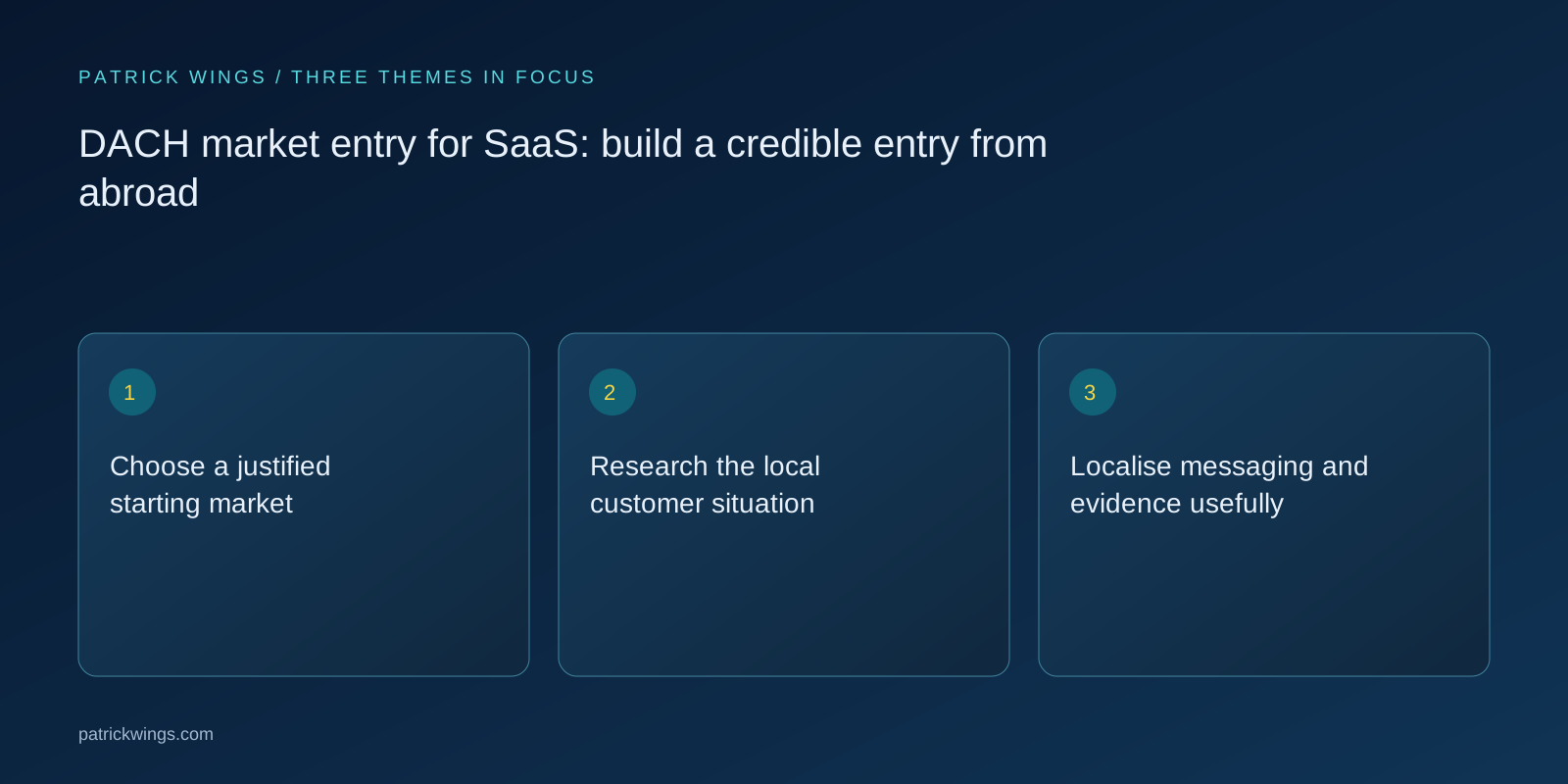
Localise messaging and evidence usefully
Localisation begins with relevance. Explain the problem, contribution and entry point in natural German, using English terminology where the audience genuinely uses it. Review important pages, advertisements and sales material together for consistency. International references can help when the application is understandable. Do not imply a local customer relationship or office that does not exist. Explain transparently how you work and which experience is relevant. For an illustrative IT offer, an understandable integration process may build more confidence than interchangeable claims of international scale or unsupported local leadership. The aim is credible evaluation, not creating an appearance your team cannot sustain in a conversation. Explore this further in the guide B2B SaaS positioning: a clear buying perspective beyond interchangeable claims.
Clarify procurement and support early
Investigate the questions suitable prospects raise before working together. Language, availability, implementation, security information and contractual processes may matter. Exact requirements vary by company and product. Involve responsible specialists for legal, tax and regulatory specifics, and verify the requirements that actually apply. Marketing should not publish broad assurances that remain unresolved internally. Decide who handles enquiries in each language and how meetings work across time zones. A reliable remote operating process is more credible than vague local positioning that fails in the first interaction. Describe the service customers will really receive and make ownership visible to the people delivering it.

Run a focused commercial pilot
Choose one segment, a clear application and an appropriate entry offer. Assign search content, advertising, partnerships or personal engagement a specific job. A local partner may help but cannot replace product suitability. Check mutual expectations, ownership and the partner's actual contribution to customer service. Record new contacts with clear sources and status in the CRM. Discuss questions from conversations promptly with the team. A pilot should reveal which argument resonates, which requirements are missing and whether the organisation can support the market. Contact volume is one observation rather than the sole definition of progress or readiness for a wider launch.
Expand when the operating connection works
Evaluate suitable conversations, relevant feedback and workable implementation together. Compare similar contact groups and allow for decision cycles before making strong claims. Ask whether difficulties arise from market suitability, unclear communication or weak support. Those causes need different responses. Add countries or segments only when the existing journey can be operated properly. Document reusable resources and local differences. Entry from abroad benefits from transparency, demonstrable competence and reliable delivery. The website supports these qualities but cannot replace learning or the actual experience prospects have with your team. Expansion becomes more defensible when both the message and the operational promise have been tested in real customer situations. Explore this further in the guide Planning a B2B SaaS launch: connect market communication with operational readiness.
INTERACTIVE / FROM READING TO ACTION
Three checkpoints for your implementation
Choose a checkpoint and track your reading progress. Checks are neither saved nor sent and do not score your business.
CHECKPOINT 01
Localise messaging and evidence usefully
Localisation begins with relevance.
Explore in the article ↗CHECKPOINT 02
Clarify procurement and support early
Investigate the questions suitable prospects raise before working together.
Explore in the article ↗CHECKPOINT 03
Run a focused commercial pilot
Choose one segment, a clear application and an appropriate entry offer.
Explore in the article ↗Frequently asked questions
Do we immediately need a DACH office?
That depends on the offer and customer requirements. A transparent and reliable remote process can support entry; specific legal requirements need separate assessment.
Is German translation enough?
No. Review terminology, applications, evidence and the complete contact and support process.
Should Germany, Austria and Switzerland launch together?
Only when resources and evidence support it. A focused starting market often makes learning easier.
How can I put “Choose a justified starting market” into practice?
Germany, Austria and Switzerland share language overlap but are not identical commercial environments. First assess where your application, relationships and service capacity support the most plausible entry. An illustrative SaaS team might test Germany first because it already has relevant reference contacts there.
What matters when working on “Research the local customer situation”?
Check how suitable businesses describe the problem and which workflows they use today. Translating internal category terms does not automatically produce the language buyers use. Ask users and responsible decision makers about previous purchases and concrete obstacles.