
THE SHORT ANSWER
A fractional CMO provides a defined portion of marketing leadership with limited available time. Success requires the scope and decision rights to fit each other. Start with the leadership problem, available resources and actual authority. The title alone creates neither an execution team nor a budget that can support the intended work.
To connect this decision with positioning, market entry and growth, read the pillar guide Go-to-market for B2B SaaS: turn market insight into an executable growth strategy.
Define the leadership problem before the role profile
Describe decisions that currently stall or conflict. Target segments may change repeatedly, agencies may receive competing briefs, or leadership may struggle to compare investments. These are different problems from producing advertisements every day. Define a concrete assignment, such as establishing a prioritised marketing plan and a reliable management routine. Identify what already works. An external leader should not automatically replace effective practices. Separate strategic leadership, operational coordination and personal execution. All three can belong in an engagement, but they consume different time and should never be assumed to fit simultaneously simply because one person carries a senior title.
Agree decision rights explicitly
Assign important decisions individually: positioning, channel budgets, supplier selection, approvals and staffing priorities. Atlassian’s DACI method distinguishes the person driving a decision from the person authorised to make it, among other roles. That distinction can help define a realistic mandate. If the chief executive approves the budget, clarify which actions the fractional CMO can take independently. Establish how marketing, sales and product disagreements are resolved. Accountability without authority creates delays; broad authority without agreed boundaries creates a different problem. Write the agreement clearly enough that employees and suppliers can apply it during ordinary work rather than asking for interpretation each time. Explore this further in the guide Build a GTM review cadence that produces decisions.
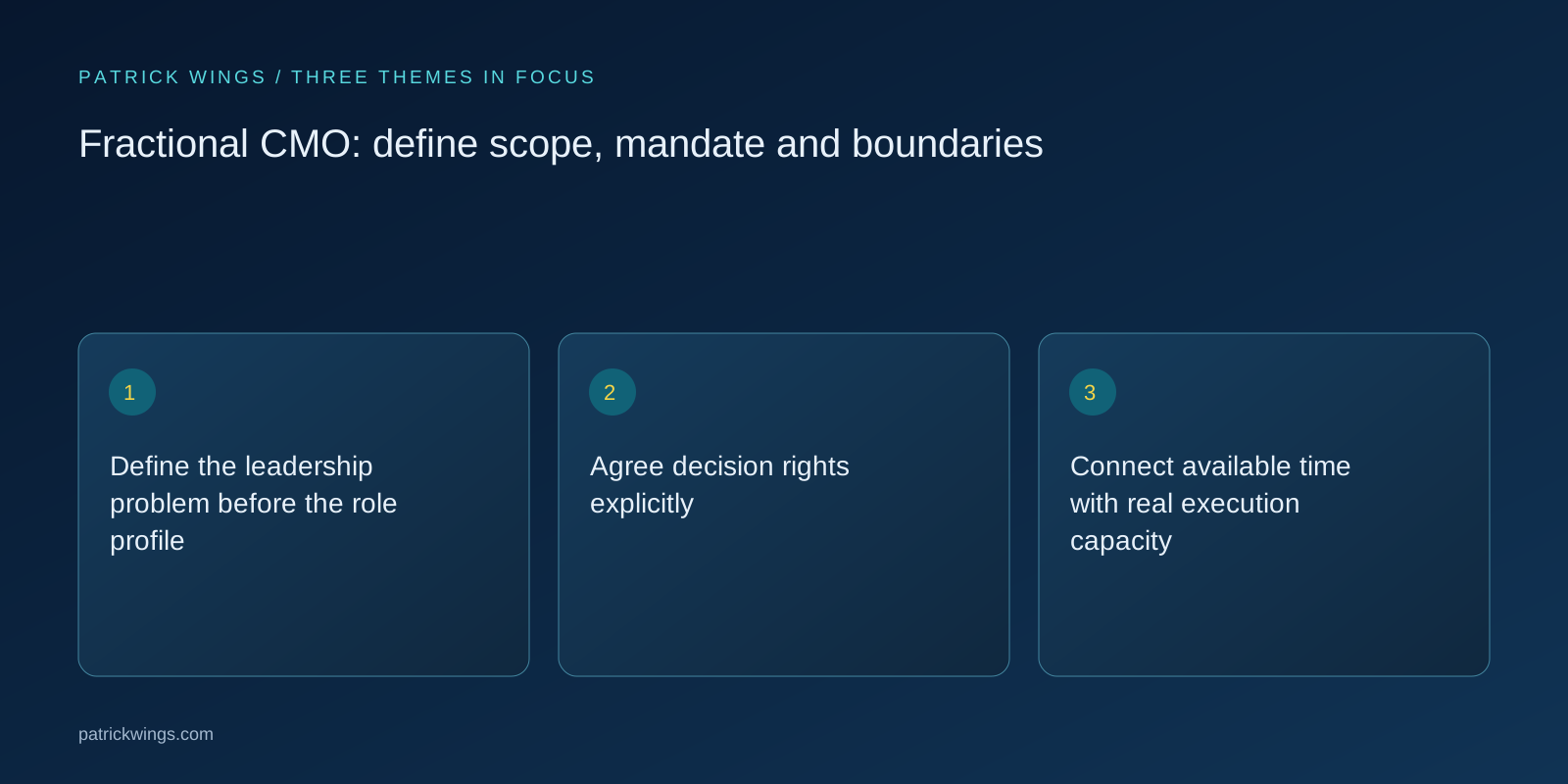
Connect available time with real execution capacity
Budget for preparation, analysis, individual conversations and decisions between meetings as well as leadership sessions. Specify which work the internal team owns and where specialist support is needed. A person with limited availability cannot conduct every interview, build every landing page and manage every campaign simultaneously. Create a compact capacity plan naming owners and dependencies. If an essential resource is missing, reduce scope or add capacity explicitly. Avoid a plan that only works through persistent unpaid overtime from the external leader or an assumption that employees can absorb additional full roles alongside their existing responsibilities without consequences.
Bound a hypothetical mandate concretely
Imagine a SaaS business with one marketing manager and two external specialists but no shared priorities. A suitable mandate might cover segment selection, quarterly planning, common briefs and monthly investment reviews. Advertisement production stays with the specialist. The marketing manager coordinates schedules and website content. Product promises are checked with product leadership. This is a hypothetical organisational example, not a client claim. If leadership also wants to enter another country, revisit the assignment. The additional work does not fit automatically because it sounds strategic. An explicit adjustment protects the quality of delivery and makes the trade-off visible to everyone involved.

Make outcomes and handovers reviewable
Assess the engagement through agreed outputs and observable improvements in decision making. Examples include a justified focus, an executable plan, clear responsibilities and a review routine that people actually use. Commercial results also matter, but they depend on the offer, sales, implementation and market conditions. Avoid promising an independently attributable revenue effect without a defensible basis. Record major decisions and their assumptions for the internal team. The engagement should leave useful organisational knowledge that does not require the external leader’s constant presence. Progress then becomes more tangible than presentation volume, meeting attendance or favourable personal impressions. Explore this further in the guide Service pages that make scope and collaboration concrete.
Plan boundaries and eventual transition
Specify when the engagement should change, end or become a different role. Sustained full-time demand may indicate a need for an internal leader. A temporary setup assignment may conclude when the team and management routines function independently. Regularly check whether the available time still matches the work and whether key decisions remain blocked. Also agree availability, backup arrangements and where working documents and access information are held. This clarity supports professional collaboration. A sound mandate explains where external leadership contributes and which responsibilities remain with company management throughout the relationship, including investment choices and the resources needed to execute them.
INTERACTIVE / FROM READING TO ACTION
Three checkpoints for your implementation
Choose a checkpoint and track your reading progress. Checks are neither saved nor sent and do not score your business.
CHECKPOINT 01
Connect available time with real execution capacity
Budget for preparation, analysis, individual conversations and decisions between meetings as well as leadership sessions.
Explore in the article ↗CHECKPOINT 02
Bound a hypothetical mandate concretely
Imagine a SaaS business with one marketing manager and two external specialists but no shared priorities.
Explore in the article ↗CHECKPOINT 03
Make outcomes and handovers reviewable
Assess the engagement through agreed outputs and observable improvements in decision making.
Explore in the article ↗Frequently asked questions
Does a fractional CMO execute the work?
Only within the agreed scope. Leadership, coordination and production should each have explicit capacity and resource assumptions.
Which decisions belong in the mandate?
Include the decisions central to the assignment, such as positioning, budget, priorities, suppliers and approvals, together with escalation routes.
When is a full-time internal leader more suitable?
Consider an internal appointment when sustained operational and people leadership requires substantial ongoing presence.
How can I put “Define the leadership problem before the role profile” into practice?
Describe decisions that currently stall or conflict. Target segments may change repeatedly, agencies may receive competing briefs, or leadership may struggle to compare investments. These are different problems from producing advertisements every day.
What matters when working on “Agree decision rights explicitly”?
Assign important decisions individually: positioning, channel budgets, supplier selection, approvals and staffing priorities. Atlassian’s DACI method distinguishes the person driving a decision from the person authorised to make it, among other roles. That distinction can help define a realistic mandate.