
THE SHORT ANSWER
Partners can discover demand, introduce a contact or help resolve a purchasing question. These are different contributions. Record origin and influence separately so a shared sale is neither fully credited to several partners nor repeatedly counted as additional revenue in consolidated reporting.
For the broader picture of how target customers, channels and sales handoffs work together, read the pillar guide B2B demand generation: from attention to qualified pipeline.
Define contribution types before adding fields
Distinguish a new introduction, support for an existing opportunity and joint marketing without a confirmed deal relationship. Agree the minimum evidence for each category. An introduction needs an identifiable case and the date of a verifiable connection. Support needs a specific action and its relationship to the project. A logo on a webinar is not evidence of influence on every later contract. Define these terms jointly with sales and partner management before required fields start generating apparently precise data. Keep reporting categories separate from contractual remuneration rules, which may have different conditions and cannot be inferred from a marketing classification alone. Explore this further in the guide CRM data quality for trustworthy marketing decisions.
Build an explainable relationship model
Connect partner ID, company ID and deal ID with the contribution type. Store date, evidence, owner and confirmation status. Several partners can support one deal without creating several deals. Preserve first known origin alongside subsequent contributions. If an import overwrites the original source field with the latest partner interaction, earlier information disappears. HubSpot documents standard deal properties; additional partner relationships need to fit your actual object and association structure. Test a case with multiple participants to establish whether reports count distinct commercial projects rather than simply counting relationship rows. The data model should preserve complexity without allowing that complexity to inflate the commercial total.
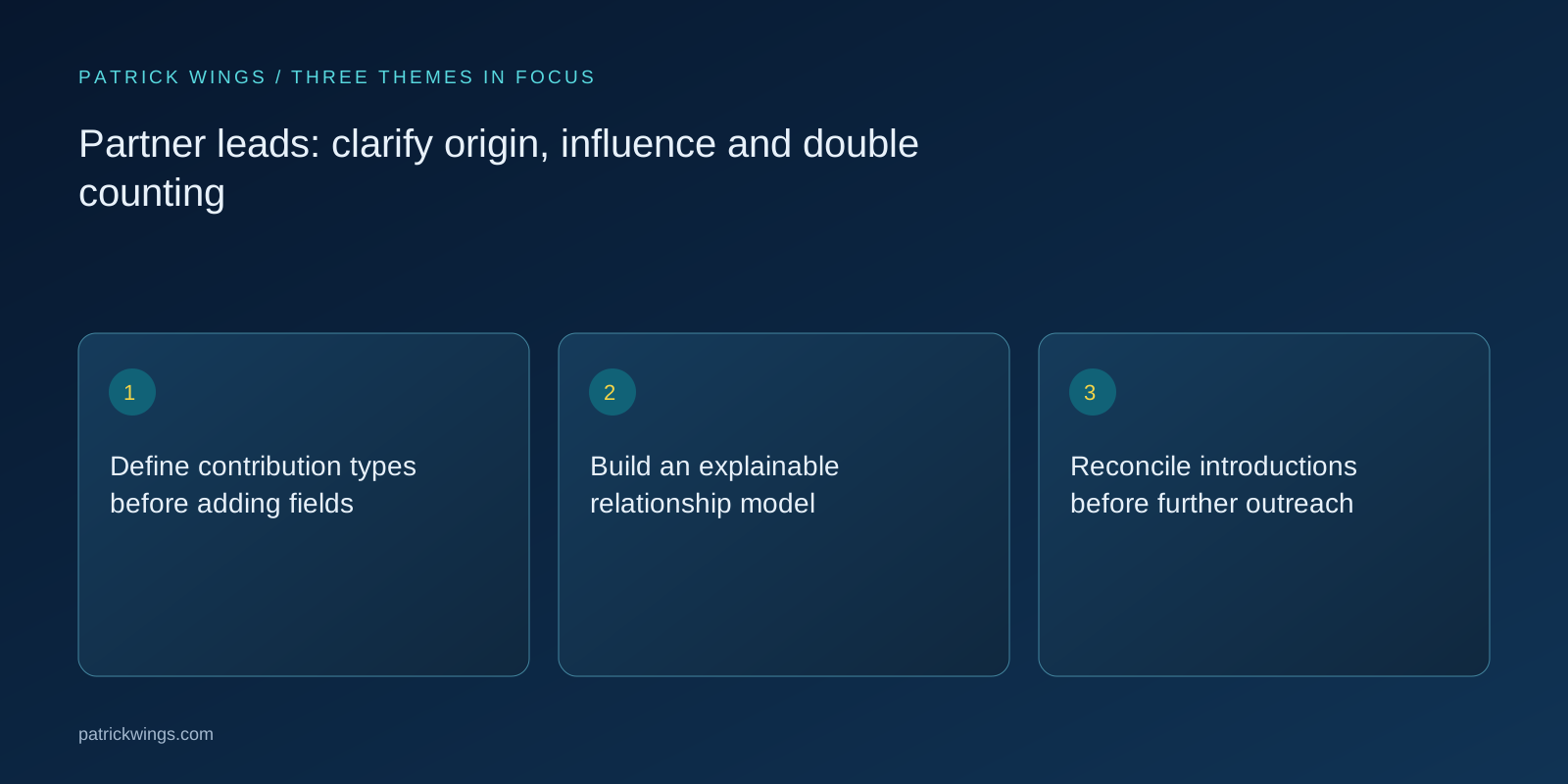
Reconcile introductions before further outreach
Check a reported contact against existing accounts and open opportunities. A known person can still receive a genuine new introduction to a different project. Conversely, an active project is not new simply because a partner names the same contact. The case owner applies documented criteria to distinguish origin from later assistance. Agree who provides the first response and which information may be returned to the partner. Reconciliation should enable joint work rather than turn collaboration into a rigid first-contact competition. Legitimate differences between projects must remain visible, while multiple messages to the same buyer should be coordinated through a clear owner.
Count a hypothetical shared project
An invented partner makes the first introduction. A second later explains a necessary technical connection, while marketing organises a specialist session. One deal closes for a hypothetical twenty thousand euros. Total revenue remains twenty thousand euros even when three contributions are recorded. A report can show partner origin and several supporting activities. If influenced revenue is added across partners, the overlap must remain visible. This example does not establish a commission split. It explains why a contribution perspective cannot be presented as a sum of independent commercial outcomes or prove how much revenue would disappear without each participating partner.

Resolve disputes through evidence
Define a resolution route for conflicting submissions: verify the original introduction, confirm the project unit and document specific later assistance. The earliest stored record is not automatically the strongest evidence of actual origin. A later presentation does not establish that the contract would have failed without it either. Keep the decision and rationale so similar cases receive consistent treatment. Contractual claims and remuneration follow the agreed partner terms; a marketing attribution view cannot replace that review. Give unresolved cases a provisional status rather than inventing a definitive source merely to make the report appear complete. Accuracy may require an explicit unresolved category.
Evaluate partners through appropriate questions
Examine verifiable introductions, suitable projects, useful assistance and realised results separately. Review handoff quality and required rework. A partner providing a few suitable introductions can be more valuable than one supplying many ambiguous contact lists. Consider time since introduction and the type of collaboration as well. Partner management maintains the contribution model; sales confirms project relevance; reporting checks double counting. Each reported contribution should have explainable evidence during the joint review. This supports decisions about future collaboration without turning documented participation into an unsupported causal revenue claim or treating every partner relationship as commercially equivalent. Explore this further in the guide Marketing pipeline review: ask the right questions with sales.
INTERACTIVE / FROM READING TO ACTION
Three checkpoints for your implementation
Choose a checkpoint and track your reading progress. Checks are neither saved nor sent and do not score your business.
CHECKPOINT 01
Reconcile introductions before further outreach
Check a reported contact against existing accounts and open opportunities.
Explore in the article ↗CHECKPOINT 02
Count a hypothetical shared project
An invented partner makes the first introduction.
Explore in the article ↗CHECKPOINT 03
Resolve disputes through evidence
Define a resolution route for conflicting submissions: verify the original introduction, confirm the project unit and document specific later assistance.
Explore in the article ↗Frequently asked questions
How does partner origin differ from influence?
Origin describes an introduction; influence describes specific later assistance. Each needs separate evidence.
Can several partners support one deal?
Yes. Contributions may appear several times, but consolidated deal revenue is counted once.
Does attribution determine commission?
Not automatically. Remuneration follows agreed terms and a separate review of their conditions.
How can I put “Define contribution types before adding fields” into practice?
Distinguish a new introduction, support for an existing opportunity and joint marketing without a confirmed deal relationship. Agree the minimum evidence for each category. An introduction needs an identifiable case and the date of a verifiable connection.
What matters when working on “Build an explainable relationship model”?
Connect partner ID, company ID and deal ID with the contribution type. Store date, evidence, owner and confirmation status. Several partners can support one deal without creating several deals.