
THE SHORT ANSWER
Lost opportunities become relevant again because something meaningful changes, not because another mailing date arrives. Review the original loss reason and today’s conditions first. Reactivation makes sense when you can now address the former obstacle or the customer is pursuing a materially different task.
For the broader picture of how target customers, channels and sales handoffs work together, read the pillar guide B2B demand generation: from attention to qualified pipeline.
Reconstruct the original loss
Read conversation notes, proposal status and closing explanation together. A no-budget entry can mean low priority, a different investment cycle or a fundamentally unsuitable price level. Distinguish a competitive loss, no decision, a technical gap and lack of fit. Preserve the original statement alongside the internal category. If the explanation remains unclear, begin with research or an appropriate question rather than a discount. Also establish whether the former project was completed and whether the same task still exists. An old deal name does not describe current demand, and a simplified reporting category may hide the condition that actually stopped the purchase.
Name a substantive change
Record precisely what has changed since closure. Examples include availability of a required integration, a budget date mentioned by the contact or a confirmed change in project scope. General product news is insufficient when it does not touch the former obstacle. Link the change to verifiable evidence and its validity date. If only your sales target changed, there is no customer-centred reason for renewed outreach. New employees at the company do not guarantee renewed interest either; first establish whether responsibilities and tasks have actually changed. A useful trigger creates a specific question worth reconsidering rather than a pretext to repeat the old pitch. Explore this further in the guide Recognise and interpret B2B buying triggers.
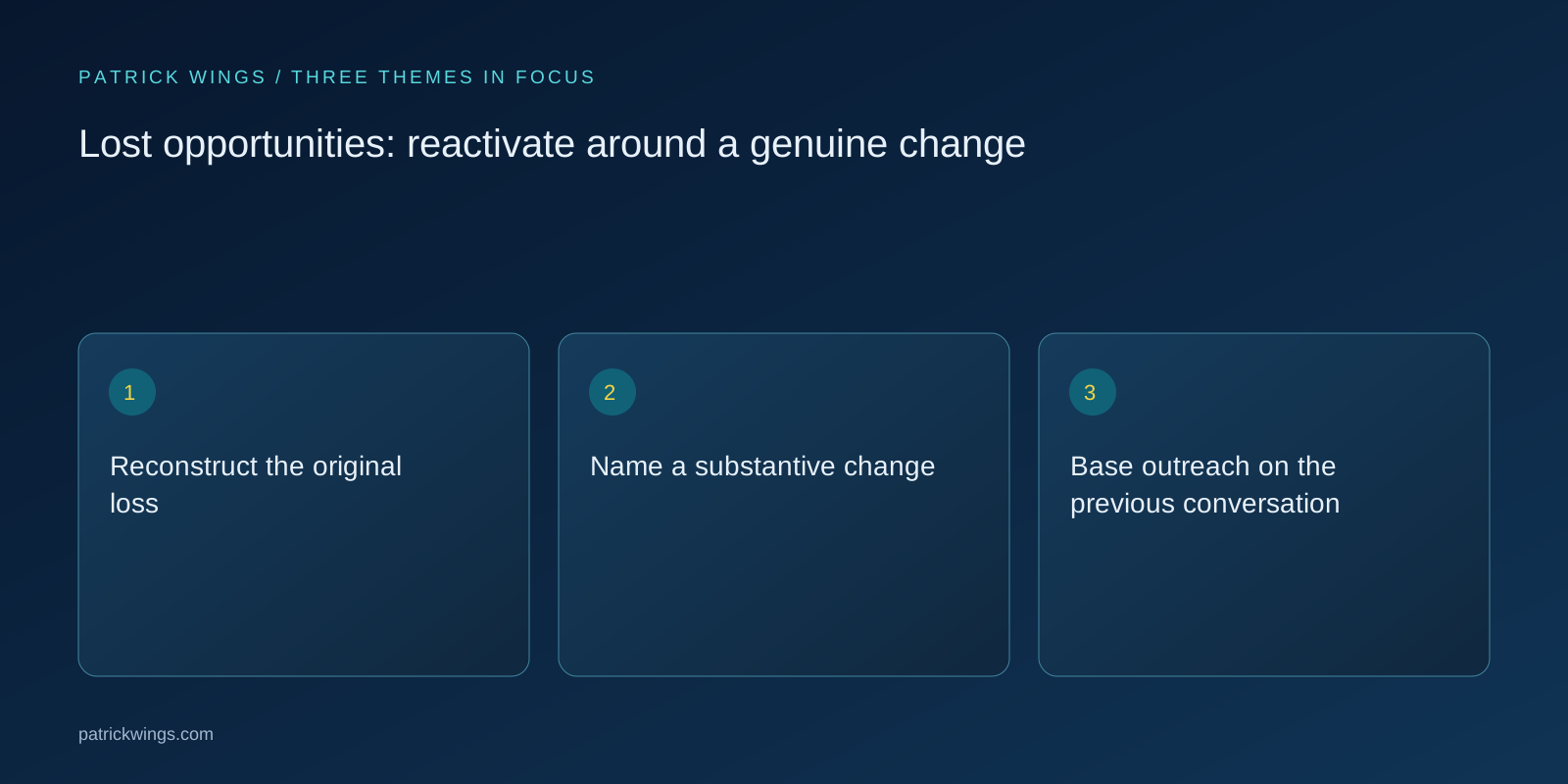
Base outreach on the previous conversation
Write a short explanation of the former requirement you understood, what has changed and the limited review that might now help. Do not claim knowledge of a new project that nobody has confirmed. Offer relevant evidence or a brief specialist update instead of immediately requesting another complete demo. Coordinate with the account owner and respect recorded contact preferences. A decision against further discussion must be able to end the process. Carefully researched reactivation loses its value when followed by an uncontrolled sequence. The recipient should be able to understand why this message is relevant without reconstructing a long interaction history themselves. Explore this further in the guide Win-loss interviews: understand buying decisions.
Resolve a hypothetical integration obstacle
An invented SaaS supplier loses a project because a necessary ERP connection is unavailable. Several months later that connection is released. Before writing, the team checks supported functionality against the former requirements. It offers the previous contact a technical comparison. A new opportunity exists only when a suitable evaluation process is confirmed again; product availability alone is not a sales outcome. If the company has since implemented another system, a later conversation may become relevant only around a future contract or project milestone. This example illustrates reasoning rather than predicting a reactivation rate or implying that a former buyer remains available indefinitely.

Separate history from the new commercial chance
Preserve the old closure and its original result. Whether you reopen a deal or create a linked new one depends on your CRM conventions and project continuity. The essential requirement is that the original closing date, loss and new handling remain distinguishable afterwards. HubSpot documents deal properties including closing information; inspect your chosen fields and automations before changing status. A renewed chance must not retrospectively erase the previous loss. Equally, a resumed case and an additional deal should not both appear as independent opportunities for the same buying decision. Agree the reporting treatment before an automated campaign begins creating records.
Evaluate reactivation by trigger
Report reviewed cases, suitable triggers, requested conversations and genuinely renewed projects separately. Do not compare technical improvements uncritically with simple reminder messages. Use declined cases to examine whether you understood the original obstacle and whether the new evidence really addresses it. The owner records the next appropriate date or ends further acquisition work. This review also informs product and positioning: some losses can be addressed through clearer explanation, while others require a substantive offer change. Reactivation should make those differences visible rather than periodically contacting the entire historical loss list as though every former opportunity had the same unresolved need.
INTERACTIVE / FROM READING TO ACTION
Three checkpoints for your implementation
Choose a checkpoint and track your reading progress. Checks are neither saved nor sent and do not score your business.
CHECKPOINT 01
Base outreach on the previous conversation
Write a short explanation of the former requirement you understood, what has changed and the limited review that might now help.
Explore in the article ↗CHECKPOINT 02
Resolve a hypothetical integration obstacle
An invented SaaS supplier loses a project because a necessary ERP connection is unavailable.
Explore in the article ↗CHECKPOINT 03
Separate history from the new commercial chance
Preserve the old closure and its original result.
Explore in the article ↗Frequently asked questions
When should lost deals be reactivated?
When a verifiable change affects the original obstacle and renewed contact is appropriate.
Should the old deal be overwritten?
Preserve its historical outcome and define a clear rule for reopening or creating a linked new deal.
Is a discount a useful trigger?
Only when price was demonstrably the relevant obstacle and the offer remains commercially sound.
How can I put “Reconstruct the original loss” into practice?
Read conversation notes, proposal status and closing explanation together. A no-budget entry can mean low priority, a different investment cycle or a fundamentally unsuitable price level. Distinguish a competitive loss, no decision, a technical gap and lack of fit.
What matters when working on “Name a substantive change”?
Record precisely what has changed since closure. Examples include availability of a required integration, a budget date mentioned by the contact or a confirmed change in project scope. General product news is insufficient when it does not touch the former obstacle.