
THE SHORT ANSWER
Robots.txt controls cooperating crawlers’ access to URL areas. Treat it as a versioned technical policy with explicit goals and tests. It does not protect confidential information or replace indexing decisions. A sound policy keeps useful material accessible, limits unnecessary fetching and remains understandable to the team responsible for maintaining it.
For the broader picture of technical foundations, useful content and visibility measurement, read the pillar guide SEO, GEO and AEO for SaaS: visibility that supports buying decisions.
Define purpose and scope first
Inventory every public host and environment. Rules for one domain do not automatically govern every other domain or subdomain service. Record who serves each file and whether the CMS, CDN or application can modify it. Distinguish the production website, documentation portal and staging environment. A central overview prevents marketing from checking only the main website while a separate documentation host remains unintentionally open or blocked. Connect every rule to a specific operational purpose and accountable owner.
Translate intentions into testable rules
Start with a short decision table: which crawler, which path and which intended behaviour? Only then translate that intention into syntax. Check case sensitivity, path boundaries and specific exceptions against the relevant platform documentation. Comments should explain why a rule exists. Avoid inherited blocks without ownership. When nobody knows the original purpose, inspect actual requests and application features before deleting an old block or copying it indiscriminately into new website areas and language directories. Explore this further in the guide Distinguishing noindex, robots and canonical controls.
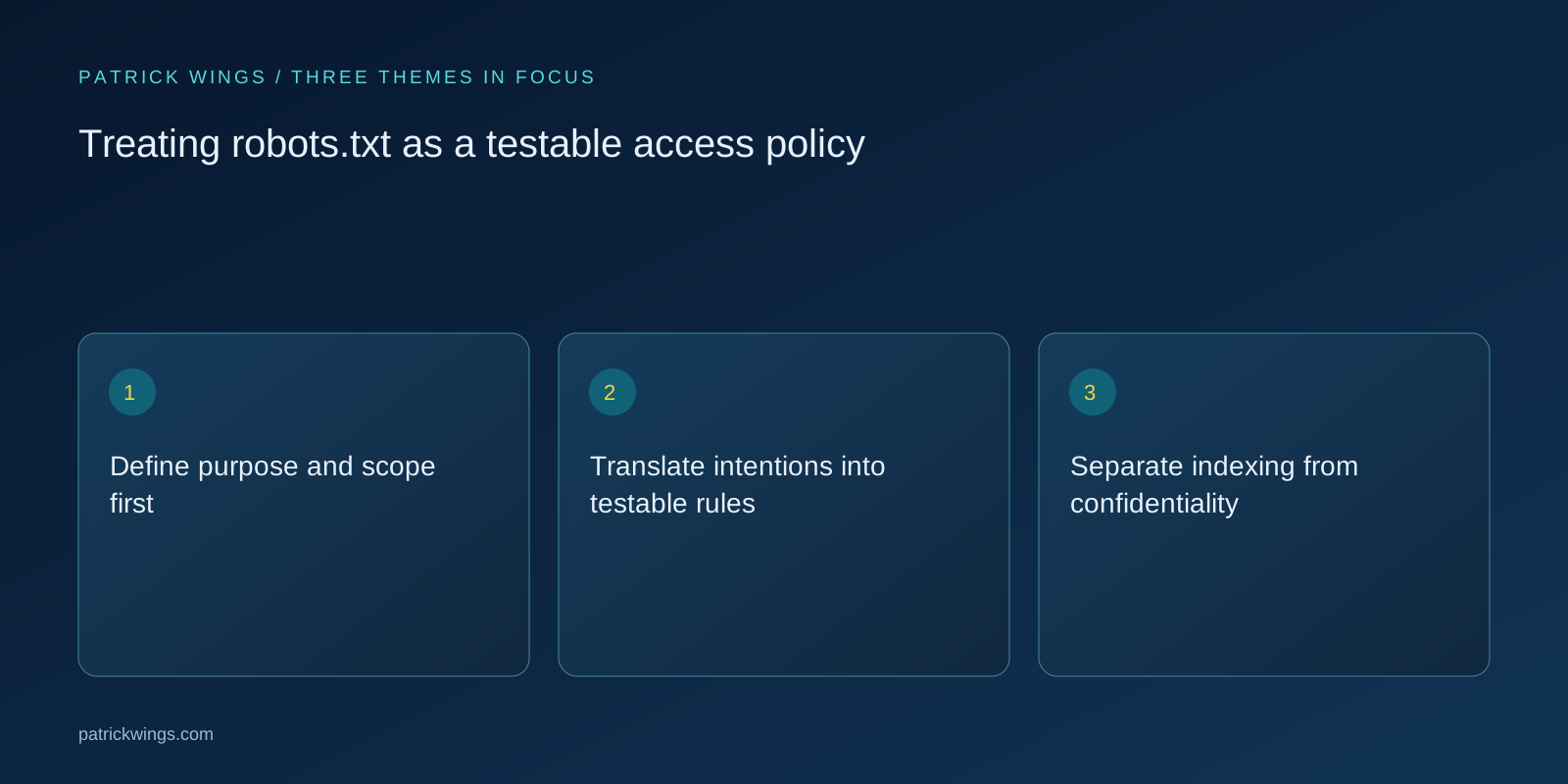
Separate indexing from confidentiality
A blocked URL may still be discovered through external links and can potentially appear as a URL in search results. A public page that should not be indexed needs an appropriate, accessible indexing instruction. Private information requires authentication or another actual access restriction. This distinction matters particularly for internal customer manuals and test reports. The robots.txt file is publicly readable, so never regard it as a secure directory of hidden resources or a substitute for application permissions.
Check resources and templates too
Test document addresses alongside the scripts, stylesheets and images they need. A broad asset directory block can impair the processing of public pages. Examine representative templates with their real dependencies. Also investigate whether your security layer challenges or rejects bot requests that the policy permits. A correct robots.txt file alone does not prove practical accessibility. Record the intended rule and the observed result of a concrete fetch separately, using an appropriate inspection method and retaining enough context to reproduce the test.

Consider a hypothetical documentation portal
A fictional software vendor wants public integration guides to remain discoverable while protecting internal previews. The team authenticates previews and uses robots.txt only for unnecessary public search variants. It explicitly checks that integration pages and their scripts remain accessible. Its test record contains both permitted and blocked example paths. This hypothetical scenario demonstrates the separation between security and crawl management; it establishes neither a visibility improvement nor identical behaviour across every third party bot on the internet.
Treat changes as technical releases
Save the previous version and prepare positive and negative tests before editing. A positive case might confirm access to a key service page, while a negative case checks a deliberately excluded filter family. After deployment, inspect the file actually served through the public host. Watch for redirects, errors and cached versions. Record the release time, responsible person and rollback path. This makes unexpected access failures easier to investigate without changing several unrelated systems simultaneously on speculation.
Review rules against the real architecture
Recheck policy after adding language areas, changing CDN providers or completing a major relaunch. Compare each rule’s intention with current URL patterns. Remove obsolete comments and update ownership. Judge quality by clear decisions and working tests rather than the number of blocks. Revisit platform documentation when adding crawlers. Search crawlers and training crawlers can have separate identifiers; do not copy a blanket AI block from another website without understanding which access decisions your own organisation intends to make. Explore this further in the guide Controlling AI search crawlers separately from training crawlers.
INTERACTIVE / FROM READING TO ACTION
Three checkpoints for your implementation
Choose a checkpoint and track your reading progress. Checks are neither saved nor sent and do not score your business.
CHECKPOINT 01
Separate indexing from confidentiality
A blocked URL may still be discovered through external links and can potentially appear as a URL in search results.
Explore in the article ↗CHECKPOINT 02
Check resources and templates too
Test document addresses alongside the scripts, stylesheets and images they need.
Explore in the article ↗CHECKPOINT 03
Consider a hypothetical documentation portal
A fictional software vendor wants public integration guides to remain discoverable while protecting internal previews.
Explore in the article ↗Frequently asked questions
Does robots.txt prevent all indexing?
No. A URL can remain known without its content being fetched.
Can robots.txt protect confidential documents?
No. Confidential documents need genuine access controls. Check authentication separately from the crawler rules governing public content; robots.txt does not enforce private access.
When should rules be retested?
After changes to rules, URL structure, hosting or security filters.
How can I put “Define purpose and scope first” into practice?
Inventory every public host and environment. Rules for one domain do not automatically govern every other domain or subdomain service. Record who serves each file and whether the CMS, CDN or application can modify it.
What matters when working on “Translate intentions into testable rules”?
Start with a short decision table: which crawler, which path and which intended behaviour? Only then translate that intention into syntax. Check case sensitivity, path boundaries and specific exceptions against the relevant platform documentation.