
THE SHORT ANSWER
A market category gives buyers an initial frame of reference for your product. It shapes the alternatives, features and buying conditions they expect. Choose it for its explanatory value in the target segment. An original label helps little if prospective customers then imagine the wrong service or must work hard to understand why the product is relevant.
To connect this decision with positioning, market entry and growth, read the pillar guide Go-to-market for B2B SaaS: turn market insight into an executable growth strategy.
Investigate the buyer’s existing frame
In actual buying conversations, ask how participants name their task and potential solutions. Which terms appear in budget requests or supplier searches? Distinguish that vocabulary from language popular mainly in industry media. April Dunford’s positioning work explains how categories place product attributes in a comprehensible context. For your decision, the issue is whether that context makes your actual strengths visible. A technically accurate category can be commercially unhelpful when the target audience associates it with a different workflow or budget owner. Start with the meaning buyers already attach to the words, rather than internal terminology. Explore this further in the guide Competitive research beyond feature collection.
Record the expectations explicitly
For each possible category, list the capabilities buyers are likely to assume. Check those assumptions through conversations instead of guessing internally. They may include integrations, operating model, support scope or procurement routes. Mark which expectations your product currently meets and where gaps remain. The question is not merely whether a term sounds attractive, but whether it creates a predominantly accurate picture. A category producing many unsuitable comparisons may be less useful than a narrower description with lower general recognition. Keep significant mismatches visible so the team cannot confuse attention with appropriate market understanding.
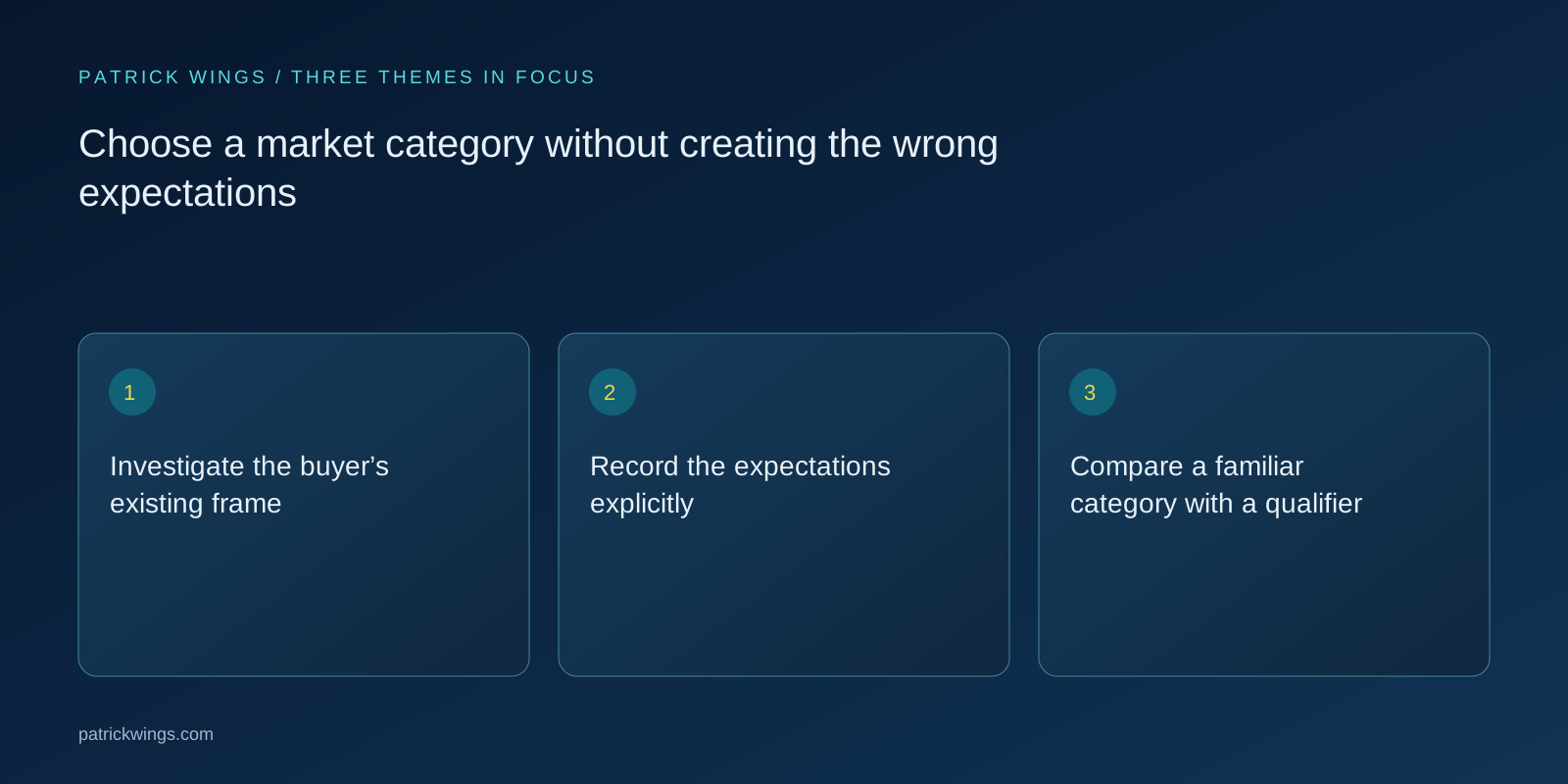
Compare a familiar category with a qualifier
First explore a familiar category with a qualifier describing the audience, task or distinctive context. This can use existing understanding while showing the relevant difference. An entirely new category requires additional explanation and strong reasons why existing terms would consistently mislead. Treat the choice as an investment decision rather than a creativity contest. Consider whether product, sales, customer experience and partners can communicate the proposed frame consistently. A novel phrase on one website does not establish a shared market category. It can instead become another piece of jargon customers must translate before discussing their actual problem. Explore this further in the guide Test messaging before rewriting your website.
Hypothetical example: planning with approvals
A fictional product combines project planning with dependable approvals from external participants. Described as a “project management platform”, it is repeatedly compared with broad task and document systems whose scope it does not intend to provide. The team tests the narrower description “approval planning for external project teams”. Interviews investigate whether buyers understand the task or expect only appointment scheduling. Persistent misunderstanding would call for a more concrete workflow explanation. The example does not claim successful category creation. It shows how expected capabilities and actual product boundaries should jointly influence the choice of a reference frame.

Test the category across the buying process
Do not evaluate the description only at the top of a website. Check whether salespeople can use it to begin an appropriate demonstration and whether internal advocates can repeat it accurately. Investigate the expectations of IT, procurement and eventual users as well. A phrase may work in marketing while triggering an unsuitable purchasing checklist. Gather feedback across several handovers. Different roles may need different details, but the underlying category should remain consistent. An explanation can become more concrete for each task without making it appear that every department is being offered a fundamentally different product.
Decide and monitor the boundaries
Choose the frame that explains relevant strengths while producing the fewest significant false assumptions. Document the segment to which the choice applies and the expectations you must explicitly limit. Then monitor unsuitable enquiries, recurring comparison questions and the language of internal recommendations. Do not change the category in response to every unfamiliar objection. However, revisit the frame when an inaccurate picture repeatedly emerges. A useful category supports orientation and honest selection. It cannot replace missing product fit or an unresolved customer benefit through linguistic invention, regardless of how distinctive the new terminology appears in a presentation.
INTERACTIVE / FROM READING TO ACTION
Three checkpoints for your implementation
Choose a checkpoint and track your reading progress. Checks are neither saved nor sent and do not score your business.
CHECKPOINT 01
Compare a familiar category with a qualifier
First explore a familiar category with a qualifier describing the audience, task or distinctive context.
Explore in the article ↗CHECKPOINT 02
Hypothetical example: planning with approvals
A fictional product combines project planning with dependable approvals from external participants.
Explore in the article ↗CHECKPOINT 03
Test the category across the buying process
Do not evaluate the description only at the top of a website.
Explore in the article ↗Frequently asked questions
Must we create a new category?
Only when existing frames consistently mislead and you can sustain the additional explanation required.
Can a narrow category limit growth?
It initially limits expectations. Whether that is helpful depends on your target segment and actual capabilities.
Who should test the category?
Prospective buyers and roles responsible for interpreting, explaining or procuring the product.
How can I put “Investigate the buyer’s existing frame” into practice?
In actual buying conversations, ask how participants name their task and potential solutions. Which terms appear in budget requests or supplier searches? Distinguish that vocabulary from language popular mainly in industry media.
What matters when working on “Record the expectations explicitly”?
For each possible category, list the capabilities buyers are likely to assume. Check those assumptions through conversations instead of guessing internally. They may include integrations, operating model, support scope or procurement routes.