
THE SHORT ANSWER
A source link in an AI response does not establish that the neighbouring claim is supported correctly. Inspect the response and linked passage together. A citation audit examines externally generated answers for provenance and accuracy. It differs from building an owned AI workflow, where the team can design and technically test the internal evidence mechanisms itself.
For the broader picture of technical foundations, useful content and visibility measurement, read the pillar guide SEO, GEO and AEO for SaaS: visibility that supports buying decisions.
Use a precise claim as the audit unit
Preserve the complete question, response, platform and time. Then identify the individual checkable claim and associated link. A paragraph may contain several assertions while the source supports only one. Distinguish facts, recommendations and inferences. A source list without clear attribution needs particularly cautious assessment. Do not merely ask whether the company appears somewhere; inspect which capability or characteristic is assigned to it. A flattering adjective may be commercially appealing and still lack evidence. The audit unit should therefore be a specific sentence or clearly bounded part rather than an entire response labelled simply correct or incorrect. Explore this further in the guide Sources in AI answers: verify evidence claim by claim.
Open the actual destination
Open the link and record the final destination after redirects. Check availability, publisher and identifiable date or version. Locate the exact passage that might support the response. A relevant page title is insufficient. If the source has since changed, the version used by the system may remain unknown. Preserve that uncertainty rather than inventing an unobservable retrieval date. Mark inaccessible or restricted material as not independently inspectable. A link is not a substitute for evidence actually examined. Record the retrieved content appropriately so that a later reviewer can understand the audit without assuming that the destination remains unchanged.
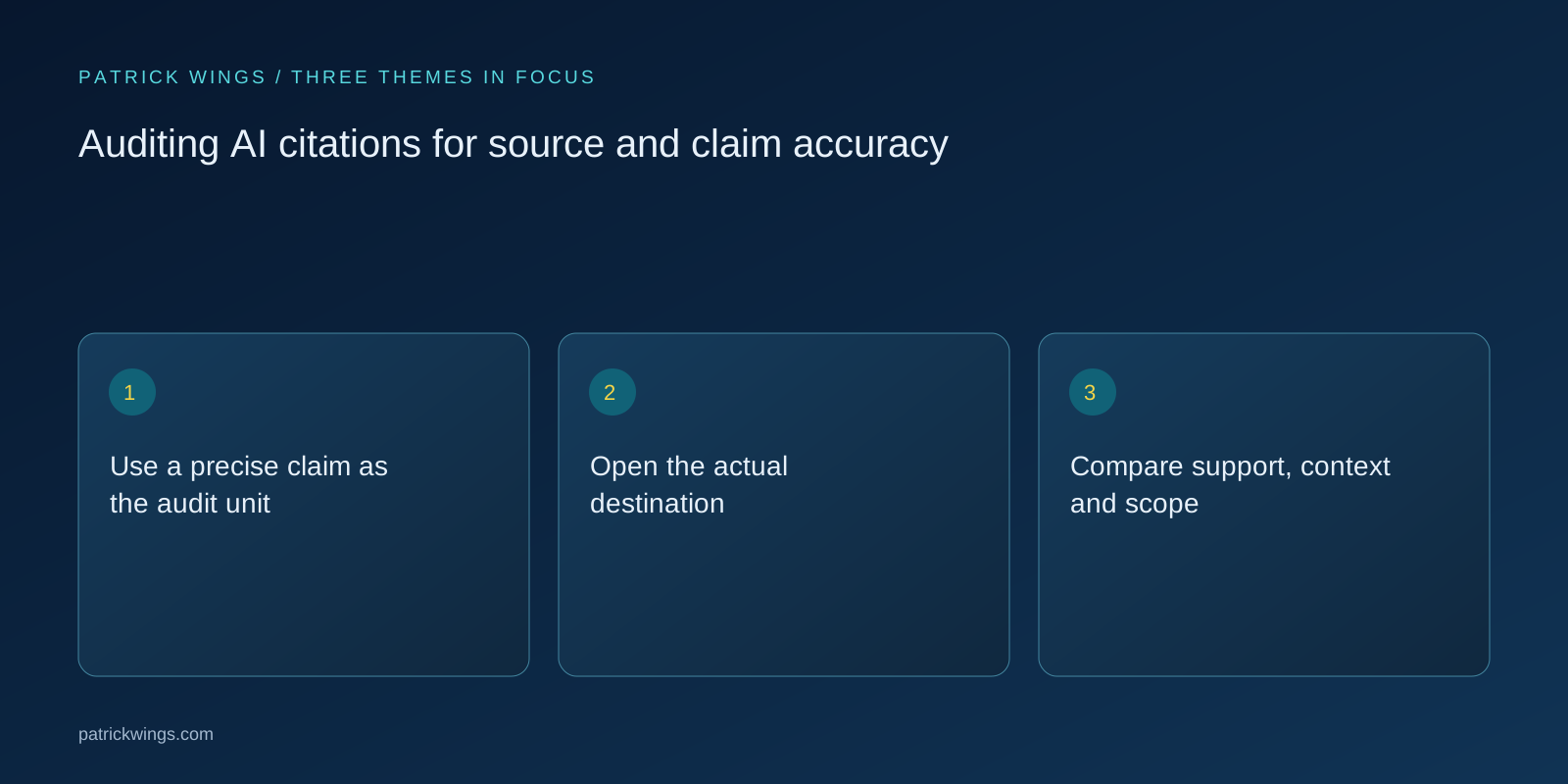
Compare support, context and scope
Compare the AI claim with the conditions and qualifications in the source. Check whether a possibility becomes a guarantee, a hypothesis becomes a finding or one case becomes a general benchmark. Inspect names, editions and time references. A source may be relevant to the subject without supporting the precise conclusion. Assess evidential support and attribution separately. For partial support, specify which part is established. A simple correct-or-incorrect label may conceal the important issue. Prioritise cases where the stronger generated statement could lead a reader towards a materially different technical or commercial decision than the original source permits.
Example: a qualified capability becomes absolute
A hypothetical AI response claims that software automatically integrates with every CRM. The linked product destination describes only specified supported systems with prerequisites. The audit marks the source as relevant to the subject but the universal statement as unsupported. The team also checks whether its own page makes the boundaries clear and accessible. It can improve that public explanation without directly controlling the external response. This example describes a failure category rather than an actual platform or software product. The citation would provide a useful inspection trail in this case, but it would not confirm the stronger generated promise.

Prioritise findings by consequence
Distinguish minor imprecision from incorrect service attribution or claims with significant decision consequences. Preserve the evidence before planning an owned-page correction or an available platform feedback route. One incorrect external answer does not automatically justify publishing a public rebuttal page for every case. First inspect whether unclear or outdated owned information might contribute. Record an owner and next action. If the source is correct and clear, document the problem as an external response error. Avoid repeating unsupported claims in marketing merely because a generated answer appears to offer a convenient third-party endorsement of the company.
Bound follow-up and reporting
Recheck important cases later under recorded conditions and preserve original findings separately. A changed response may have several causes and does not prove that an owned-page revision produced it. Report valid audit cases, error categories and uninspectable sources rather than an opaque quality grade. NIST’s framework addresses trustworthiness and risks in AI use and evaluation; the citation audit proposed here is a practical editorial application, not a NIST-certified procedure. Its usefulness lies in inspecting individual claims transparently and responding appropriately to their limitations rather than asserting control over external AI systems. Explore this further in the guide Editing SEO articles around verifiable evidence.
INTERACTIVE / FROM READING TO ACTION
Three checkpoints for your implementation
Choose a checkpoint and track your reading progress. Checks are neither saved nor sent and do not score your business.
CHECKPOINT 01
Compare support, context and scope
Compare the AI claim with the conditions and qualifications in the source.
Explore in the article ↗CHECKPOINT 02
Example: a qualified capability becomes absolute
A hypothetical AI response claims that software automatically integrates with every CRM.
Explore in the article ↗CHECKPOINT 03
Prioritise findings by consequence
Distinguish minor imprecision from incorrect service attribution or claims with significant decision consequences.
Explore in the article ↗Frequently asked questions
Is a linked source automatically proof?
No. The precise claim must match the source’s content and limitations.
Can external AI answers be corrected directly?
You can improve owned information and use available feedback routes without controlling the external output.
What belongs in an audit case?
Question, response, time, platform, destination source, checked claim and reasoned assessment.
How can I put “Use a precise claim as the audit unit” into practice?
Preserve the complete question, response, platform and time. Then identify the individual checkable claim and associated link. A paragraph may contain several assertions while the source supports only one.
What matters when working on “Open the actual destination”?
Open the link and record the final destination after redirects. Check availability, publisher and identifiable date or version. Locate the exact passage that might support the response.