
THE SHORT ANSWER
Verify sources in AI answers claim by claim: does the evidence exist, support the particular statement and apply to its context? A long list of links does not establish evidence quality. Connect important claims to findable passages and distinguish direct reporting from inference. This lets reviewers inspect the answer without repeating the entire research process or assuming that every nearby citation supports everything the paragraph says.
To connect individual AI applications with reliable marketing operations, read the pillar guide AI transformation in B2B marketing: from individual prompts to reliable operations.
Identify claims requiring evidence
Mark statements that affect a decision: prices, availability, dates, capabilities and external factual claims. General advice can remain clearly identified as advice without pretending to have a source. Split compound sentences where their parts require different support. A source might establish that a feature exists without demonstrating its value to a particular buyer group. The second statement requires separate evidence or an explicitly labelled assessment. Avoid attaching one link to an entire paragraph when readers cannot tell which claims it supports. Scope the wording to what the evidence actually establishes rather than broadening the claim because the source appears reputable. Explore this further in the guide Auditing AI citations for source and claim accuracy.
Check access, provenance and location
Open the evidence and inspect its title, publisher, relevant version and actual supporting passage. A matching page title is insufficient. Search snippets can be truncated or omit a material qualification. Prefer the original source and provide a section or page for longer documents. If only a secondary account is accessible, disclose that limitation. A reference should enable an authorised reader to verify the claim. Consider use boundaries too: an internal link may be inaccessible or unsuitable for an external recipient even when the underlying information is accurate. Do not confuse internal verifiability with permission to distribute the source or its contents.
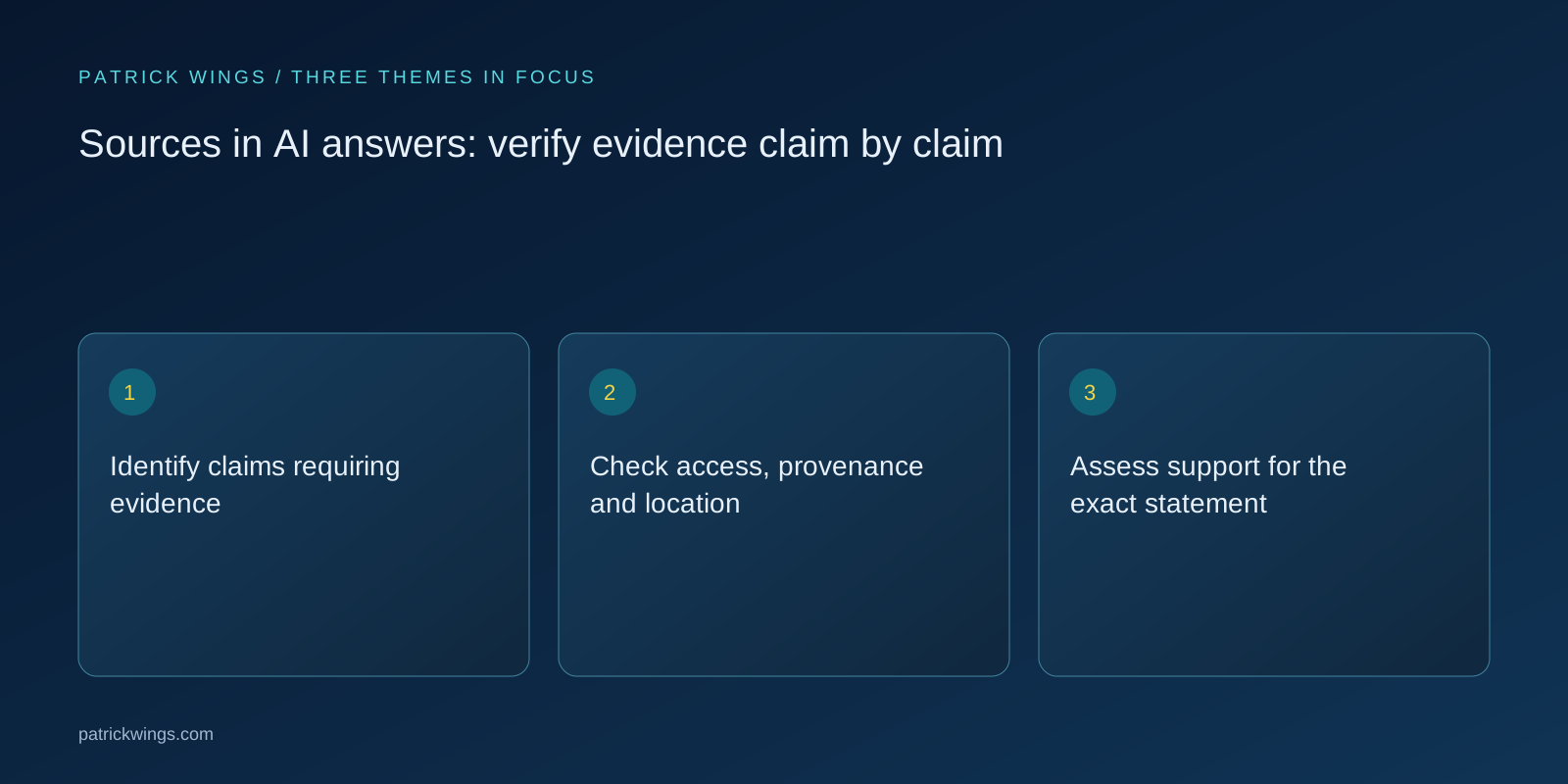
Assess support for the exact statement
Ask whether the source actually says what the answer claims. A report about one customer does not establish a general success rate. A product page listing a capability does not establish availability in every market. Check figures including units, period and denominator. Inspect negative claims especially carefully: absence from one page does not prove a feature does not exist. The agent should distinguish found, not found and demonstrably absent. That distinction prevents a limited search from quietly becoming a definitive statement and makes the remaining research need visible to whoever will use the result.
Label synthesis and inference
Some answers combine several sources with a reasoned interpretation. State the underlying observations and make the additional reasoning step visible. An inference must not appear to be a direct statement from the source. Preserve traceable provenance and relevant processing steps too. W3C’s PROV overview describes provenance in terms of entities, activities and people involved in producing information. A simple mapping of claim, source, version and reviewer may already be useful for your workflow; a particular technical data model is not automatically necessary. The goal is to make the basis inspectable rather than create documentation nobody can practically use.

Inspect an explicitly fictional competitor claim
A fictional agent states that a competitor does not support regional billing and links a general feature overview that says nothing about it. Review changes the wording to not confirmed in the reviewed overview and identifies an open research question. This hypothetical example illustrates inadequate support rather than an actual company capability. Another source may later confirm or exclude availability. The first review cannot pre-empt that finding. Several copied overviews would not independently confirm the original negative assertion either, even if their repetition makes the answer look well sourced to a reader who does not inspect the underlying passages.
Integrate evidence review into the workflow
Ask the agent to map consequential claims concisely to supporting locations. Knowledgeable reviewers inspect material claims and qualifications first. Add automatic checks for missing references and invalid links while recognising their limits: a working link does not establish semantic support. Include test cases with real but irrelevant sources, incorrect periods and unsupported inferences. Passing requires the answer to correct or limit its claim, not merely add another link. Retain confirmed failures as regression examples so later changes can be checked against the specific evidence errors that previously affected decisions or required corrective work. Explore this further in the guide Reviewing marketing claims with evidence and explicit limits.
INTERACTIVE / FROM READING TO ACTION
Three checkpoints for your implementation
Choose a checkpoint and track your reading progress. Checks are neither saved nor sent and do not score your business.
CHECKPOINT 01
Assess support for the exact statement
Ask whether the source actually says what the answer claims.
Explore in the article ↗CHECKPOINT 02
Label synthesis and inference
Some answers combine several sources with a reasoned interpretation.
Explore in the article ↗CHECKPOINT 03
Inspect an explicitly fictional competitor claim
A fictional agent states that a competitor does not support regional billing and links a general feature overview that says nothing about it.
Explore in the article ↗Frequently asked questions
Does a clickable link prove the claim?
No. It establishes at most accessibility. Check content, scope and support for the specific statement.
Does every sentence need a source?
Not every clearly labelled recommendation. Decision-relevant external factual claims should be traceably supported.
Can we infer across multiple sources?
Yes. Separate supported observations from additional interpretation and state uncertainty.
How can I put “Identify claims requiring evidence” into practice?
Mark statements that affect a decision: prices, availability, dates, capabilities and external factual claims. General advice can remain clearly identified as advice without pretending to have a source. Split compound sentences where their parts require different support.
What matters when working on “Check access, provenance and location”?
Open the evidence and inspect its title, publisher, relevant version and actual supporting passage. A matching page title is insufficient. Search snippets can be truncated or omit a material qualification.