
THE SHORT ANSWER
Workflow automation connects recurring steps. AI can process unstructured information or produce drafts, while other steps often work better as fixed rules. Value comes from their combination. Clever text generation saves little if incorrect data enters the process and nobody afterwards knows which output should be reviewed or is permitted to be published.
To connect individual AI applications with reliable marketing operations, read the pillar guide AI transformation in B2B marketing: from individual prompts to reliable operations.
Choose a process with explicit boundaries
A suitable starting point has a recognisable trigger and a clear ending. “Automate marketing” is too broad. “Create three draft briefs from an approved webinar transcript” can be evaluated. Specify which information already exists and which decisions the process must not make. Define the output as a work product, such as a brief containing source passages and unresolved questions. This reveals whether automation completes a meaningful task or merely transfers additional clarification and correction work to another team later in the process. Explore this further in the guide AI agents in marketing: which tasks can be bounded usefully.
Separate fixed rules from interpretive steps
Checking file formats, validating required fields and storing an output in the right place are often deterministic tasks. Summarising themes or organising arguments for an audience may benefit from AI. Do not use a language model for every step. Fixed checks are useful where conditions are explicit. Record each step’s input, expected output and possible failures. This separation makes testing easier and avoids asking a model to approximate a simple technical rule that ordinary validation could enforce more dependably.
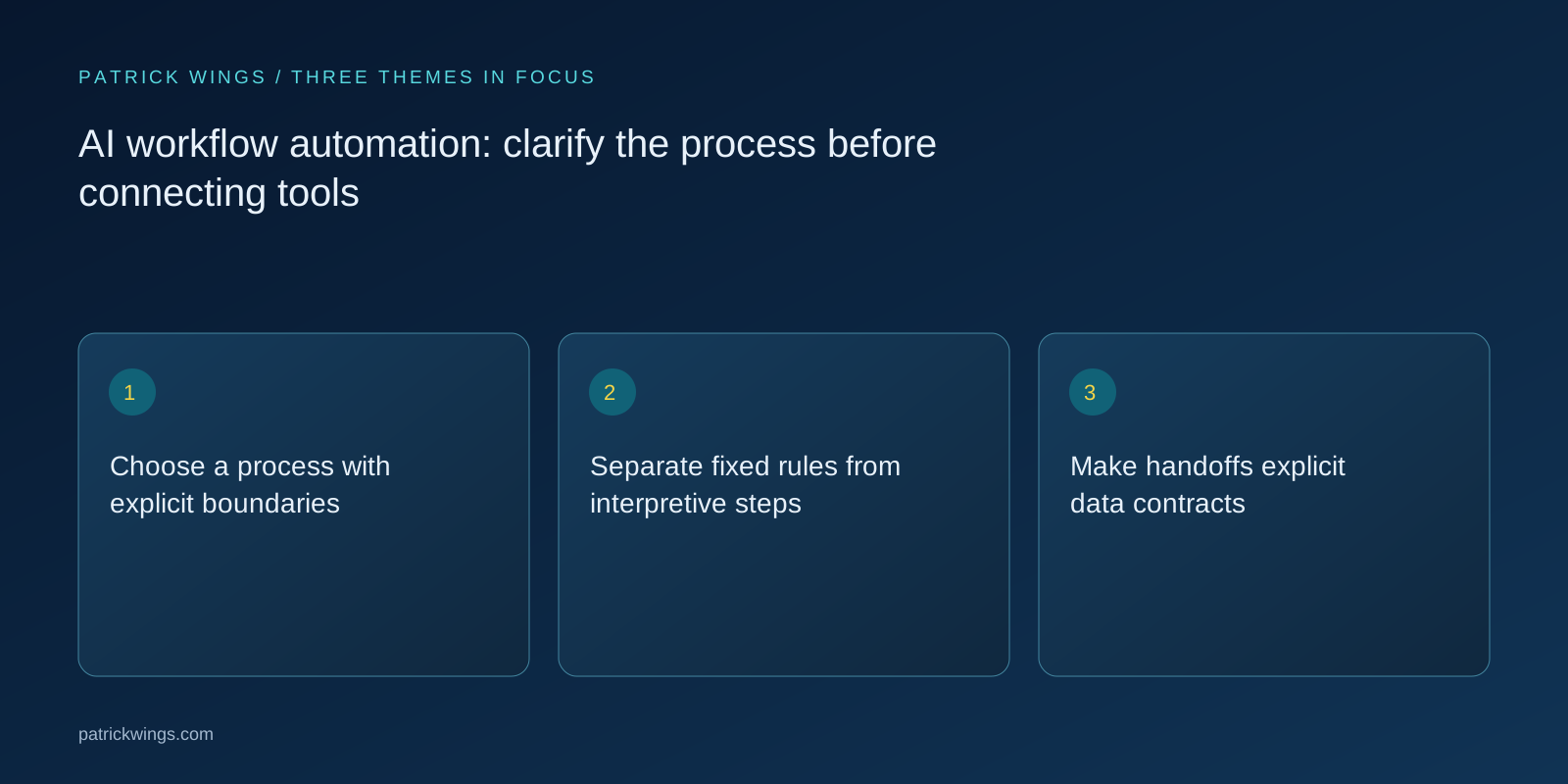
Make handoffs explicit data contracts
A downstream step needs clear fields rather than an arbitrary block of prose. A content brief might contain subject, audience, main claim, source passages and open questions. Validate required fields and allowed values independently of whether the writing sounds convincing. A formally valid output can still be factually wrong, so both checks remain necessary. Specify what happens with empty or contradictory inputs. A useful workflow stops in a controlled way or returns an appropriate question instead of silently inventing the missing information it needs.
Plan for retries and partial failures
What happens when an integration does not respond or a task is accidentally triggered twice? Set retry limits and identify every work item clearly. For actions that change external systems, check whether a retry could repeat the effect. Regenerating a draft differs from sending the same message twice. Preserve understandable intermediate results and failure status. The responsible employee should be able to see what has already happened and where a safe continuation is possible, without having to infer the entire sequence from scattered notifications.

Place approval before consequential action
An initial pilot can save drafts and provide a review checklist. Publication, sending and changes to budget settings remain separate actions. Reviewers need both the intended action and the actual output to assess the decision. Approval for one draft should not silently extend to later modifications. Define when a new review becomes necessary. This allows independent preparation while keeping important external consequences under appropriate expert control. It also gives the team a clearer basis for deciding which actions might eventually be automated more extensively. Explore this further in the guide AI readiness in marketing: is your team ready for a first pilot?.
Compare the entire process with previous work
Measure handling time including review, questions and correction. Assess whether outputs are useful and consistent. A pilot with a few examples provides initial evidence, not a universal efficiency promise for every marketing task. Record the conditions and decide which steps are stable enough for routine work. Sometimes automating one bottleneck is sufficient. A shorter, understandable process is often easier to maintain than a long chain whose overall benefit nobody can verify. Expansion should follow demonstrated usefulness rather than the availability of another integration.
INTERACTIVE / FROM READING TO ACTION
Three checkpoints for your implementation
Choose a checkpoint and track your reading progress. Checks are neither saved nor sent and do not score your business.
CHECKPOINT 01
Make handoffs explicit data contracts
A downstream step needs clear fields rather than an arbitrary block of prose.
Explore in the article ↗CHECKPOINT 02
Plan for retries and partial failures
What happens when an integration does not respond or a task is accidentally triggered twice?
Explore in the article ↗CHECKPOINT 03
Place approval before consequential action
An initial pilot can save drafts and provide a review checklist.
Explore in the article ↗Frequently asked questions
Does every automated step need AI?
No. Explicit technical rules are often better validated or executed directly. Use AI where interpretation is genuinely useful.
What makes a good first workflow?
A bounded internal process with an assessable result, such as a reviewed brief based on approved sources.
How can we avoid duplicate external actions?
Plan unique work identifiers, retry rules and checks of actual system state. Sending and publishing need particular attention.
How can I put “Choose a process with explicit boundaries” into practice?
A suitable starting point has a recognisable trigger and a clear ending. “Automate marketing” is too broad. “Create three draft briefs from an approved webinar transcript” can be evaluated.
What matters when working on “Separate fixed rules from interpretive steps”?
Checking file formats, validating required fields and storing an output in the right place are often deterministic tasks. Summarising themes or organising arguments for an audience may benefit from AI. Do not use a language model for every step.