

THE SHORT ANSWER
A multi-agent system uses several specialised agents for parts of a task. That can be useful when work is genuinely separable and requires different capabilities. Additional agents also create coordination overhead and further failure points. For marketing teams, the architecture should therefore follow a concrete requirement rather than a desire to demonstrate as many AI roles as possible.
To connect individual AI applications with reliable marketing operations, read the pillar guide AI transformation in B2B marketing: from individual prompts to reliable operations.
Justify the division through the task
First check whether one assistant or a defined workflow would suffice. Separation may help when source research, expert checking and editorial preparation deliver genuinely distinct work products. That does not yet demonstrate an advantage. State which bottleneck the division should resolve and how you will recognise a benefit. If every agent must read the same long context and reconsider the same decision, you may simply create extra work. The architecture needs an assessable reason, not merely a diagram with several specialist labels.
Define roles through outputs and boundaries
A research agent returns evidence and knowledge gaps, while an editorial agent drafts from approved information. A review step evaluates explicit criteria. Each role needs clear inputs, outputs and permissions. A creative title such as “strategy guru” does not replace that definition. Decide which choices belong only to the accountable person or central coordinator. Otherwise several agents may change positioning, sources and tone simultaneously, leaving nobody able to explain why the final draft took its particular form or which assumption was responsible for a mistake. Explore this further in the guide AI agents in marketing: which tasks can be bounded usefully.
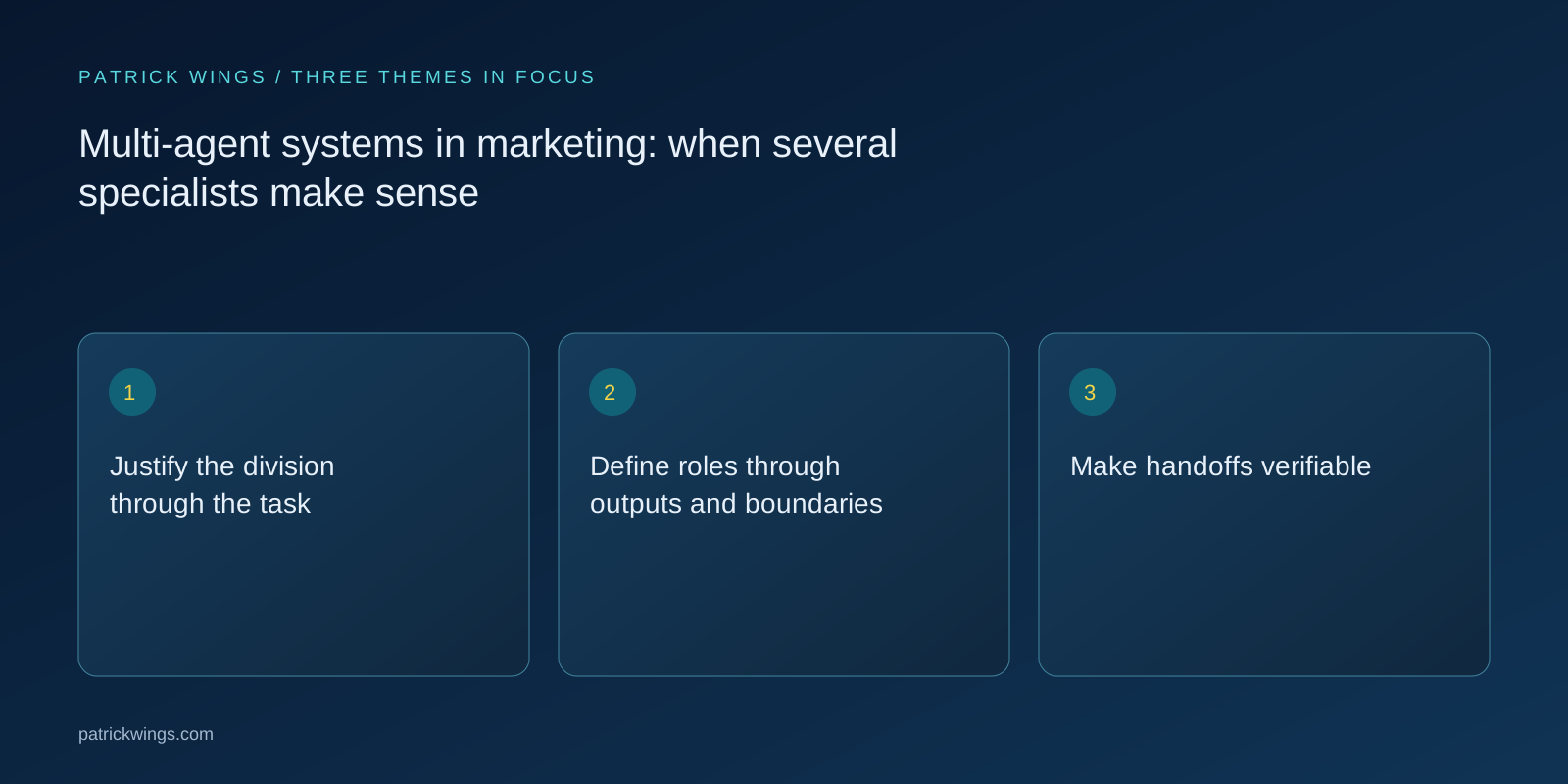
Make handoffs verifiable
Free-form conversation between agents is not automatically a sound operating process. Use understandable intermediate products: claim, source, limitation, open question and status. Check that required fields exist and that evidence supports the statements. Information should not become more certain merely by crossing a handoff. “Possibly” must not turn into “demonstrably” without additional support. Preserve important evidence relationships throughout the chain. This makes expert review and later failure analysis easier, rather than requiring a reviewer to reconstruct the argument from several loosely connected conversational summaries.
Choose parallel and sequential work deliberately
Independent research into different subquestions may work in parallel. Expert checking usually needs a concrete draft first. Define dependencies and prevent agents from overwriting the same file or external record simultaneously. Plan how outputs are combined and what happens when one is missing. A coordinating agent needs limits for questions and retries. Otherwise division of labour can become a loop in which drafting and criticism continue without an acceptable final decision. More activity does not establish that the overall task is progressing towards completion.

Do not confuse multiple voices with independent truth
When several agents rely on the same incorrect source, they can agree persuasively on the same mistake. Adding a critic does not guarantee correctness. Evaluate claims against real evidence and subject criteria. Test cases where inputs contain a shared false assumption. Check whether the system identifies it or merely improves its wording. Human expertise remains important for positioning, product promises and external decisions. Agreement within the system is not a substitute for substantiated evidence, particularly when the participating agents share similar information and evaluation weaknesses.
Compare against a simpler alternative
Measure total time, usage effort, rework and errors for the same tasks. Compare the multi-agent design with a simpler process under understandable conditions. One faster subprocess is not a benefit if handoffs slow everything else down. Document permissions, ownership and stopping mechanisms for the entire system. Retain the division only when it offers identifiable value. Reducing complexity can be the better improvement when the result is easier to understand, less demanding to operate and just as easy to review. The most elaborate architecture is not automatically the most effective one. Explore this further in the guide AI governance in marketing: meaningful ownership and human review.
INTERACTIVE / FROM READING TO ACTION
Three checkpoints for your implementation
Choose a checkpoint and track your reading progress. Checks are neither saved nor sent and do not score your business.
CHECKPOINT 01
Make handoffs verifiable
Free-form conversation between agents is not automatically a sound operating process.
Explore in the article ↗CHECKPOINT 02
Choose parallel and sequential work deliberately
Independent research into different subquestions may work in parallel.
Explore in the article ↗CHECKPOINT 03
Do not confuse multiple voices with independent truth
When several agents rely on the same incorrect source, they can agree persuasively on the same mistake.
Explore in the article ↗Frequently asked questions
Are several agents always better than one?
No. Coordination overhead can remove the benefit. Compare quality and total effort with a simpler solution.
Does a review agent guarantee correctness?
No. It may inherit the same source errors. Reliable evidence, appropriate testing and expert review remain necessary.
Which tasks can run in parallel?
Independent subtasks with separate outputs. Shared changes to files or systems need clear coordination.
How can I put “Justify the division through the task” into practice?
First check whether one assistant or a defined workflow would suffice. Separation may help when source research, expert checking and editorial preparation deliver genuinely distinct work products. That does not yet demonstrate an advantage.
What matters when working on “Define roles through outputs and boundaries”?
A research agent returns evidence and knowledge gaps, while an editorial agent drafts from approved information. A review step evaluates explicit criteria. Each role needs clear inputs, outputs and permissions.