
THE SHORT ANSWER
A B2B channel is useful when it can perform a specific job in the buying process. Choose it through buyer access, information needs and available execution capacity. This guide helps you frame channel choices as testable hypotheses and evaluate bounded experiments according to the decision they are intended to support.
To connect this decision with positioning, market entry and growth, read the pillar guide Go-to-market for B2B SaaS: turn market insight into an executable growth strategy.
Start with an unresolved buying problem
Ask what the intended buyer group does not yet understand or cannot decide. A new offer may need to explain a problem, while a familiar product may be blocked by missing technical evidence. Those are different communication tasks. Write a concrete job such as introducing relevant IT directors to an integration approach or helping evaluators find the documentation they need. Avoid an abstract requirement to be visible everywhere. Without a defined contribution, every channel can look successful under a different metric while the actual buying obstacle remains unresolved. The task establishes which audience, content and subsequent actions belong in a useful channel experiment before anyone begins comparing platform performance reports. Explore this further in the guide Test messaging before rewriting your website.
Check actual access to the audience
Investigate whether the relevant person can be reached in an appropriate context. Consider search behaviour, specialist publications, professional networks, existing subscribers and personal recommendations. Treat assumptions about media use as research questions initially. A large audience does not prove access to your buyers. Conversations about previous information searches help identify concrete sources and situations; the GOV.UK interview guide provides an open approach to those discussions. Then check whether the channel actually supports the selection or placement required. An IT audience is too broad when the offer serves only a particular system environment. Record the access hypothesis, known restrictions and likely irrelevant exposure separately instead of presenting reach as a single reassuring number.
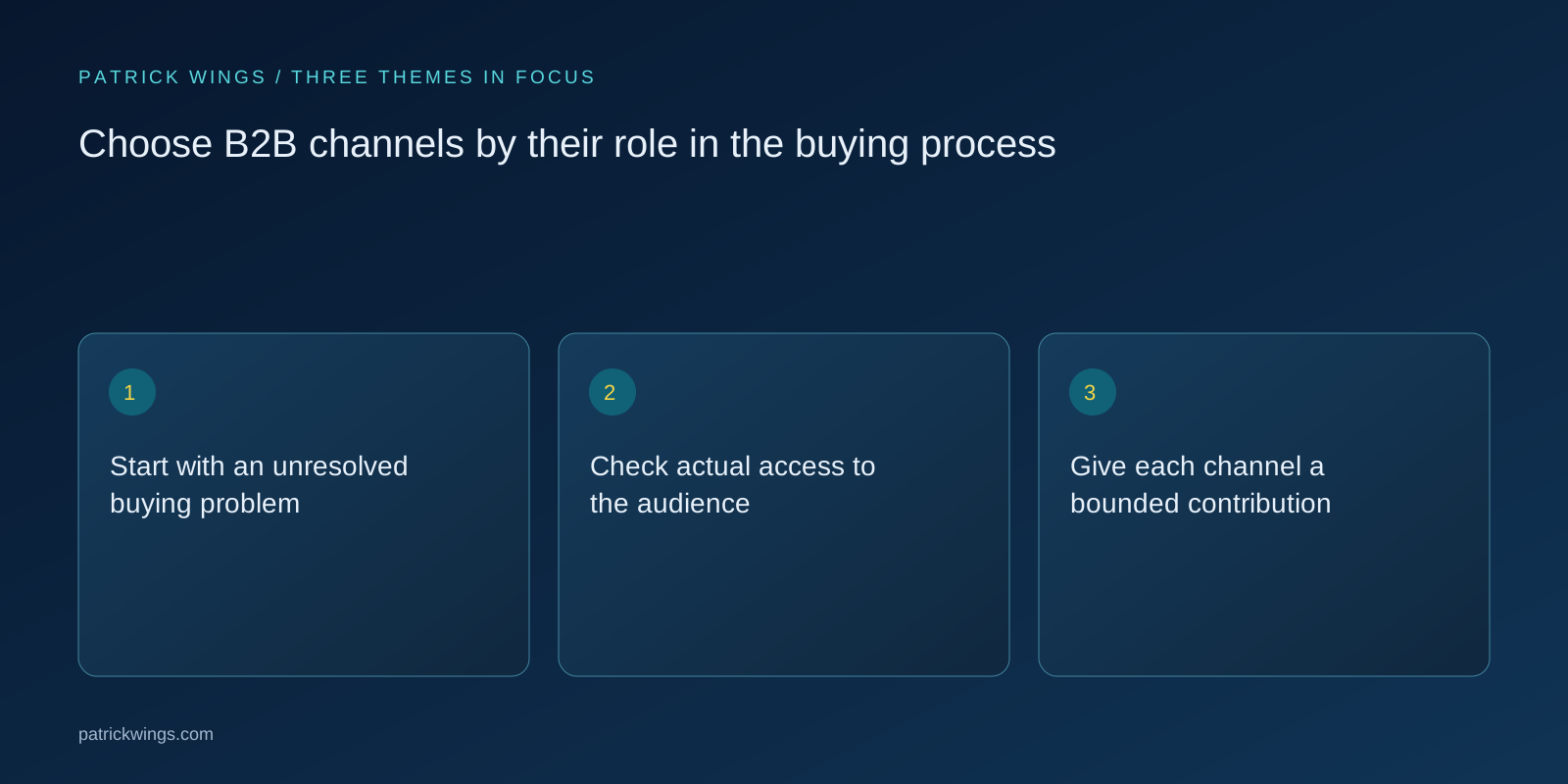
Give each channel a bounded contribution
Assign a limited role to each candidate. Search advertising might capture existing interest, while a specialist article explains an unfamiliar perspective. An owned newsletter can deepen an existing relationship. These are practical hypotheses rather than guaranteed platform effects. Define the content and appropriate next action for each role. A complex first encounter does not always need to lead straight to a demonstration. Conversely, a general overview is unhelpful when someone needs to verify a technical prerequisite. The channel plan should therefore contain the job, context, content and continuation for each candidate. That combination can be assessed; a channel name alone does not explain a plausible path towards a commercial decision.
Check delivery capacity before attractiveness
Compare production requirements, ongoing management, expert availability and the learning time required. A channel demanding frequent specialist contributions is difficult for a team with no access to subject experts. Include destination-page quality and feedback handling in the assessment. A media budget does not fund a complete buyer journey by itself. State which tasks remain internal and what outside support is needed. Estimate costs as your own planning assumptions, rather than presenting them as universal market rates. Identify material that can be reused meaningfully without distributing the same text unchanged everywhere. A limited set of properly supported channels creates better learning conditions than broad presence with permanently unfinished contact points. Explore this further in the guide Compare channels through customer economics beyond CPL.

Work through an illustrative comparison
Suppose an integration vendor considers a specialist newsletter and search advertising. Research suggests technical evaluators search for compatibility answers, while business owners first need to understand the new approach. This example is hypothetical. The search experiment receives a precise integration page; the newsletter receives an explanatory contribution with a suitable next step. Assess each against its own task. Lower click costs alone cannot settle the comparison because people arrive with different questions. The experiment should show whether relevant people are reached, whether they receive the information they need and whether the continuation fits their decision context. Otherwise the test compares unrelated traffic rather than alternative ways to support a buyer.
Seek a decision rather than a league table
Before running the test, agree observations, a review date and possible consequences. Strategyzer's Test Card supports explicit hypotheses, tests and decision thresholds. Add qualitative feedback about understanding and fit to your channel experiment. Separate absent audience access from weak content or an unsuitable next step. A poor result may otherwise disprove only the execution, not the channel. Decide whether to continue, make a specific change or stop, recording the reasons and remaining uncertainty. A useful channel plan is a bounded investment decision with a clear job and learning logic, rather than a permanent ranking of supposedly superior B2B platforms that ignores different buyer situations.
INTERACTIVE / FROM READING TO ACTION
Three checkpoints for your implementation
Choose a checkpoint and track your reading progress. Checks are neither saved nor sent and do not score your business.
CHECKPOINT 01
Give each channel a bounded contribution
Assign a limited role to each candidate.
Explore in the article ↗CHECKPOINT 02
Check delivery capacity before attractiveness
Compare production requirements, ongoing management, expert availability and the learning time required.
Explore in the article ↗CHECKPOINT 03
Work through an illustrative comparison
Suppose an integration vendor considers a specialist newsletter and search advertising.
Explore in the article ↗Frequently asked questions
Which channel is best for B2B SaaS?
It depends on audience, task and execution. First establish the buying obstacle to address and whether relevant people can be reached.
Should we compare channels by click cost?
Only when tasks and contact quality are sufficiently comparable. Different buying-process roles require different assessments.
When should a channel experiment end?
When the agreed investigation supports a decision or exposes a critical access problem. Record execution weaknesses separately.
How can I put “Start with an unresolved buying problem” into practice?
Ask what the intended buyer group does not yet understand or cannot decide. A new offer may need to explain a problem, while a familiar product may be blocked by missing technical evidence. Those are different communication tasks.
What matters when working on “Check actual access to the audience”?
Investigate whether the relevant person can be reached in an appropriate context. Consider search behaviour, specialist publications, professional networks, existing subscribers and personal recommendations. Treat assumptions about media use as research questions initially.