

THE SHORT ANSWER
Choosing a new SaaS market involves more than visible potential. Consider how you can test important uncertainties and deliver an appropriate service. Compare specific entry situations through demand, access, adaptation and learning effort. An attractive country is not automatically a feasible first market, and a ranking is useful only when it relates to your offer and available capabilities.
To connect this decision with positioning, market entry and growth, read the pillar guide Go-to-market for B2B SaaS: turn market insight into an executable growth strategy.
Frame expansion as a bounded decision
Describe the offer, audience and purpose of entry. Bringing an existing product to a similar segment differs from changing the audience, language and sales model simultaneously. Record resources and established strengths, including what you will initially leave unchanged. This distinguishes uncertainty arising from the market from uncertainty already present in the offer. Avoid generic country rankings without a use context. The comparison should explain the next sensible learning step for your company rather than identify the country generally considered most innovative. A clear boundary also makes it easier to recognise when research is expanding beyond the decision. Explore this further in the guide B2B localisation starts with buying decisions.
Combine existing information with direct investigation
Use credible market information for orientation, then check relevant assumptions with local buyers and specialists. The International Trade Administration distinguishes direct research from existing sources and recommends assessing specific destinations. For SaaS, apply that perspective to digital delivery, procurement and support; merchandise trade data is not direct evidence of SaaS demand. Record provenance, currency and limitations. A large number of potentially relevant firms does not establish that the task matters or your product can compete under local buying conditions. Direct conversations should investigate those gaps rather than merely confirm that organisations in the industry exist.
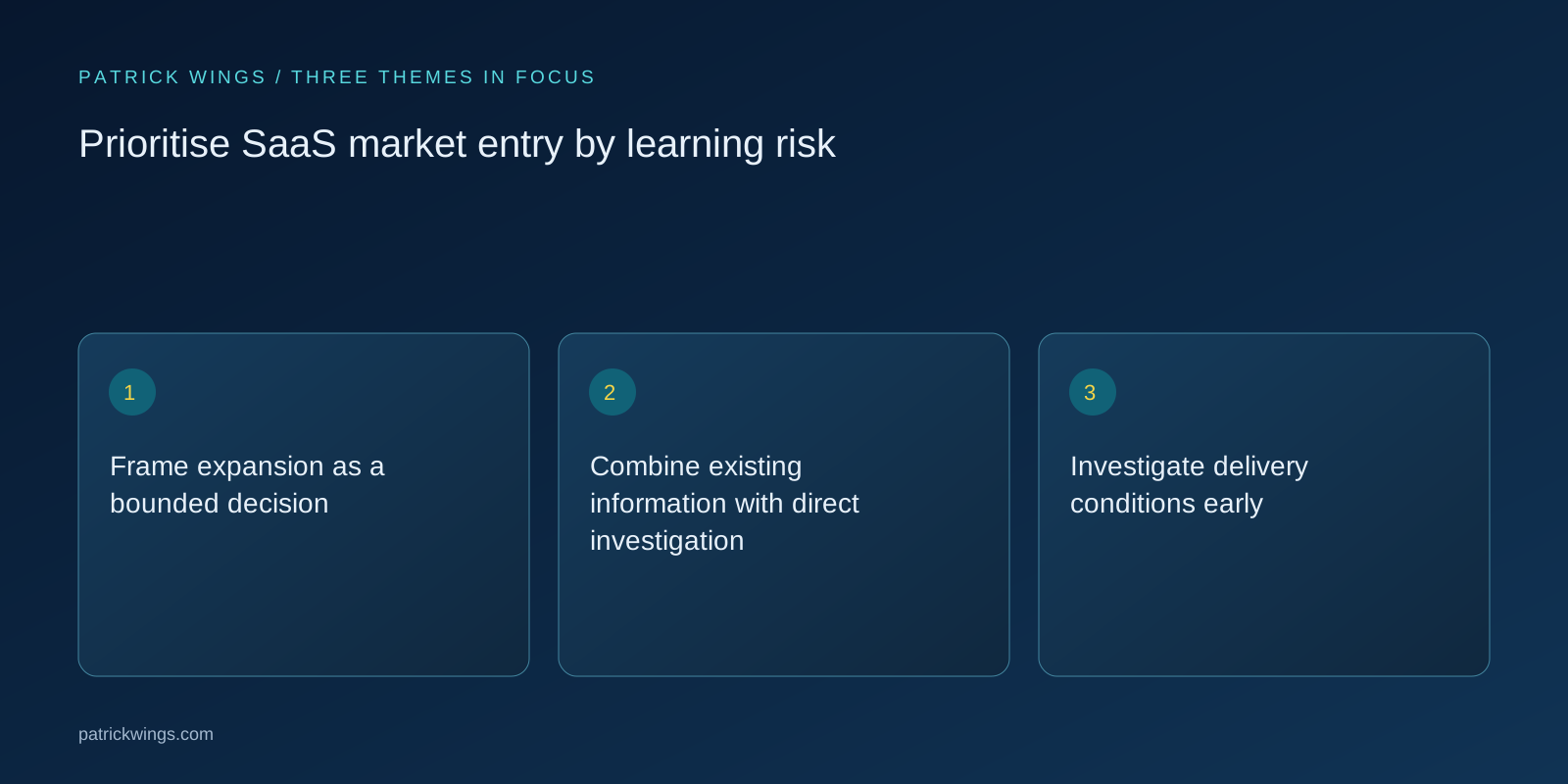
Investigate delivery conditions early
Check language, support, procurement, integrations and local requirements for the intended use. Relevant legal and tax questions belong with qualified specialists. Avoid creating an apparent compliance checklist from country stereotypes. Record the specific condition needing clarification and its implications for product or operations. Examine access too: relevant interview contacts, existing customer connections or dependable partners may differ. A market with promising demand can still be unsuitable first if necessary adaptation exceeds capacity or essential assumptions are expensive to investigate. Delivery and learning feasibility should therefore appear alongside commercial potential rather than being deferred until after campaign launch. Explore this further in the guide Paid media country tests: test demand and sales readiness together.
Hypothetical example: two neighbouring markets
A fictional planning supplier compares two markets. Market A appears larger, but its target segment needs an unsupported integration. Market B contains fewer suitable firms but offers established contacts and a familiar workflow. The team prioritises conversations in B without declaring it permanently superior. It investigates A’s integration requirement in parallel. The example contains no market statistics or success forecast. It illustrates how learning access and delivery capacity can affect sequence even when headline market size points elsewhere. The first choice remains provisional and can change when the assumptions behind either market become clearer.

Compare risks as well as opportunities
For each market, list critical assumptions, existing evidence and the least demanding useful investigation. Prioritise questions whose failure would stop or materially alter entry. A combined score should not conceal a fundamental barrier. Consider different outcomes: absent demand, difficult access and required product adaptation imply different responses. Agree when to investigate further, begin narrowly or defer. This prevents one positive conversation automatically triggering a large campaign before essential conditions are understood. Keep the distinction between demonstrated customer need and supplier enthusiasm visible during reviews so pressure to expand does not quietly redefine the evidence.
Plan a bounded learning entry
Select a manageable use case and owned activities addressing the key questions. Specify which feedback is recorded and when the decision is reviewed. Include support and handovers rather than treating entry as translation or advertising alone. Afterwards compare expected and actual barriers. An appropriate first market permits relevant learning and dependable service under manageable conditions. It need not be the largest, and it remains a reasoned choice for current circumstances rather than a permanent judgement. New evidence should be able to change the sequence without the team treating reconsideration as failure or abandoning the underlying expansion objective.
INTERACTIVE / FROM READING TO ACTION
Three checkpoints for your implementation
Choose a checkpoint and track your reading progress. Checks are neither saved nor sent and do not score your business.
CHECKPOINT 01
Investigate delivery conditions early
Check language, support, procurement, integrations and local requirements for the intended use.
Explore in the article ↗CHECKPOINT 02
Hypothetical example: two neighbouring markets
A fictional planning supplier compares two markets.
Explore in the article ↗CHECKPOINT 03
Compare risks as well as opportunities
For each market, list critical assumptions, existing evidence and the least demanding useful investigation.
Explore in the article ↗Frequently asked questions
Should we enter the largest market first?
Only when demand, access, adaptation effort and delivery feasibility also fit.
Are merchandise trade data sufficient for SaaS?
No. They may provide context but cannot replace investigation of digital tasks and buying conditions.
When should we defer a market?
When a critical prerequisite is missing or investigation and adaptation exceed current capacity.
How can I put “Frame expansion as a bounded decision” into practice?
Describe the offer, audience and purpose of entry. Bringing an existing product to a similar segment differs from changing the audience, language and sales model simultaneously. Record resources and established strengths, including what you will initially leave unchanged.
What matters when working on “Combine existing information with direct investigation”?
Use credible market information for orientation, then check relevant assumptions with local buyers and specialists. The International Trade Administration distinguishes direct research from existing sources and recommends assessing specific destinations. For SaaS, apply that perspective to digital delivery, procurement and support; merchandise trade data is not direct evidence of SaaS demand.