
THE SHORT ANSWER
A good lead magnet saves your audience work or makes a difficult decision easier. A whitepaper is one possible format, not the automatic choice. Before producing a download, define the question your prospective customer is trying to resolve. The following approach helps align the resource, its landing page and the next step.
To see how this step fits into your content strategy, read the pillar guide B2B content marketing: From useful expertise to qualified demand.
1. Describe the buying situation precisely
Collect questions from discovery calls, lost deals and onboarding conversations. Separate people still defining a problem from teams already comparing suppliers. An introductory automation guide may help the first group; the second may need evaluation criteria, prerequisites and limitations. Write one sentence: after using this resource, the reader can perform this specific task better. If that sentence remains vague, the resource is not sufficiently focused yet.
Choose a primary role as well. A download aimed simultaneously at executives, IT, procurement and daily users can become generic. Other stakeholders can have dedicated sections, but their needs should not obscure the main purpose of the material.
2. Choose the smallest useful format
A checklist suits a repeatable review with explicit criteria. A selection matrix helps compare options using the same questions. A whitepaper can explain relationships, trade-offs and implementation steps in greater depth. A calculator works when prospects have credible inputs of their own and can understand the assumptions. Let the task determine the scope instead of imposing an arbitrary page count before the research begins.
Illustrative example: an IT service management provider could create a support handover checklist. Helping readers document responsibilities and escalation paths offers a clearer practical benefit than a general e-book about digital transformation with no defined application. Explore this further in the guide B2B visual storytelling: Make complex services understandable.
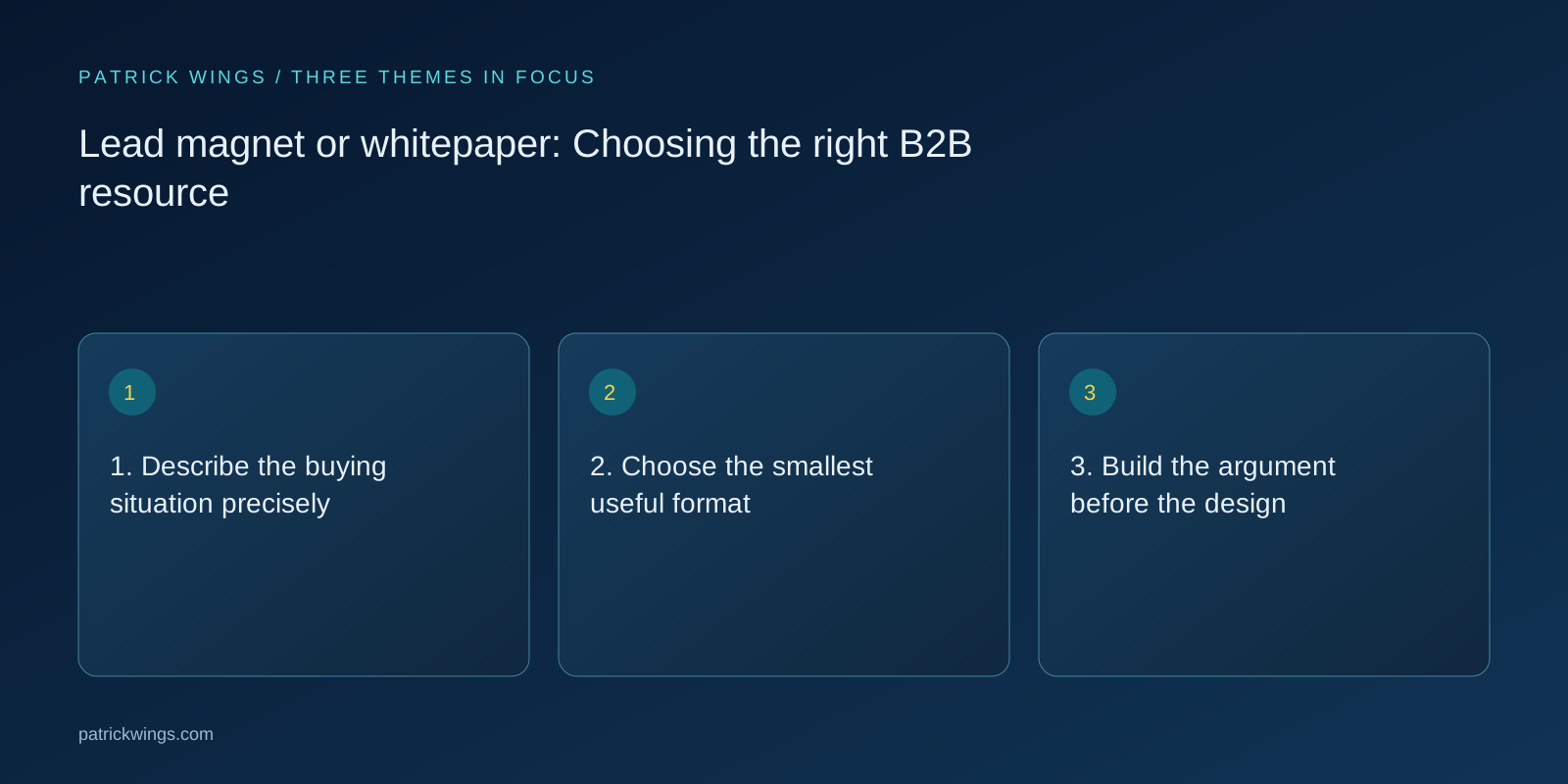
3. Build the argument before the design
Plan the reasoning first: starting problem, common mistakes, decision criteria, application and next step. Label assumptions and explain when a recommendation does not apply. Templates need a completed example. Whitepapers need traceable sources and subject review. An elaborate cover cannot replace a useful answer to the central question, particularly when several colleagues will inspect the document before choosing a supplier.
Decide which parts remain useful independently of your product. If every section simply introduces another feature, the resource becomes an extended brochure. A helpful asset can demonstrate your approach while still functioning as a working tool. That balance gives readers a reason to keep it.
4. Make the landing page promise specific
The landing page should identify the audience, the questions answered and the resource format. Show a genuine excerpt or contents page. A title such as “Implementation guide” needs more context: implementation of what, for which organisation, and resulting in which useful output? Avoid broad promises of guaranteed savings or a predictable number of leads without evidence that can support those claims.
Choose consciously whether a form is appropriate. Make basic information openly available and assess whether a substantial resource justifies an access barrier. Explain what happens after submission. Requesting a document should not silently be interpreted as asking for a sales call, because those are different expressions of intent.

5. Evaluate usefulness after the download
Downloads initially indicate an attractive offer and willingness to provide information. Evaluation also needs contact fit, questions about the resource and subsequent progress. Agree with sales which signals indicate a relevant requirement. Consider whether an openly available version creates more appropriate usage than a gated version, and define the comparison before interpreting differences in raw conversion counts as an improvement.
Invite readers to give one voluntary piece of specific feedback: which section was immediately useful, and which question remains unresolved? Use the answer to develop the next version. Connect the resource with a relevant detailed article and a transparent conversation option, so that readers seeking orientation and readers exploring a purchase can take suitable paths. Explore this further in the guide B2B nurturing content: Answer the next buying question.
INTERACTIVE / FROM READING TO ACTION
Three checkpoints for your implementation
Choose a checkpoint and track your reading progress. Checks are neither saved nor sent and do not score your business.
CHECKPOINT 01
3. Build the argument before the design
Plan the reasoning first: starting problem, common mistakes, decision criteria, application and next step.
Explore in the article ↗CHECKPOINT 02
4. Make the landing page promise specific
The landing page should identify the audience, the questions answered and the resource format.
Explore in the article ↗CHECKPOINT 03
5. Evaluate usefulness after the download
Downloads initially indicate an attractive offer and willingness to provide information.
Explore in the article ↗Frequently asked questions
How long should a whitepaper be?
Long enough to answer its specific question clearly. Scope the decision and reading context rather than choosing an arbitrary page count.
Does a lead magnet require a form?
No. Open resources can support discovery and trust. Any form should have a clear purpose appropriate to the value of the material.
Does a download make someone a qualified lead?
Only when additional criteria for audience fit and relevant need are met. A download alone does not establish qualification.
How can I put “1. Describe the buying situation precisely” into practice?
Collect questions from discovery calls, lost deals and onboarding conversations. Separate people still defining a problem from teams already comparing suppliers. An introductory automation guide may help the first group; the second may need evaluation criteria, prerequisites and limitations.
What matters when working on “2. Choose the smallest useful format”?
A checklist suits a repeatable review with explicit criteria. A selection matrix helps compare options using the same questions. A whitepaper can explain relationships, trade-offs and implementation steps in greater depth.