
THE SHORT ANSWER
Lead nurturing helps suitable prospects resolve unanswered questions over time. An automated email series is one possible tool rather than the strategy itself. Relevant context, voluntary participation and a useful next step matter most. This guide explains how to plan content around information needs instead of sending every contact through the same sales sequence.
To see how this step fits into your content strategy, read the pillar guide B2B content marketing: From useful expertise to qualified demand.
1. Identify the unresolved information need
Start by distinguishing why the contact exists. Downloading a whitepaper, attending a webinar and requesting a demo indicate different interests. Do not assign a buying stage that the action does not establish. Instead, consider what the person can already know and which next question is plausibly relevant given the original context and the material they chose to explore.
Gather recurring objections with sales: implementation effort, integration, internal approval, security or ownership. Create resources that address those questions with clear boundaries. A contact evaluating rollout may need a project roadmap. A general product overview only partly answers that question, even if it describes every feature in detail and contains a prominent invitation to speak with the team.
2. Build a logical sequence with standalone value
Each message should answer a concrete question and remain understandable without the rest of the series. One possible progression begins with understanding the problem, explains evaluation criteria and then covers implementation conditions. This is a planning aid rather than a universal sequence. The material needs to fit the original interest and the actual offer instead of following a template designed for a different buying process.
Illustrative example: after someone voluntarily requests implementation guidance, a message can explain typical project roles. A later resource can show how to review data before starting. A conversation option remains available without dominating the entire message. This supports preparation without turning every useful explanation into an artificial urgency claim or assuming that continued reading means readiness for a purchase. Explore this further in the guide Writing B2B case studies: Show evidence, decisions and limitations.
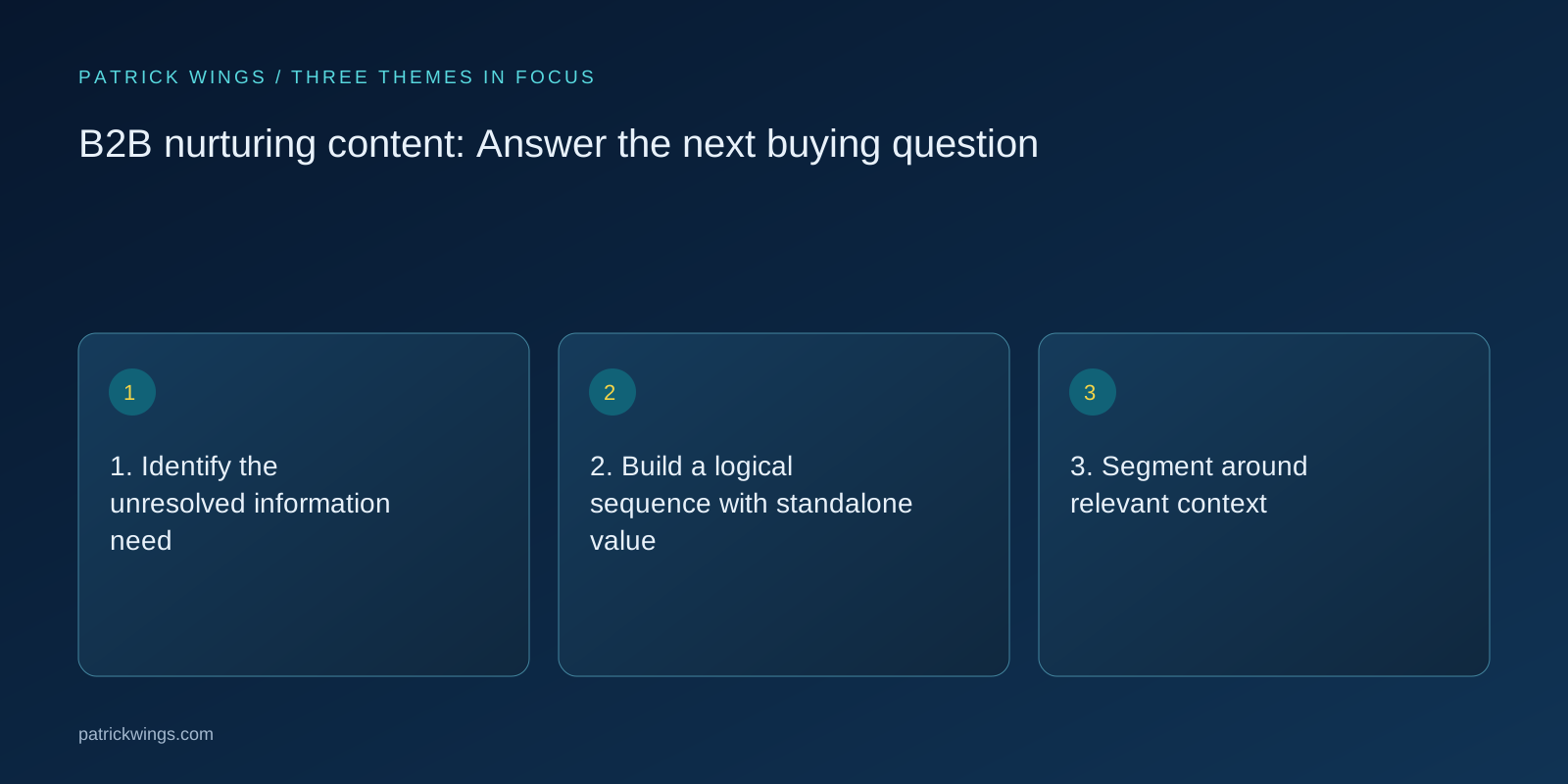
3. Segment around relevant context
Use information that justifies a meaningful change in the content. Role, topic and explicitly stated needs can help. Very fine segmentation is unnecessary if all groups ultimately receive the same message. Begin with a few recognisably different situations, then expand only when you have suitable content and a clear reason to treat those situations differently in the communication process. Explore this further in the guide Demo and signup forms: Set the right B2B entry barrier.
Avoid overinterpreting a single click. A link may be opened out of curiosity or forwarded internally. Treat behaviour as a possible signal and combine it with explicit information and actual conversations. Highly personal wording can feel inappropriate when it asserts a need the recipient never expressed. Relevance comes from useful context rather than the apparent sophistication of the automation rules.
4. Define triggers, exits and ownership
A workflow needs more than a list of send actions. Specify why someone enters, what conditions trigger a message and when the journey ends. HubSpot describes nurturing workflows as part of automated contact development; the implementation depends on your system and available capabilities. Establish which rules can be represented reliably before designing a complex journey your tools cannot execute or your team cannot maintain.
Stop or pause unsuitable messages when an active conversation begins, the person objects or the original context no longer applies. Agree these rules with sales. Personal communication and a running automated sequence should not contradict each other. Name an owner who can investigate errors and respond to questions rather than treating the workflow as a permanently unattended campaign.

5. Evaluate relevance and handovers beyond activity
Opens and clicks can provide clues, but they do not establish buying progress. Review replies, suitable conversations, useful resources and the documented development of relevant opportunities. Also examine unsubscribes and complaints as possible signs of excessive frequency or poor relevance. Interpret all of these signals in the context of the audience and the particular information need being addressed.
Schedule reviews of both content and rules. Update links, product information and examples. Remove or revise messages without a clear task. A shorter relevant journey can be more useful than a long series of general tips. Effective nurturing makes it easier for prospective customers to make their next decision independently and with better information, while keeping an appropriate route to help available when needed.
INTERACTIVE / FROM READING TO ACTION
Three checkpoints for your implementation
Choose a checkpoint and track your reading progress. Checks are neither saved nor sent and do not score your business.
CHECKPOINT 01
3. Segment around relevant context
Use information that justifies a meaningful change in the content.
Explore in the article ↗CHECKPOINT 02
4. Define triggers, exits and ownership
A workflow needs more than a list of send actions.
Explore in the article ↗CHECKPOINT 03
5. Evaluate relevance and handovers beyond activity
Opens and clicks can provide clues, but they do not establish buying progress.
Explore in the article ↗Frequently asked questions
How many emails should a nurture journey contain?
The number depends on useful unanswered questions and context. A fixed message count is not a quality measure.
When should sales take over?
When a suitable contact expresses a relevant need or a desire to talk and meets your jointly agreed handover criteria.
Does a click show purchase intent?
It can be a clue, but it is not proof. Combine behaviour with explicit information, fit and actual conversation.
How can I put “1. Identify the unresolved information need” into practice?
Start by distinguishing why the contact exists. Downloading a whitepaper, attending a webinar and requesting a demo indicate different interests. Do not assign a buying stage that the action does not establish.
What matters when working on “2. Build a logical sequence with standalone value”?
Each message should answer a concrete question and remain understandable without the rest of the series. One possible progression begins with understanding the problem, explains evaluation criteria and then covers implementation conditions. This is a planning aid rather than a universal sequence.