
THE SHORT ANSWER
Thought leadership on LinkedIn begins with a useful perspective on an audience problem. A grand label or provocative headline is not sufficient. What matters is whether readers understand a situation better or can make a more informed decision. This approach helps translate expertise into a recognisable presence that can be maintained over time.
To see how this step fits into your content strategy, read the pillar guide B2B content marketing: From useful expertise to qualified demand.
1. Choose a topic where you can contribute
Start at the intersection of audience needs, your actual experience and the service your company provides. A broad position as a voice for innovation is difficult to make tangible. A perspective on implementing complex B2B software creates concrete questions: where do handovers fail, what role does management play, and which data is often missing at the start? Repeated questions establish a recognisable subject area.
Record which statements draw on direct experience and where outside expertise is needed. Nobody needs to publish an opinion on every industry trend. A well-explained limitation can demonstrate competence: an approach works under certain conditions, while a different situation may require another solution or a different sequence of decisions.
2. Find the perspective through conversation
A strong expert interview explores decisions rather than requesting general tips. What did the person initially assume? Which observation changed their assessment? Which customer objection was justified? What alternative would they recommend in another situation? These questions reveal reasoning that readers can follow and relate to their own circumstances instead of generating a list of familiar slogans.
Secure approval for specific examples. If customer details are confidential, use a clearly labelled illustrative scenario or explain the decision without identifying information. Do not invent apparently personal experiences. Editorial support is compatible with an authentic post, but the published text must reflect the named person's actual views and knowledge, including the limits of that knowledge. Explore this further in the guide Writing B2B case studies: Show evidence, decisions and limitations.
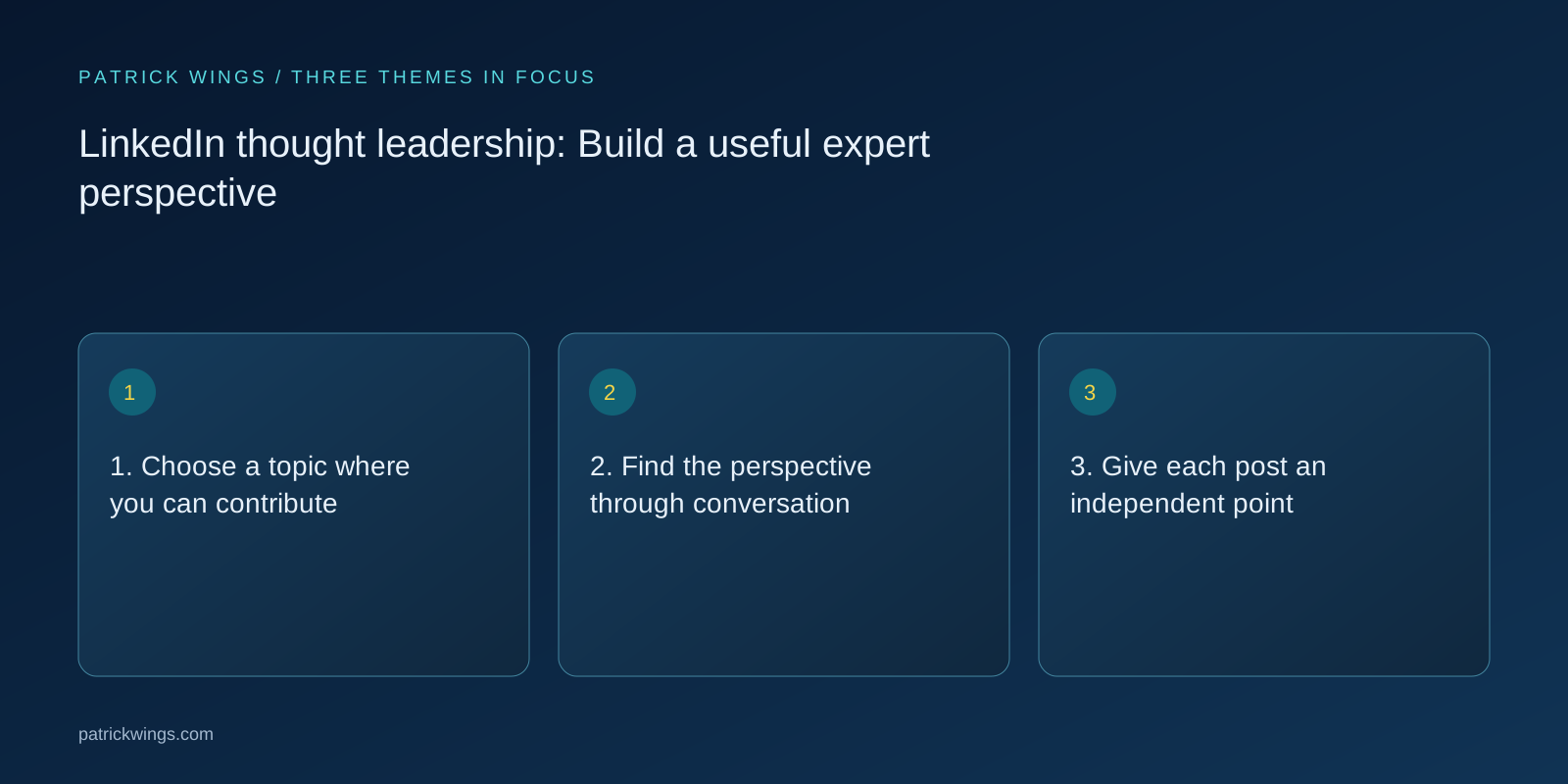
3. Give each post an independent point
One useful structure is a concrete situation, a clear argument, supporting reasoning, a qualification and an open question. Treat this as a writing aid rather than a mandatory template. Some ideas need a brief story; others need a comparison or a small diagram. Readers should understand the central point without opening an external link or remembering a previous instalment in the series.
Illustrative example: rather than claiming “AI will revolutionise marketing,” explain why an automatically generated campaign idea can be unusable without verified customer objections. Then describe a practical review step. That creates a specific professional perspective without dismissing all automation or constructing an artificial conflict simply to attract attention.
4. Make dialogue part of publication
Choose a publishing rhythm the expert can sustain. A calendar full of posts has limited value when substantive questions remain unanswered. Reserve time for comments and useful discussion. Respond to the substance, ask about context and acknowledge differences between situations. These exchanges can reveal new topics and expose places where an original statement was too broad or needed another example.
Company Pages and personal profiles can play different roles. The company presence documents offers and developments; individual experts explain their perspectives. Both need consistent basic facts, but they do not have to sound identical. Choose the combination according to your audience, available voices and the work required to maintain real participation rather than treating every surface as a duplicate broadcast channel.

5. Evaluate relevant response and commercial proximity
Look at who responds and what kind of conversation follows. Reach alone does not show whether suitable decision-makers recognise your expertise. Record recurring questions, relevant connection requests, invitations to talk and traceable website use. Connect these signals with sales records without assigning every subsequent sale to a single post or pretending that a social interaction confirms purchasing intent.
Review which themes create practical insight rather than agreement alone. Develop those themes in your blog and refer to the detail from relevant posts. A useful presence grows through repeated, consistent explanation. Credibility also requires room to revise an opinion and acknowledge uncertainty, rather than presenting complete confidence about every possible question your audience might raise. Explore this further in the guide Content repurposing: Turn expertise into a connected B2B topic.
INTERACTIVE / FROM READING TO ACTION
Three checkpoints for your implementation
Choose a checkpoint and track your reading progress. Checks are neither saved nor sent and do not score your business.
CHECKPOINT 01
3. Give each post an independent point
One useful structure is a concrete situation, a clear argument, supporting reasoning, a qualification and an open question.
Explore in the article ↗CHECKPOINT 02
4. Make dialogue part of publication
Choose a publishing rhythm the expert can sustain.
Explore in the article ↗CHECKPOINT 03
5. Evaluate relevant response and commercial proximity
Look at who responds and what kind of conversation follows.
Explore in the article ↗Frequently asked questions
Does thought leadership need to be controversial?
No. A useful interpretation, clearly explained decision or important qualification can be more relevant than a provocative claim.
Can an editorial team prepare posts?
Yes, provided the named person owns the perspective, claims and approval. Invented personal experiences undermine credibility.
How often should we post?
Choose a rhythm that allows review and real conversation. Consistency can help, but no universal frequency guarantees results.
How can I put “1. Choose a topic where you can contribute” into practice?
Start at the intersection of audience needs, your actual experience and the service your company provides. A broad position as a voice for innovation is difficult to make tangible. A perspective on implementing complex B2B software creates concrete questions: where do handovers fail, what role does management play, and which data is often missing at the start?
What matters when working on “2. Find the perspective through conversation”?
A strong expert interview explores decisions rather than requesting general tips. What did the person initially assume? Which observation changed their assessment?