
THE SHORT ANSWER
Return qualified CRM events only after validating definition, identity and delivery.
For the broader picture of how target customers, channels and sales handoffs work together, read the pillar guide B2B demand generation: from attention to qualified pipeline.
Qualification before upload mechanics
Return qualified CRM events only after validating definition, identity and delivery. A successful upload is only half the job. The event must have the same business meaning regardless of which sales team handles the enquiry or when a colleague happens to update the record. Explore this further in the guide B2B conversion goals: organise meaningful business signals.
A qualified lead needs business entry criteria, such as a suitable application and confirmed ability to proceed. Creating a deal may mean different things across teams. Classify the same borderline examples together before making that status a cross-system success event.
A complete event contract
Specify event name, actual occurrence time, identifiers, unique event ID and any defensible value with currency. Verify current platform requirements. Google’s documentation describes changes to settings and upload routes during 2026, so an older Google Ads API tutorial should not be adopted uncritically as the current implementation plan. Explore this further in the guide CRM data quality for trustworthy marketing decisions.
The contract also specifies corrections and repeated qualification. One contact can have several projects while one opportunity can be saved repeatedly. Event identity must distinguish the intended business unit while recognising technical repetitions of the same message as retries rather than additional progress.
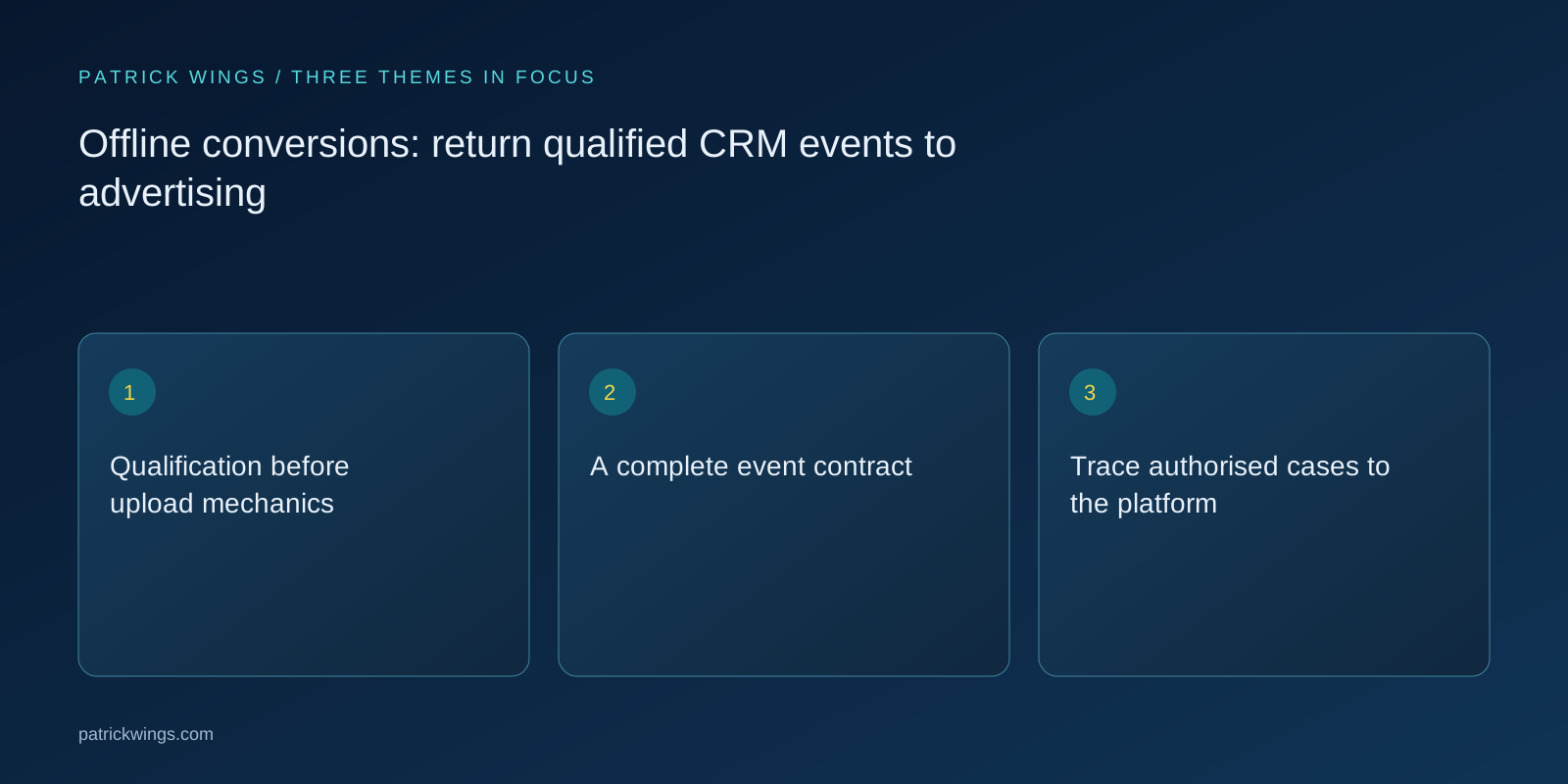
Trace authorised cases to the platform
Write an event specification and test a few authorised cases from form submission through import diagnostics. Inspect time zones, repeated status changes and retry behaviour. Confirm required consent and data-use conditions. Hashing does not replace those prerequisites or correct an event assigned to the wrong commercial stage.
Keep a test table with expected event, transmitted record, response and subsequent diagnosis. Limit personal test information to what is needed. A technical test file should not remain indefinitely in shared campaign folders merely because the transfer uses encryption or hashing.
Fourteen rows are not fourteen events
An invented CRM records twelve qualified contacts. Two are exported twice after another save, while three lack usable matching information. The export contains fourteen rows, not fourteen distinct business signals. The team needs stable event IDs and separate counts for exported, accepted and actually attributed records.
Each of the twelve distinct qualifications now has one expected identifier. Handle the two repeated rows deliberately and investigate the three missing matches separately. Duplication control and identity coverage remain separate tasks, each with an outcome that can be verified independently.

Separate acceptance and attribution
Upload acceptance and attribution are different states. Delayed or incomplete status changes can also distort the result. Do not claim complete CRM coverage when only some events contain the required identifiers. Check whether multiple conversion goals count the same economic step more than once as well.
An accepted record may still lack attribution. A rejected row may instead have a formatting problem. These require different actions; indiscriminately resending everything can reproduce errors and create further uncertainty about which events were actually processed.
Reconcile the chain independently
Monitor event coverage, rejections, duplication and delay by source and sales team. Reconcile platform diagnostics with an independent CRM count. When a break appears, investigate the pipeline first; a missing upload series should not be mistaken for an abrupt deterioration in actual demand or sales performance.
Create control totals by event date at a frequency suitable for volume. Compare sending date too so backfills do not resemble new demand. Investigate differences through IDs. Matching overall totals alone can hide missing and duplicate events that happen to cancel each other out.
Corrections and current upload routes
Assign business ownership for stage definitions and technical ownership for transfer and recovery. Maintain a procedure for failed uploads and corrections. Document the integration route actually used and the date its platform requirements were checked so subsequent product changes can be assessed against a concrete implementation.
Document recovery after an outage: affected period, resent IDs and checked responses. When requirements change, investigate the actual connection first. An outdated generic tutorial does not itself prove that your existing integration, possibly operated by another provider, has already failed.
INTERACTIVE / FROM READING TO ACTION
Three checkpoints for your implementation
Choose a checkpoint and track your reading progress. Checks are neither saved nor sent and do not score your business.
CHECKPOINT 01
Trace authorised cases to the platform
Write an event specification and test a few authorised cases from form submission through import diagnostics.
Explore in the article ↗CHECKPOINT 02
Fourteen rows are not fourteen events
An invented CRM records twelve qualified contacts.
Explore in the article ↗CHECKPOINT 03
Separate acceptance and attribution
Upload acceptance and attribution are different states.
Explore in the article ↗Frequently asked questions
Is successful upload enough?
No. Validate business meaning, coverage and actual attribution.
What prevents duplicate events?
Stable IDs, explicit stage logic and controlled retries.
Which API should we use?
Check the currently supported route in the linked documentation; upload requirements changed in 2026.
How can I put “Qualification before upload mechanics” into practice?
Return qualified CRM events only after validating definition, identity and delivery. A successful upload is only half the job. The event must have the same business meaning regardless of which sales team handles the enquiry or when a colleague happens to update the record.
What matters when working on “A complete event contract”?
Specify event name, actual occurrence time, identifiers, unique event ID and any defensible value with currency. Verify current platform requirements. Google’s documentation describes changes to settings and upload routes during 2026, so an older Google Ads API tutorial should not be adopted uncritically as the current implementation plan.