
THE SHORT ANSWER
Marketing agent permissions should bound data scope, actions and execution conditions separately. Read access does not justify a change, a draft is not sending approval, and one approved case does not open an entire workspace. Enforce important limits through tools and destination systems. An agent can be instructed to respect boundaries, but technical enforcement needs its own independently testable basis.
To connect individual AI applications with reliable marketing operations, read the pillar guide AI transformation in B2B marketing: from individual prompts to reliable operations.
Inventory actions rather than broad roles
List what the agent must actually do: read campaign data, create a text draft, suggest a CRM field or apply a reviewed update. Record the data involved and possible downstream effects for each action. A role such as marketing assistant is too broad because it can combine harmless research with consequential publication. Ask whether the task really needs every accessible account. A bounded campaign analysis should not automatically access other customer areas or personal inboxes merely because an integration technically exposes them through the same connection or user identity. Explore this further in the guide Prompt injection in marketing workflows: contain untrusted content.
Separate reading, drafting and changing technically
Use distinct tools or explicitly enforced action modes. A drafting tool can save a proposal in a review area without changing the production field. An update tool additionally validates approval, destination identifier and permitted fields. Do not assume a parameter called draft only prevents all side effects. Inspect the actual integration and automatic follow-up processes. Creating a record may already trigger notifications. Permission review must therefore consider the real effect rather than relying on the action’s visible label or the intention expressed by the model when it requested the operation.
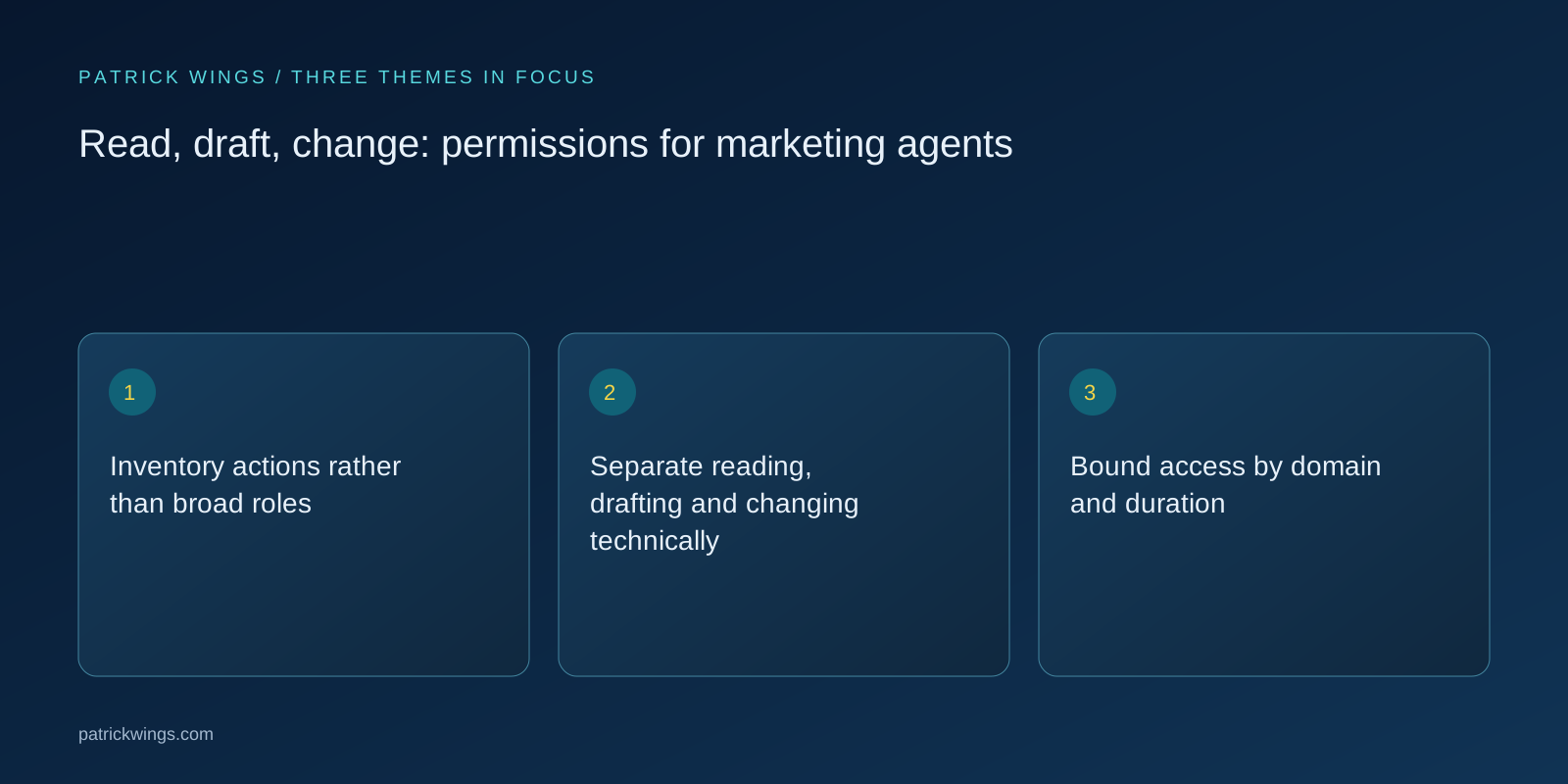
Bound access by domain and duration
Check whether permitted actions apply only to specific projects, accounts or record types. Exclude prohibited information during retrieval where possible rather than inspecting the output afterwards. Time-limited access can help when a pilot ends or a task finishes. Document who can grant, review and revoke permissions. Remove obsolete connections and unnecessary credentials from the active process. Even a carefully bounded written request can remain exposed if it executes through a technical identity with broad, uncontrolled access. Review the actual account used by each integration rather than assuming the user-facing role is enforced underneath.
Bind approval to a concrete operation
Approval should identify the destination, proposed content, relevant version and material side effects. Recheck those conditions immediately before execution. When the target or content changes, the workflow must recognise that earlier approval may no longer apply. A broad request to tidy things when needed is not a reviewable instruction for arbitrary record updates. At the same time, define which routine bounded steps can proceed within existing authorisation. Otherwise the process generates unnecessary questions while consequential operations remain vaguely described and poorly connected to what someone actually intended to approve.

Inspect a fictional campaign review
A fictional agent analyses approved performance data for one advertising account and prepares recommendations. It may read reports and save internal drafts but cannot change budgets. When a user approves a particular budget proposal, a separate tool checks the account, campaign, amount and current version. This hypothetical case makes the boundary explicit. Analysis access is not generally expanded; the specific confirmed operation is enabled. Another campaign or a changed amount must be checked against the original instruction rather than inheriting permission from a related but materially different proposal.
Test allowed and refused paths
Alongside successful work, test access outside the project, updates to unapproved fields and requests after access is revoked. The important evidence is that the execution boundary refuses a disallowed action even if the agent attempts it. Also test understandable errors and a usable exception path. When an authorised request fails, the person responsible for checking access should be clear. Repeat these checks after integration or role changes. An original permission test cannot establish whether later tools introduced additional rights or side effects that were never included in the first review. Explore this further in the guide Describing agent tools: clear inputs and verifiable results.
INTERACTIVE / FROM READING TO ACTION
Three checkpoints for your implementation
Choose a checkpoint and track your reading progress. Checks are neither saved nor sent and do not score your business.
CHECKPOINT 01
Bound access by domain and duration
Check whether permitted actions apply only to specific projects, accounts or record types.
Explore in the article ↗CHECKPOINT 02
Bind approval to a concrete operation
Approval should identify the destination, proposed content, relevant version and material side effects.
Explore in the article ↗CHECKPOINT 03
Inspect a fictional campaign review
A fictional agent analyses approved performance data for one advertising account and prepares recommendations.
Explore in the article ↗Frequently asked questions
Is an instruction not to change data enough?
It is useful but does not replace technical limits on available actions.
Does every action need fresh approval?
No. First inspect existing authorisation and its boundaries; additional approval should correspond to material consequences.
Who should review permissions?
Process owners and people who understand the integration and destination should jointly compare the requested action with its technical effect.
How can I put “Inventory actions rather than broad roles” into practice?
List what the agent must actually do: read campaign data, create a text draft, suggest a CRM field or apply a reviewed update. Record the data involved and possible downstream effects for each action. A role such as marketing assistant is too broad because it can combine harmless research with consequential publication.
What matters when working on “Separate reading, drafting and changing technically”?
Use distinct tools or explicitly enforced action modes. A drafting tool can save a proposal in a review area without changing the production field. An update tool additionally validates approval, destination identifier and permitted fields.