
THE SHORT ANSWER
An enterprise pilot is a jointly agreed investigation of a specific buying decision. It needs bounded scope, appropriate participants and criteria established beforehand. Unlike a standardised trial, it is negotiated for the customer’s situation. Plan evaluation, responsibility and the possibility of ending without purchase as carefully as the usage experience, so the pilot produces a decision rather than indefinite activity.
To connect this decision with positioning, market entry and growth, read the pillar guide Go-to-market for B2B SaaS: turn market insight into an executable growth strategy.
Formulate the unresolved decision together
Clarify what uncertainty the pilot should remove: workflow suitability, technical connection or organisational adoption, for example. One pilot cannot answer every open enterprise question. Write the decision with the customer so both parties understand the same issue. Check that the relevant roles participate and can use the result. Without an owner for subsequent evaluation, the pilot risks becoming informal operation without commitment to learning. Start with a decision and its prerequisites rather than a generic free account. This also gives both sides a defensible reason to decline a pilot that cannot answer a useful question. Explore this further in the guide Understand enterprise buying groups.
Negotiate scope and conditions
Agree the use case, teams, data, integrations and support. Define exclusions and change handling. Have the appropriate people clarify charges, duration and contractual conditions. A pilot is not an implicit promise of complete implementation. Bespoke work needs realistic capacity on both sides. If the customer cannot resource the task, a later start may be better than a formally active pilot with no actual investigation. Define conditions for stopping early as well. Scope should describe the work and commitments clearly enough that an additional request can be assessed without relying on memory or goodwill.
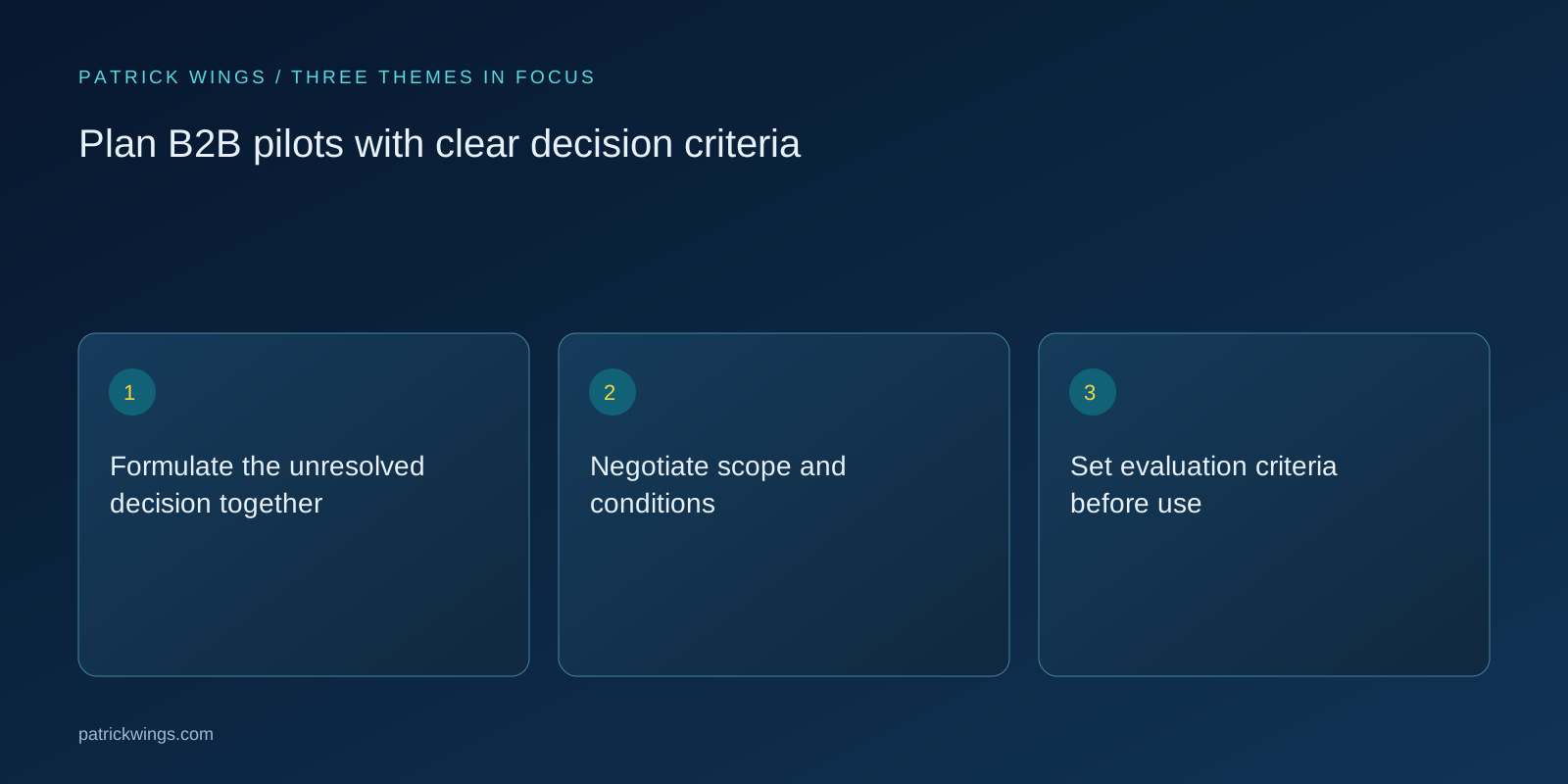
Set evaluation criteria before use
Choose observable criteria matching the decision. A successful demonstration is insufficient when the question concerns independent customer work. Establish the baseline, assessors and limitations. Strategyzer’s Test Card explicitly connects hypothesis, test, measurement and criterion. An enterprise pilot adds jointly negotiated responsibilities to that logic. Avoid criteria measuring only your product activity. Technical faults, missing prerequisites and unmet goals must be possible results, so evaluation cannot be retrofitted to look favourable. The parties should know what would justify proceeding, stopping or acknowledging that the evidence remains insufficient to answer the original question.
Hypothetical example: a bounded procurement approval
A fictional customer evaluates approval software for one procurement workflow. Supplier and customer agree roles, required data and a concrete case with traceable decision material. They state that the pilot does not cover full enterprise integration. During use, an approval role needs different internal ownership. Both sides record the change and assess whether the original question remains answerable. This example promises no purchase. It shows how a pilot produces useful learning and visible limits when the actual process differs from the initial plan, rather than treating any deviation as something to conceal before the final presentation. Explore this further in the guide Prepare SaaS for enterprise procurement.

Manage the pilot deliberately
Agree short review points for obstacles and decisions. Distinguish product defects, missing preparation and changed tasks. New requests do not automatically enter scope. Decide together whether they are necessary for the original question and what expansion would require. Document assistance so the conditions behind the result remain clear. If the supplier performs substantial work, evaluation must not represent it as already completed independently by the customer. Transparent support is more valuable than an artificially smooth success account. It helps reveal what a later implementation would actually require and whether the proposed service includes enough assistance.
Close with a reasoned decision
Summarise results against the agreed questions, separating met, unmet and unassessable criteria. An unresolved issue is not success merely because time expires. The relevant roles then decide between implementation, further investigation and stopping. Another test needs a new, justified question rather than automatic extension. Confirm treatment of data and access at the end. A useful pilot provides a defensible decision foundation for both parties. Its value does not depend solely on immediately signing a larger contract, particularly where the evidence reveals a mismatch that would otherwise have created a difficult implementation for everyone involved.
INTERACTIVE / FROM READING TO ACTION
Three checkpoints for your implementation
Choose a checkpoint and track your reading progress. Checks are neither saved nor sent and do not score your business.
CHECKPOINT 01
Set evaluation criteria before use
Choose observable criteria matching the decision.
Explore in the article ↗CHECKPOINT 02
Hypothetical example: a bounded procurement approval
A fictional customer evaluates approval software for one procurement workflow.
Explore in the article ↗CHECKPOINT 03
Manage the pilot deliberately
Agree short review points for obstacles and decisions.
Explore in the article ↗Frequently asked questions
When is a trial insufficient?
When individual integrations, organisational conditions or several approvals require targeted investigation.
Is a free pilot better?
Being free does not answer the research question. Scope, effort, criteria and agreements matter.
When should we extend?
When a relevant unresolved question can be answered through a revised plan and both sides have capacity.
How can I put “Formulate the unresolved decision together” into practice?
Clarify what uncertainty the pilot should remove: workflow suitability, technical connection or organisational adoption, for example. One pilot cannot answer every open enterprise question. Write the decision with the customer so both parties understand the same issue.
What matters when working on “Negotiate scope and conditions”?
Agree the use case, teams, data, integrations and support. Define exclusions and change handling. Have the appropriate people clarify charges, duration and contractual conditions.