
THE SHORT ANSWER
A proof architecture plans the evidence your offer needs across different buying decisions. It connects strategic claims, buyer stages and product maturity in a shared portfolio. This guide helps you identify gaps and prioritise investment in demonstrations, case studies, technical materials or research. Use the linked claim-review guide for editorial checks on individual statements before publication.
To connect this decision with positioning, market entry and growth, read the pillar guide Go-to-market for B2B SaaS: turn market insight into an executable growth strategy.
Organise strategic claims as a portfolio
Start with a small set of statements explaining why buyers should seriously consider the offer. Group them by their contribution to positioning, such as problem resolution, integration or implementation confidence. Avoid compiling every advertising phrase: this exercise concerns the strategic pillars of the offer. Connect each pillar with the relevant customer situation and product area. An evidence portfolio needs that structure to reveal whether many existing materials demonstrate the same strength while leaving other essential questions unanswered. The output is a manageable set of strategic evidence needs, ready to connect with buying stages and product maturity rather than a collection of sentences being edited for immediate publication.
Build a claim-by-stage matrix
For each strategic claim, create columns for problem understanding, functional evaluation, technical assessment and implementation. These labels are a practical working model; real buying processes do not always proceed linearly. Place existing evidence in the appropriate cells. An understandable use case may support early comprehension, technical documentation may support integration assessment and an implementation plan may support an operating decision. One asset can serve several cells, but it should not be declared sufficient everywhere without a reason. Record the specific buyer question that remains open in each cell. The matrix then reveals whether essential decisions receive appropriate information rather than merely displaying the quantity of content already produced. Explore this further in the guide Launch gates: what must be resolved before going to market.
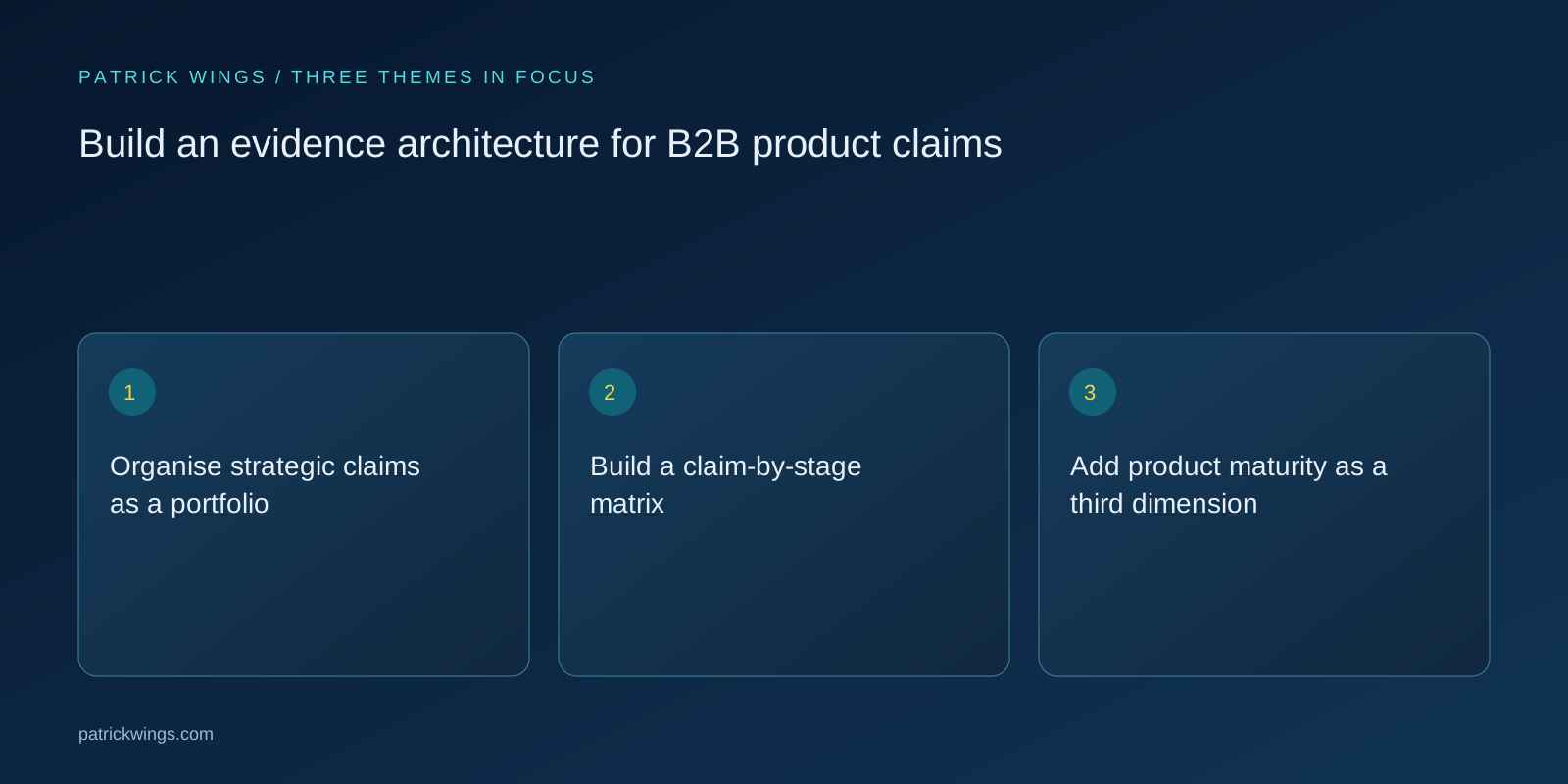
Add product maturity as a third dimension
Label whether a product area is experimental, available within defined boundaries or already observed reliably in the intended use. Define these categories internally; they are not a universal maturity standard. For a new capability, a transparent demonstration with explicit limits may be suitable evidence, while an established offer may need a traceable implementation experience. The matrix should not disguise missing experience through sophisticated design. It should show what evidence can realistically exist today. That may lead to a research task, beta programme or bounded evaluation before another substantial case study can sensibly enter the production plan or before marketing promises an outcome that has not been observed. Explore this further in the guide Reviewing marketing claims with evidence and explicit limits.
Prioritise gaps through decision consequences
Assess open cells through their importance to real buying decisions, the uncertainty involved and the work needed to close them. Missing integration documentation may stop technical assessment completely, while another early explanatory video adds little. Consider reuse across segments and dependencies on product development or customer permission. Avoid apparently precise scores when the foundations are weak. A reasoned priority order with documented assumptions is often enough. Strategyzer's Test Card supports the planning of open evidence questions through explicit hypotheses and tests. Your portfolio connects that learning work with the separate question of which evidence investment should receive the next allocation of people, specialist attention and budget.

Work through an illustrative portfolio
Suppose a SaaS company has several general success stories but no usable explanation of an important data integration. A new product area also lacks approved customer experience. This example is hypothetical. The matrix might produce three different projects: technical documentation for the existing integration, a bounded learning programme for the new capability and a focused implementation story from a suitable current deployment. Not every gap therefore calls for another blog article. The shared plan identifies the buying decision each project supports and the prerequisite it depends on. Marketing, product and delivery can discuss the same priorities instead of ordering similar materials independently or competing over which team produces the next attractive piece.
Maintain an accountable proof roadmap
Turn prioritised gaps into a plan containing the owner, required contributions, dependencies and next decision date. A project is only meaningfully scheduled when necessary inputs, such as a technical specialist or potentially publishable customer experience, are available. Revisit the portfolio when positioning, target segments or product scope changes. Observe which questions remain unresolved in sales conversations despite existing assets. Finished materials then pass through the separate editorial claim-review process. This division keeps strategic investment planning distinguishable from approving individual statements. The proof architecture provides a traceable route from consequential buying decisions to evidence investments, with boundaries and responsibilities visible across the teams expected to contribute to their completion.
INTERACTIVE / FROM READING TO ACTION
Three checkpoints for your implementation
Choose a checkpoint and track your reading progress. Checks are neither saved nor sent and do not score your business.
CHECKPOINT 01
Add product maturity as a third dimension
Label whether a product area is experimental, available within defined boundaries or already observed reliably in the intended use.
Explore in the article ↗CHECKPOINT 02
Prioritise gaps through decision consequences
Assess open cells through their importance to real buying decisions, the uncertainty involved and the work needed to close them.
Explore in the article ↗CHECKPOINT 03
Work through an illustrative portfolio
Suppose a SaaS company has several general success stories but no usable explanation of an important data integration.
Explore in the article ↗Frequently asked questions
How does proof architecture differ from claim review?
Architecture plans the evidence portfolio and investment priorities. Claim review checks individual statements before publication.
Does every gap need a case study?
No. Depending on the buyer question and product maturity, documentation, a demonstration, an implementation plan or further research may fit better.
How should evidence gaps be prioritised?
Consider consequences for a real buying decision, remaining uncertainty, effort, reuse and available prerequisites.
How can I put “Organise strategic claims as a portfolio” into practice?
Start with a small set of statements explaining why buyers should seriously consider the offer. Group them by their contribution to positioning, such as problem resolution, integration or implementation confidence. Avoid compiling every advertising phrase: this exercise concerns the strategic pillars of the offer.
What matters when working on “Build a claim-by-stage matrix”?
For each strategic claim, create columns for problem understanding, functional evaluation, technical assessment and implementation. These labels are a practical working model; real buying processes do not always proceed linearly. Place existing evidence in the appropriate cells.