
THE SHORT ANSWER
Onboarding friction occurs where suitable customers cannot meaningfully continue towards first value. Causes may involve interaction, data, responsibility or incorrect expectations. Investigate the complete path instead of answering every interruption with another reminder. The important question is which barrier affects which participants and why, so an improvement addresses the cause rather than the visible symptom.
To connect this decision with positioning, market entry and growth, read the pillar guide Go-to-market for B2B SaaS: turn market insight into an executable growth strategy.
Map entry beyond the interface
Draw the path from the initial commitment to the completed task. Include steps outside the product: preparing data, gaining approval, inviting colleagues and coordinating work. Record who acts and what information they need. A seemingly simple product path can involve several organisational handovers. GOV.UK beta research considers services end to end, including support and offline activity. Applied to SaaS onboarding, this means investigating the actual customer journey rather than only screens your team directly controls. Organisational barriers then become visible alongside interface issues instead of being dismissed as somebody else’s implementation problem.
Observe different causes separately
Distinguish unclear meaning, technical faults, missing authority and lack of priority. Someone unsure which file is required needs different support from someone unable to access it. Observe real attempts and then explore decisions at difficult points. Avoid repeatedly explaining the intended interaction during observation, because that makes the unaided experience appear easier than it is. Record the expectations people bring as well. If entry requires something different from what previous communication suggested, better product guidance may be insufficient. The promise made before registration may need correction before another interface change can have much effect. Explore this further in the guide Design SaaS trials around a real buying decision.
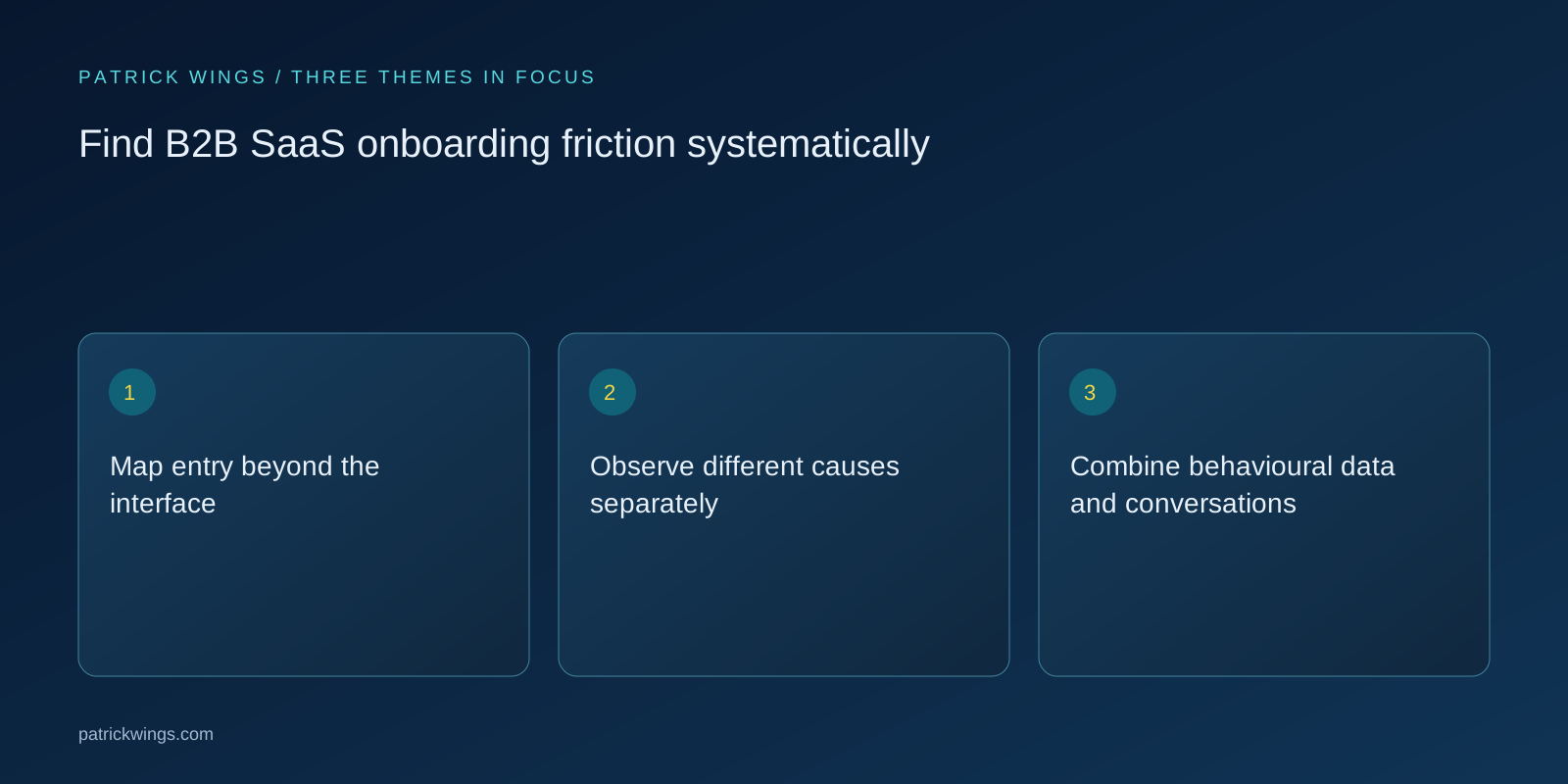
Combine behavioural data and conversations
Use event data to locate interruptions and qualitative investigation to understand possible reasons. Verify measurement first: a missing event may indicate instrumentation failure rather than actual abandonment. Segment by characteristics with a plausible effect, such as integration requirements or implementation role. Small groups often cannot support stable rankings. Add support cases and observed sessions. A useful friction record includes the affected task, observed obstacle, proposed cause and evidence. This prevents an interpretation becoming accepted fact through repeated circulation. It also shows where further investigation is needed before the team commits to a substantial redesign.
Hypothetical example: blocked import
A fictional supplier sees many interrupted data imports and initially plans more reminders. Observation shows that setup owners cannot access the required source data and do not know which internal team can help. The supplier adds clear preparation guidance identifying responsibilities and an example format. It then checks whether suitable accounts can complete the import. This example reports no measured uplift. It illustrates why an organisational prerequisite needs different treatment from forgetfulness or lack of interest, and why additional messages cannot automatically resolve a barrier that participants have no authority to remove themselves.

Prioritise improvements by impact and risk
Focus on obstacles preventing relevant participants from reaching value and connected to your responsibilities. A conspicuous but rare convenience issue may matter less than an unobtrusive permissions barrier. For each change, examine any new burden. More explanation can improve orientation or overwhelm entry. An automatic default can save effort or create incorrect data. Test targeted changes with a clear question and appropriate participants. Keep uncertain conclusions provisional. Sometimes the better solution is earlier qualification or a different implementation route, rather than simplifying a standard workflow until it no longer supports the customer situation reliably.
Distinguish friction from necessary care
Not every extra step should disappear. Security checks, explicit approval and validation of important data may be necessary. Make them understandable and timely instead of removing them merely to shorten a click path. After a change, examine errors, support needs and result quality as well as speed. Faster setup is not useful if customers later operate with incorrect configuration. Product, customer success and relevant technical owners should share responsibility for improvements. Effective onboarding lets appropriate customers begin reliably; it does not merely optimise an isolated completion rate for setup actions while moving difficulties into later work. Explore this further in the guide When product-led growth needs human assistance.
INTERACTIVE / FROM READING TO ACTION
Three checkpoints for your implementation
Choose a checkpoint and track your reading progress. Checks are neither saved nor sent and do not score your business.
CHECKPOINT 01
Combine behavioural data and conversations
Use event data to locate interruptions and qualitative investigation to understand possible reasons.
Explore in the article ↗CHECKPOINT 02
Hypothetical example: blocked import
A fictional supplier sees many interrupted data imports and initially plans more reminders.
Explore in the article ↗CHECKPOINT 03
Prioritise improvements by impact and risk
Focus on obstacles preventing relevant participants from reaching value and connected to your responsibilities.
Explore in the article ↗Frequently asked questions
Are reminders a good default?
Only when forgetting is the barrier. Permissions, data and understanding need other responses.
Should every step be shorter?
No. Necessary checks should be clear and timely rather than removed without considering consequences.
How do we investigate abandonment?
Combine verified event data with observation, support cases and open questions about the actual sequence.
How can I put “Map entry beyond the interface” into practice?
Draw the path from the initial commitment to the completed task. Include steps outside the product: preparing data, gaining approval, inviting colleagues and coordinating work. Record who acts and what information they need.
What matters when working on “Observe different causes separately”?
Distinguish unclear meaning, technical faults, missing authority and lack of priority. Someone unsure which file is required needs different support from someone unable to access it. Observe real attempts and then explore decisions at difficult points.