
THE SHORT ANSWER
Human assistance within product-led growth should remove a specific barrier and strengthen independent use. It needs explicit triggers, appropriate agreement to contact and reliable handling. A usage event is not an instruction to start selling. Design assistance as a controlled process with a clear route back to self-service, rather than an automatic transfer from product activity to a sales sequence.
To connect this decision with positioning, market entry and growth, read the pillar guide Go-to-market for B2B SaaS: turn market insight into an executable growth strategy.
Separate support needs from buying intent
Describe situations where people cannot make useful progress unaided. These may involve technical prerequisites, an unclear workflow or organisational questions. Heavy usage is not automatically a request for help, and inactivity does not establish resistance to buying. Check proposed triggers against real cases. A useful trigger connects an observed event, a plausible obstacle and an appropriate service. Preserve alternative explanations. This is the operational layer of assisted PLG: specific interventions, their prerequisites and the handling of individual cases, rather than another broad description of when product-led growth is strategically suitable. Explore this further in the guide Lead routing: assign every suitable enquiry an owner.
Make the invitation and agreement clear
Explain what assistance is offered, by whom and for what purpose. Optional help should not become a concealed requirement to speak with sales. Respect contact preferences and applicable rules for data use and communication, involving the appropriate specialists where needed. The product choice must be comprehensible: what happens when someone requests help, declines or continues independently? Avoid repeated offers that burden people after refusal. Internally, agreement to a specific support interaction must remain distinct from a general assumption of commercial interest. The handover should preserve that purpose rather than silently changing it.
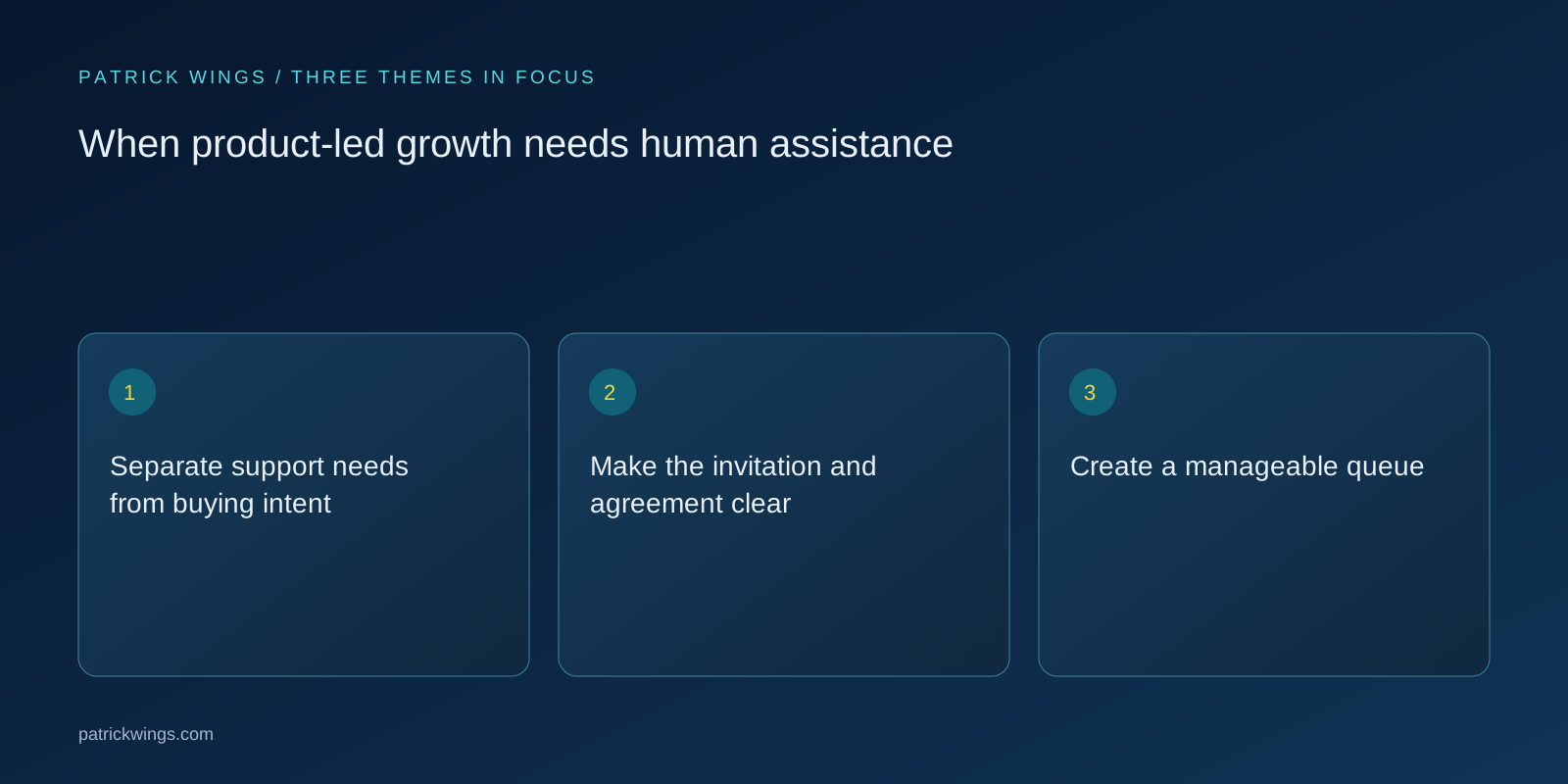
Create a manageable queue
Define which cases belong with support, customer success or sales and what context each needs. Record the trigger, observed obstacle, requested assistance and owner. Prioritise by blockage and agreed need rather than perceived company size alone. Plan capacity and visible status. An assistance button creates another problem if nobody reliably handles requests. Close unsuitable or duplicate cases transparently. Review whether you collect information unnecessary for the service or suggesting more certainty than the evidence supports. The queue should make responsibility clear and prevent the same person receiving several disconnected approaches from different teams.
Hypothetical example: configuring roles
A fictional supplier detects repeated attempts to configure roles. Rather than automatically scheduling sales contact, the product offers optional setup help. The requester explains that internal approval is missing. The case goes to appropriate specialist assistance instead of immediately entering a closing sequence. Afterwards the team receives guidance for completing setup independently. This example predicts no conversion effect. It shows triggers, agreement, routing and return to the product path working together without confusing activity with confirmed purchase intent. It also makes the customer’s actual barrier more important than the supplier’s initial interpretation of the event.

Bound the help and return learning to product
Begin each interaction with the agreed concern and establish whether it can be resolved within scope. If additional consulting or a commercial conversation becomes useful, make the change of purpose explicit. Record the outcome and next independent step. Repeated barriers should return to product or documentation owners where they can be addressed. Human assistance should not indefinitely conceal avoidable interface complexity. Equally, some help may intentionally remain part of the model when the customer task and delivery economics justify it. The important distinction is whether support is a deliberate service or an unexamined workaround.
Evaluate the complete intervention
Measure requested and handled help, resolved obstacles, recurrence and subsequent independent use. Another meeting alone is not success. Watch refusals, unsuitable repeated offers and neglected cases. Compare assisted and unassisted paths cautiously because the groups may differ before contact. GOV.UK beta guidance includes support evidence and the whole service experience; that perspective is useful here. Use findings to decide which triggers remain, which assistance belongs inside the product and which situations need a different entry route. This keeps the process responsive to customer needs rather than rewarding contact volume regardless of whether it helped. Explore this further in the guide Find B2B SaaS onboarding friction systematically.
INTERACTIVE / FROM READING TO ACTION
Three checkpoints for your implementation
Choose a checkpoint and track your reading progress. Checks are neither saved nor sent and do not score your business.
CHECKPOINT 01
Create a manageable queue
Define which cases belong with support, customer success or sales and what context each needs.
Explore in the article ↗CHECKPOINT 02
Hypothetical example: configuring roles
A fictional supplier detects repeated attempts to configure roles.
Explore in the article ↗CHECKPOINT 03
Bound the help and return learning to product
Begin each interaction with the agreed concern and establish whether it can be resolved within scope.
Explore in the article ↗Frequently asked questions
Does heavy usage authorise sales outreach?
No. Examine context and requested assistance; usage intensity alone does not confirm purchase intent.
Where should a technical obstacle go?
To an appropriate owner with context and clear responsibility, rather than automatically to sales.
When should assistance end?
When the agreed concern is resolved and the next step is clear, ideally returning to independent use.
How can I put “Separate support needs from buying intent” into practice?
Describe situations where people cannot make useful progress unaided. These may involve technical prerequisites, an unclear workflow or organisational questions. Heavy usage is not automatically a request for help, and inactivity does not establish resistance to buying.
What matters when working on “Make the invitation and agreement clear”?
Explain what assistance is offered, by whom and for what purpose. Optional help should not become a concealed requirement to speak with sales. Respect contact preferences and applicable rules for data use and communication, involving the appropriate specialists where needed.