

THE SHORT ANSWER
Preparing content for AI answers starts with presenting information precisely and making it verifiable. A useful answer states its conclusion and the conditions under which it applies. That immediately helps human readers. Whether an AI system uses a particular passage or links to it as a source remains that system’s decision and cannot be guaranteed by a writing format.
For the broader picture of technical foundations, useful content and visibility measurement, read the pillar guide SEO, GEO and AEO for SaaS: visibility that supports buying decisions.
Answer first, then explain the context
When a heading asks a specific question, answer it directly in the opening paragraph. Then explain prerequisites, exceptions and the practical method. Avoid lengthy introductions that hide the conclusion behind general market observations. For example, a question about software implementation time should first explain which factors determine the schedule. A universal number of weeks without discussing migration, integrations and approvals might look concise but would be weak advice. Precision matters more than artificial brevity, especially when a buyer may use the answer to plan an actual project.
Make individual statements understandable
Use unambiguous product names, roles and processes. A sentence such as “this reduces it significantly” becomes meaningless outside its paragraph. Explain which activity may improve through which change instead. Avoid mechanically repeating the same phrase in every sentence. The editorial task is clear reference, not constant repetition of your brand name. Tables can expose meaningful differences when criteria and limitations are explicit. They still need an explanation of how a buyer should weigh those criteria in a real selection process.
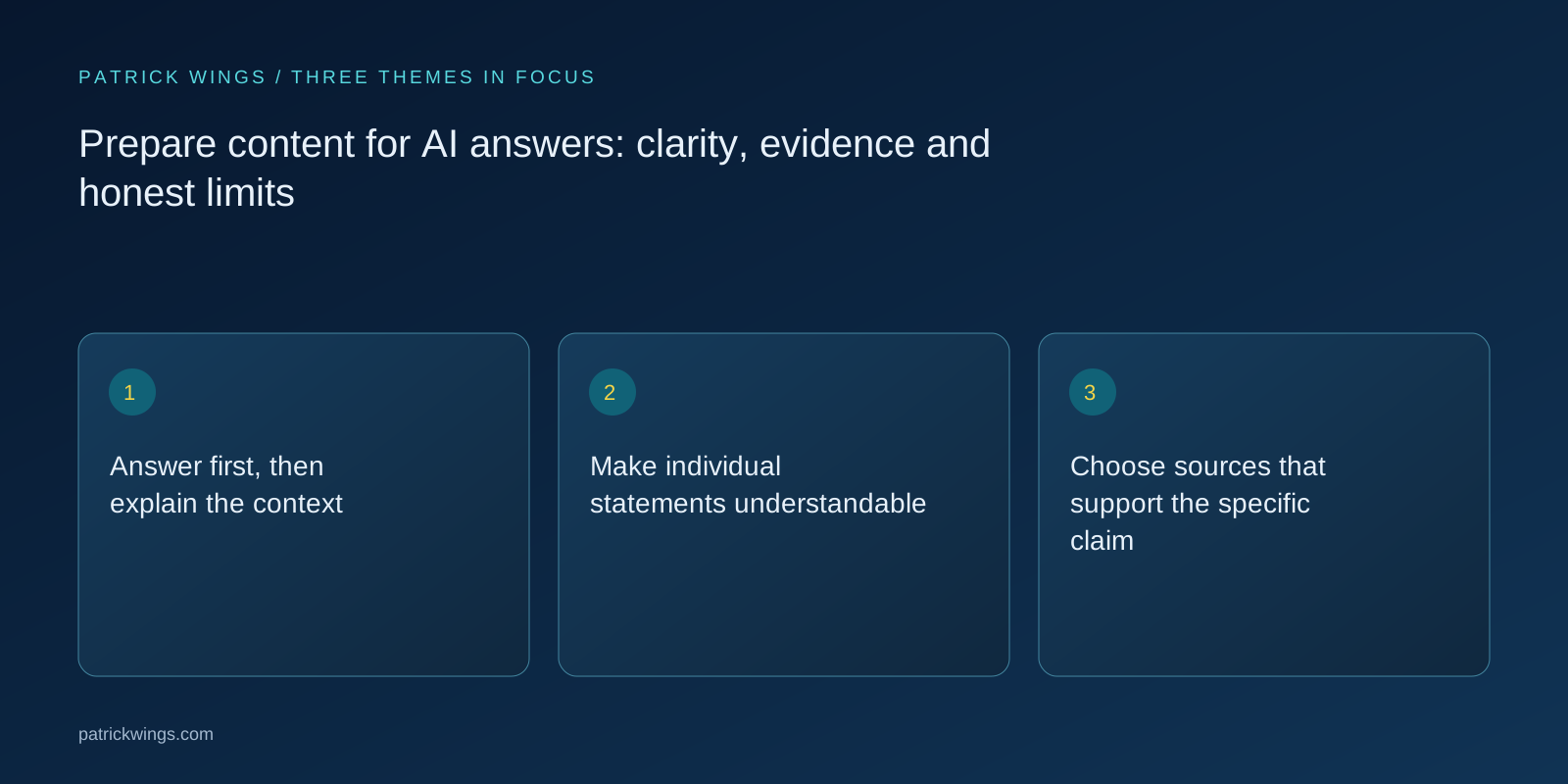
Choose sources that support the specific claim
A source should substantiate the factual statement immediately beside it. Prefer current vendor documentation for product capabilities and original research for study findings. Check publication date, population and metric definitions. A general industry overview cannot substantiate an individual customer result. When a source supports only part of a statement, separate documented information from your own interpretation. This makes the page easier for readers to verify and helps your team identify outdated or overstated claims during later reviews instead of treating every paragraph as equally reliable. Explore this further in the guide Structured data for SaaS: what schema can and cannot do.
Give first-hand experience an understandable context
Your own examples are useful when they reveal a concrete decision process. Describe the starting situation, approach, observed outcome and limitations. Confidential work may permit an anonymised example if it remains accurate and does not mislead. Constructed scenarios must be clearly labelled. Never invent metrics, customer quotations or supposed experiments. An honest qualitative observation can be more helpful than an impressive number without a measurement basis. Explain when a recommendation does not apply and which alternative might be more appropriate in those circumstances.

Connect editorial quality with accessibility
Even excellent writing is of limited use to search systems if the page is unavailable or the main content is not reliably delivered. Check important text, functioning links and access for relevant search crawlers. OpenAI provides separate controls for search and potential training use, so make that choice deliberately. Allowing access does not automatically make your page a preferred source or guarantee reuse. Technical availability and editorial credibility serve different purposes within the same strategy, and both deserve explicit ownership rather than assumptions that the other team has handled them.
Treat changes as testable hypotheses
When you clarify a section or add stronger evidence, record the change and its rationale. Then monitor relevant search data, customer questions and, where useful, a consistent sample of AI prompts. Avoid conclusions from one positive result. Answers can vary by system, context and time. A useful review therefore asks first whether the information became more valuable for customers. Observed citations are an additional finding, not retrospective proof that a particular paragraph length or wording caused the outcome. Keep that distinction visible when reporting the work. Explore this further in the guide FAQs on SaaS websites: answer real questions instead of hiding keywords.
INTERACTIVE / FROM READING TO ACTION
Three checkpoints for your implementation
Choose a checkpoint and track your reading progress. Checks are neither saved nor sent and do not score your business.
CHECKPOINT 01
Choose sources that support the specific claim
A source should substantiate the factual statement immediately beside it.
Explore in the article ↗CHECKPOINT 02
Give first-hand experience an understandable context
Your own examples are useful when they reveal a concrete decision process.
Explore in the article ↗CHECKPOINT 03
Connect editorial quality with accessibility
Even excellent writing is of limited use to search systems if the page is unavailable or the main content is not reliably delivered.
Explore in the article ↗Frequently asked questions
Should answers always be very short?
No. A direct conclusion helps, but complex questions require conditions, examples and limitations. Brevity should not reduce accuracy.
Should we use external studies or our own data?
Both can be useful. Choose credible sources and explain the method, period and limitations of your own data.
Does a clear answer guarantee AI citation?
No. Structure improves understanding. The system decides whether to select a source.
How can I put “Answer first, then explain the context” into practice?
When a heading asks a specific question, answer it directly in the opening paragraph. Then explain prerequisites, exceptions and the practical method. Avoid lengthy introductions that hide the conclusion behind general market observations.
What matters when working on “Make individual statements understandable”?
Use unambiguous product names, roles and processes. A sentence such as “this reduces it significantly” becomes meaningless outside its paragraph. Explain which activity may improve through which change instead.