
THE SHORT ANSWER
An FAQ is useful when it resolves a real uncertainty faster than another lengthy section. On SaaS websites, those questions often concern prerequisites, integrations, implementation and working arrangements. An FAQ should not be a collection of artificial search phrases. Choose questions from real conversations and answer them in a way that improves the reader’s next decision.
For the broader picture of technical foundations, useful content and visibility measurement, read the pillar guide SEO, GEO and AEO for SaaS: visibility that supports buying decisions.
Collect questions from real customer touchpoints
Sales, support and customer success encounter different uncertainties. Ask about recurring questions before a demo, during evaluation and shortly before signing. Record the actual wording and why the answer matters. “How does integration work?” may concern effort, supported data or internal responsibilities. Separate those needs instead of writing one general answer for all of them. Add questions from enquiry forms and consulting conversations. The quality of this collection matters more than its size, because every published answer should resolve a recognisable issue.
Put the question on the appropriate page
A question about working arrangements belongs on a consulting or service page. A detailed technical question may require its own documentation. Article FAQs should relate to the subject and resolve outstanding points. Avoid copying identical general answers beneath every post. When one explanation applies across many pages, link to a central resource and provide a short local context. This reduces contradictions and maintenance work without making visitors search through a long universal list that mixes unrelated product, commercial and editorial questions together.
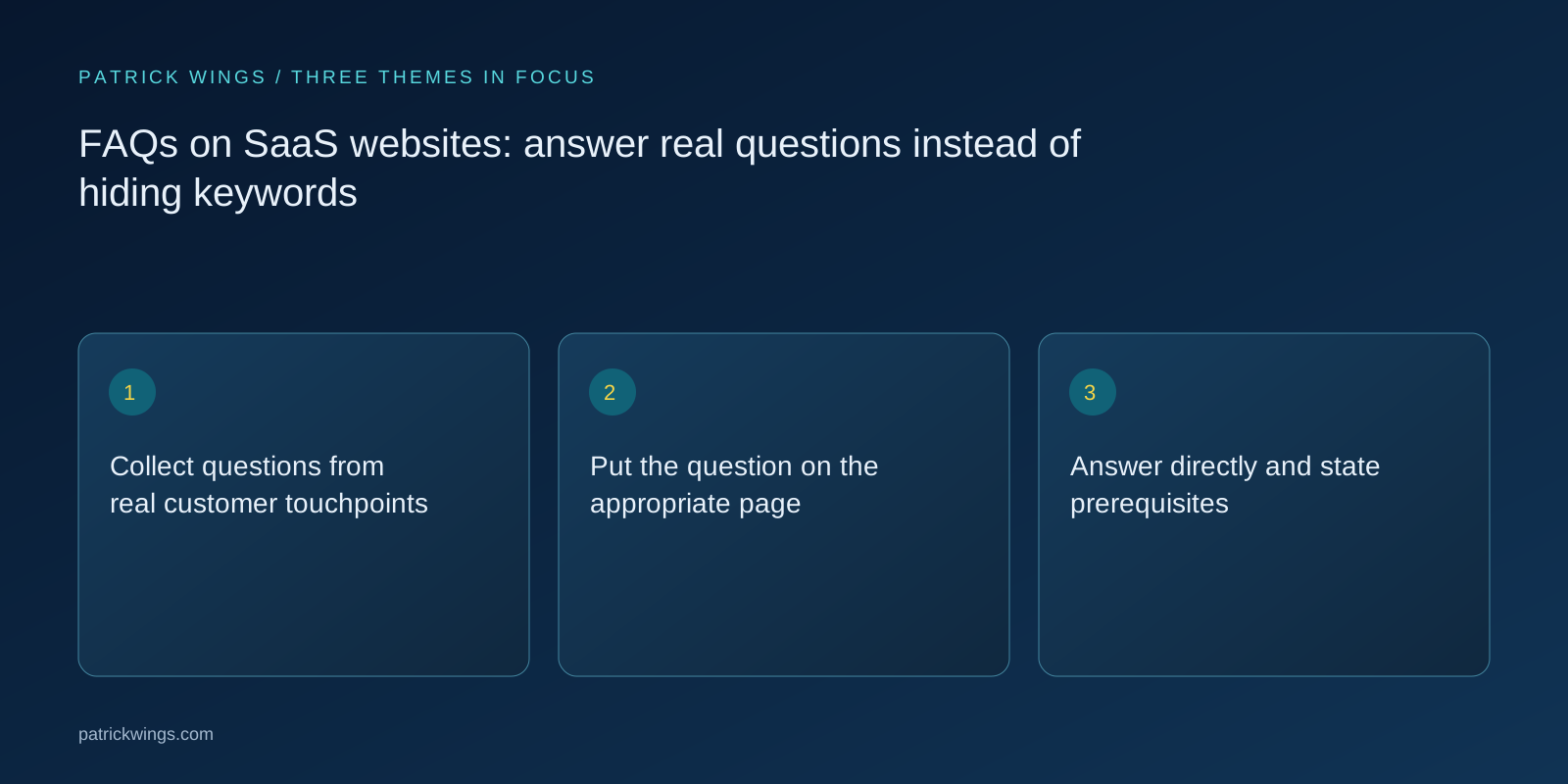
Answer directly and state prerequisites
Begin with a clear conclusion, then add the condition under which it applies and, when useful, a next step. A simple “yes” to “can we keep our existing CRM?” is unhelpful if only certain interfaces are supported. Name the relevant limitation or explain which details are required for an assessment. An answer may be brief without creating false certainty. Avoid sales slogans that merely repeat the objection and ask for another conversation. Readers should learn something useful before being invited to contact your team.
Set realistic expectations for search and AI
FAQ content can help visitors and make relevant answers explicit. It does not guarantee a particular search appearance or AI citation. According to its official documentation history, Google discontinued the FAQ rich result feature in May 2026 and later removed its related guidance. Build an FAQ section for its usefulness on the page. If structured data is used, it must reflect visible content. Technical validity is different from support for a particular search feature or selection within a generative answer. Keep those distinctions clear when discussing expected outcomes.

Check mobile interaction and accessibility
For expandable answers, make questions easy to recognise and controls usable with a keyboard. Verify that complete answers are actually present in the page content and appear reliably. A visual accordion should not make important information dependent on a fragile extra request. Plain expanded text may be clearer for a short list. Choose the format according to the volume and reader’s task. Essential product limitations should also appear in the main explanation rather than being available only in an easily missed section at the bottom of the page.
Maintain FAQs as part of the offer
Assign a subject owner to each answer, especially those concerning prices, integrations and contractual requirements. Update every affected page when a central statement changes. Notice which questions still recur despite the FAQ. The wording may be unclear or the information may be in the wrong place. Remove obsolete questions and add new ones when there is a demonstrated need. A compact, current section is more useful than an apparently complete collection nobody reviews. The best FAQ improves conversations without pretending to replace necessary individual assessment. Explore this further in the guide B2B search intent: which page does your SaaS buyer need?.
INTERACTIVE / FROM READING TO ACTION
Three checkpoints for your implementation
Choose a checkpoint and track your reading progress. Checks are neither saved nor sent and do not score your business.
CHECKPOINT 01
Answer directly and state prerequisites
Begin with a clear conclusion, then add the condition under which it applies and, when useful, a next step.
Explore in the article ↗CHECKPOINT 02
Set realistic expectations for search and AI
FAQ content can help visitors and make relevant answers explicit.
Explore in the article ↗CHECKPOINT 03
Check mobile interaction and accessibility
For expandable answers, make questions easy to recognise and controls usable with a keyboard.
Explore in the article ↗Frequently asked questions
How many questions should a page include?
As many as there are relevant unresolved questions. Three precise answers can be more useful than a long list of generic statements.
Do we need FAQ markup for enhanced Google displays?
Google states that its FAQ rich result feature ended in May 2026. Build FAQs for visitors and check current platform guidance.
Should answers be expanded or collapsed?
That depends on length and use. Either format must be understandable, accessible and technically reliable.
How can I put “Collect questions from real customer touchpoints” into practice?
Sales, support and customer success encounter different uncertainties. Ask about recurring questions before a demo, during evaluation and shortly before signing. Record the actual wording and why the answer matters.
What matters when working on “Put the question on the appropriate page”?
A question about working arrangements belongs on a consulting or service page. A detailed technical question may require its own documentation. Article FAQs should relate to the subject and resolve outstanding points.