

THE SHORT ANSWER
Design filter navigation by separating useful user controls from the limited set of filtered pages that deserve independent search visibility. Define permitted URL combinations, stable ordering and empty-state behaviour before exposing every combination as a link. This preserves useful navigation while reducing avoidable crawling and maintenance of near-duplicate or nonsensical addresses.
For the broader picture of technical foundations, useful content and visibility measurement, read the pillar guide SEO, GEO and AEO for SaaS: visibility that supports buying decisions.
Map the space your filters can create
List every filter, sort order, page selector and tracking parameter, including defaults. Identify which combinations change substantive content and which merely rearrange the same items. Inspect repeated parameters, alternative ordering and invalid values because each can create additional addresses without additional usefulness. Estimate the shape of the URL space from actual rules rather than reporting an invented page count. Review logs to see which combinations crawlers already request. A modest visible interface can generate an extensive address space when independent controls combine freely.
Select landing pages around genuine demand
Choose independently discoverable filtered pages only when they serve a clear audience need and can maintain a useful result set. Give those pages stable addresses, descriptive headings and relevant contextual information. Explain how the selected items meet the need instead of copying a generic category introduction. Assign responsibility for reviewing the page when inventory changes. Search demand alone does not justify keeping an empty collection alive. Conversely, a valuable niche page may deserve a deliberate editorial route rather than being left as an accidental parameter combination. Explore this further in the guide Prioritising crawl budget on large SaaS websites.
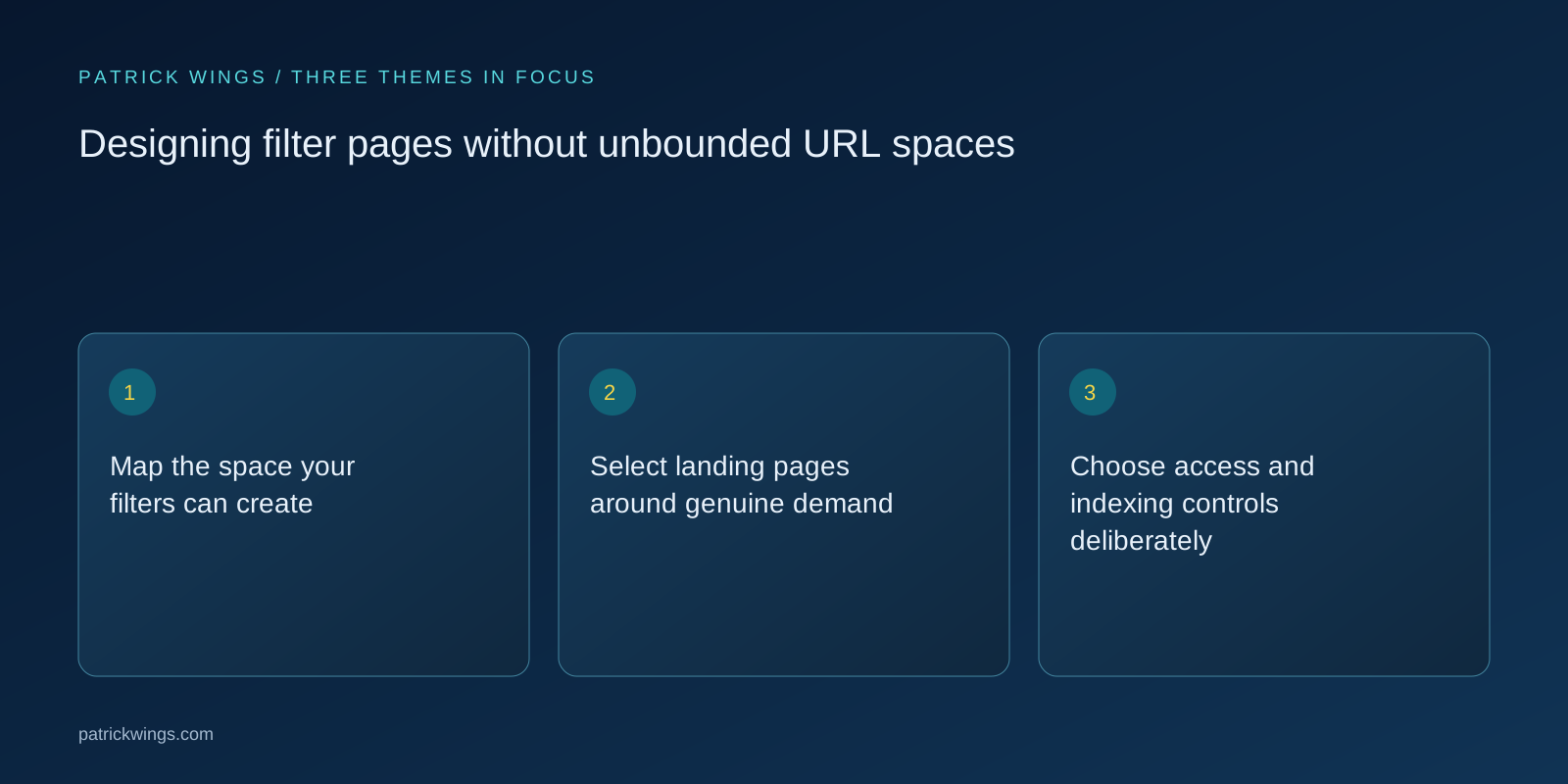
Choose access and indexing controls deliberately
When arbitrary combinations have no search purpose, Google’s faceted-navigation guidance describes preventing their crawling as an option. Define precise patterns and test that valuable item pages remain reachable. Remember that crawl blocking and index exclusion are different goals; an already known blocked URL can still be referenced in search. Canonical annotations can describe equivalent variants but are not a dependable immediate crawl-budget switch. If you need noindex to be read, the relevant crawler must be able to fetch the resource containing that directive. Explore this further in the guide Running canonical audits on SaaS websites.
Make valid and invalid states predictable
Use consistent parameter conventions and ordering so equivalent selections do not generate unnecessary permutations. Prevent duplicate filters and meaningless values. For nonexistent or nonsensical combinations, implement an appropriate not-found response rather than redirecting every address to a generic page. Follow the documented guidance for the application architecture you use. Test browser history, shared links and direct navigation because a clean crawl policy should still support real users. Do not silently change a visitor’s requested selection in a way that misrepresents available results or hides a failed query.

Illustrative example: a software partner library
Imagine an illustrative partner library with industry, integration and region filters. The team selects a maintained healthcare integration collection as a useful landing page, while arbitrary multi-filter combinations remain interface states without an independent search objective. It defines stable selection rules and tests nonexistent pages beyond the available results. Product detail pages remain discoverable through ordinary links. This example demonstrates a bounded design; it does not establish that blocking filters always increases traffic or that every industry combination should become a separate SEO article.
Review crawling and reader outcomes together
After release, compare log patterns, important-page discovery and user journeys with the documented design. Investigate whether a new parameter or sorting widget recreates uncontrolled permutations. Check that useful collections still contain relevant items and that their headings accurately describe the result set. Revisit decisions when the product catalogue or buyer needs change. Success means bounded, understandable states and accessible valuable content. Lower crawl volume alone is insufficient if readers lose necessary navigation or important pages become orphaned. Search engines still decide what to index and rank from the accessible material.
INTERACTIVE / FROM READING TO ACTION
Three checkpoints for your implementation
Choose a checkpoint and track your reading progress. Checks are neither saved nor sent and do not score your business.
CHECKPOINT 01
Choose access and indexing controls deliberately
When arbitrary combinations have no search purpose, Google’s faceted-navigation guidance describes preventing their crawling as an option.
Explore in the article ↗CHECKPOINT 02
Make valid and invalid states predictable
Use consistent parameter conventions and ordering so equivalent selections do not generate unnecessary permutations.
Explore in the article ↗CHECKPOINT 03
Illustrative example: a software partner library
Imagine an illustrative partner library with industry, integration and region filters.
Explore in the article ↗Frequently asked questions
Should every filter be indexed?
No. Select independently useful destinations and treat the remaining combinations according to their actual purpose.
Does canonical immediately stop crawling?
No. It expresses a preferred representative and is not an immediate access restriction.
What about empty combinations?
Distinguish legitimate temporary states from nonexistent or nonsensical URLs and implement the appropriate response using the documented platform guidance.
How can I put “Map the space your filters can create” into practice?
List every filter, sort order, page selector and tracking parameter, including defaults. Identify which combinations change substantive content and which merely rearrange the same items. Inspect repeated parameters, alternative ordering and invalid values because each can create additional addresses without additional usefulness.
What matters when working on “Select landing pages around genuine demand”?
Choose independently discoverable filtered pages only when they serve a clear audience need and can maintain a useful result set. Give those pages stable addresses, descriptive headings and relevant contextual information. Explain how the selected items meet the need instead of copying a generic category introduction.