
THE SHORT ANSWER
A useful AI approval presents a concrete executable operation with its target, content, evidence and consequences. The reviewer should understand what will happen after agreeing. Bind approval to that version and check whether relevant conditions changed before execution. This makes approval a professional decision rather than a routine click on an unclear summary of an operation that has not yet been fully prepared.
To connect individual AI applications with reliable marketing operations, read the pillar guide AI transformation in B2B marketing: from individual prompts to reliable operations.
Show the change in the reviewer’s language
Start with the intended effect: which field receives which value, which message goes to whom or which draft is published. Include existing values and a readable preview. Technical identifiers help establish identity but cannot replace business meaning. Reviewers should not need to compare raw records to recognise a budget change or external commitment. When several changes are proposed, show their scope and material differences separately. Do not conceal a consequential individual action inside a broad approval of a large package whose summary emphasises less important or routine adjustments.
Supply evidence and unresolved issues
A good preview includes sources or system observations supporting the proposed action. Mark unsupported details, uncertainty and missing prerequisites where they affect the decision. Avoid a polished recommendation that omits contradictory information. Reviewers need to see what has been checked and what remains for their judgment. Separate factual review from stylistic choice: an appropriate tone does not justify an unsupported product claim. For complex cases, approve a bounded component while other components wait for clarification and remain ineligible for execution. Make that partial approval visible in both the preview and stored state. Explore this further in the guide AI team ownership: who decides, reviews and operates?.
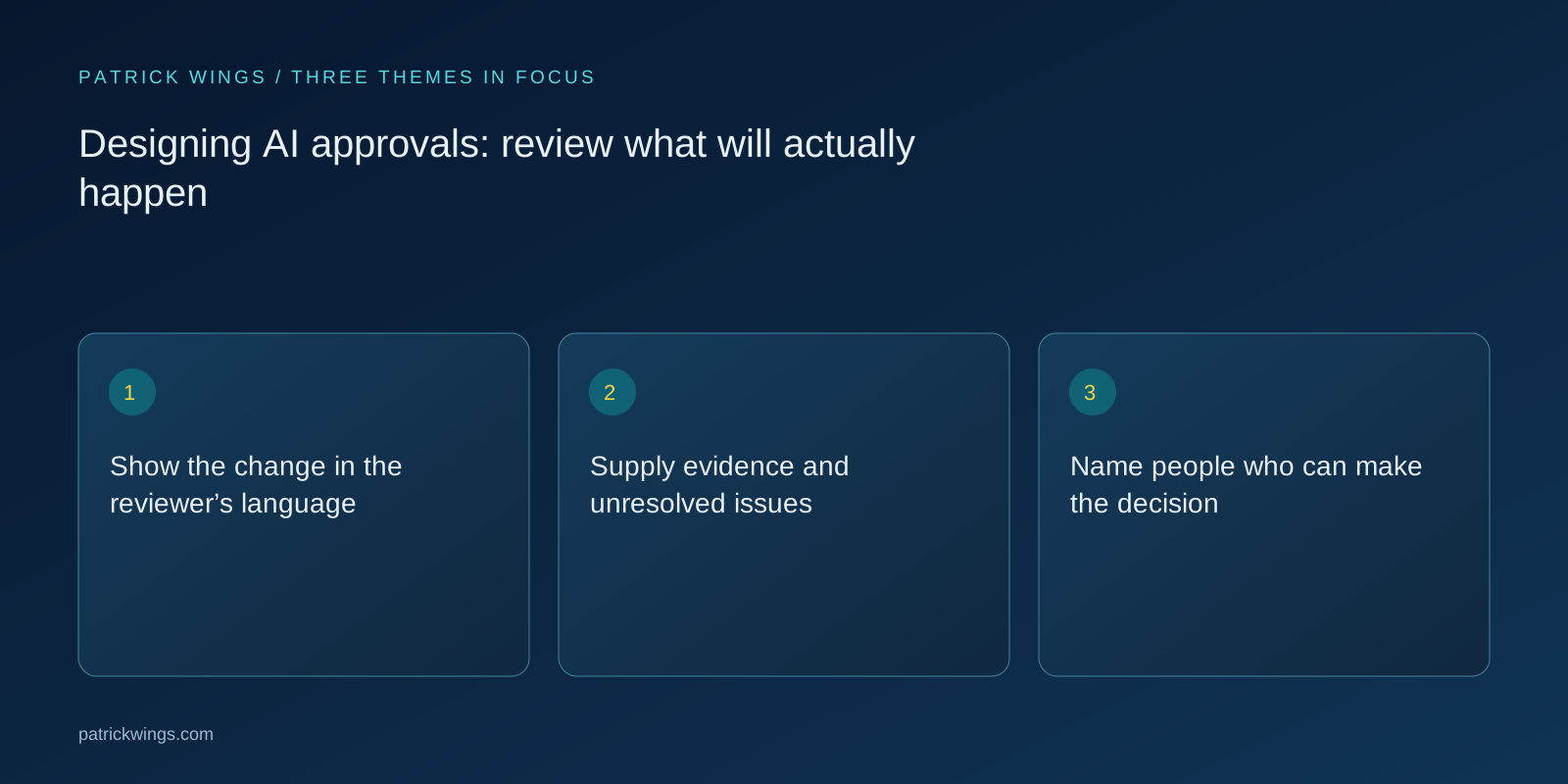
Name people who can make the decision
Specify who may make each kind of professional decision and has the necessary context. A colleague may review an internal wording suggestion without having authority to change contract details. Check real availability and name a substitute. When nobody owns the decision, use an explicit waiting state rather than automatic consent after a timeout. Define how questions and rejections are recorded. A rejection should support a next step, such as supplying a source or removing a statement, rather than leaving an unexplained failure that the agent or operator must guess how to resolve.
Bind consent to content and target conditions
Record the exact version approved and the relevant destination conditions at that point. Immediately before execution, check that content, recipient and affected record still match. Changes made after approval must not silently inherit it. Depending on their consequences, they may require renewed review. Apply the same discipline to long delays, expired sources and target objects edited in the meantime. Technically, execution should reject an invalid or mismatched approval reference rather than relying on the agent’s general claim that someone agreed earlier or that the new version is essentially equivalent.

Walk through a fictional sending case
A fictional agent prepares an email about a product change. The preview includes the recipient, subject, complete text, product source and notice that a date remains unresolved. The reviewer approves only the version without that commitment. If the agent subsequently adds a new date, the approval no longer matches. This hypothetical example shows why agreement with an intention does not automatically cover every later wording. A completed draft and an approved send remain separate evidenced states in the process, even when both concern the same conversation and business objective. Explore this further in the guide Editorial approvals with clear responsibilities and bounded review.
Check whether review actually works
Test whether real reviewers can correctly restate the destination, change and unresolved issues after inspecting the preview. Introduce deliberately wrong recipients, unsupported statements and altered versions in controlled test cases. Verify that these cases stop. Also examine unnecessary approvals: requiring confirmation for every harmless intermediate step can reduce attention to important decisions. Remove interruptions already covered by existing authorisation and improve concrete previews. Measure detected defects and corrections after approval as well as approval counts, because a high volume of clicks alone says little about the quality of professional oversight.
INTERACTIVE / FROM READING TO ACTION
Three checkpoints for your implementation
Choose a checkpoint and track your reading progress. Checks are neither saved nor sent and do not score your business.
CHECKPOINT 01
Name people who can make the decision
Specify who may make each kind of professional decision and has the necessary context.
Explore in the article ↗CHECKPOINT 02
Bind consent to content and target conditions
Record the exact version approved and the relevant destination conditions at that point.
Explore in the article ↗CHECKPOINT 03
Walk through a fictional sending case
A fictional agent prepares an email about a product change.
Explore in the article ↗Frequently asked questions
What should an approval show at minimum?
The exact operation, destination, content, relevant evidence and foreseeable side effects.
Does approval survive a text change?
Only to the extent existing authorisation covers that specific change; material changes require renewed review.
Should silence automatically mean consent?
For consequential actions, an explicit waiting state with named ownership provides a more reviewable design.
How can I put “Show the change in the reviewer’s language” into practice?
Start with the intended effect: which field receives which value, which message goes to whom or which draft is published. Include existing values and a readable preview. Technical identifiers help establish identity but cannot replace business meaning.
What matters when working on “Supply evidence and unresolved issues”?
A good preview includes sources or system observations supporting the proposed action. Mark unsupported details, uncertainty and missing prerequisites where they affect the decision. Avoid a polished recommendation that omits contradictory information.