
THE SHORT ANSWER
Map migration redirects by comparing the task of the old URL with the answer at the new destination. Prefer a direct route to the most suitable maintained equivalent, and explicitly record cases with no replacement. A technically valid redirect can still fail readers when its destination does not fulfil the original promise.
For the broader picture of technical foundations, useful content and visibility measurement, read the pillar guide SEO, GEO and AEO for SaaS: visibility that supports buying decisions.
Use the approved inventory as input
Begin with source URLs whose current purpose, status and dependencies are understood. Include important historical aliases and existing redirect destinations so a new mapping does not accidentally extend old chains. Separate known canonical content from tracking variants, while preserving exceptions that change meaning. Assign editorial review for ambiguous matches. A filename resemblance or shared slug can suggest a candidate but cannot establish equivalence. Record the migration version and owners so the mapping remains a controlled release input rather than a spreadsheet copied between teams without clear authority. Explore this further in the guide Starting an SEO migration with a dependable URL inventory.
Match the reader task before the path
Read the old answer and the proposed successor. Compare subject, audience, implementation depth and required action. A broad category page may be useful navigation but still fail to replace a specific troubleshooting guide. When several old articles consolidate, confirm that the destination preserves their useful tasks and evidence. For language moves, preserve the appropriate language where an equivalent exists. Keep a short rationale for non-obvious decisions. This gives reviewers something stronger to assess than a numerical similarity score generated from titles or a bulk rule based only on folder names. Explore this further in the guide Consolidating similar content without losing useful answers.
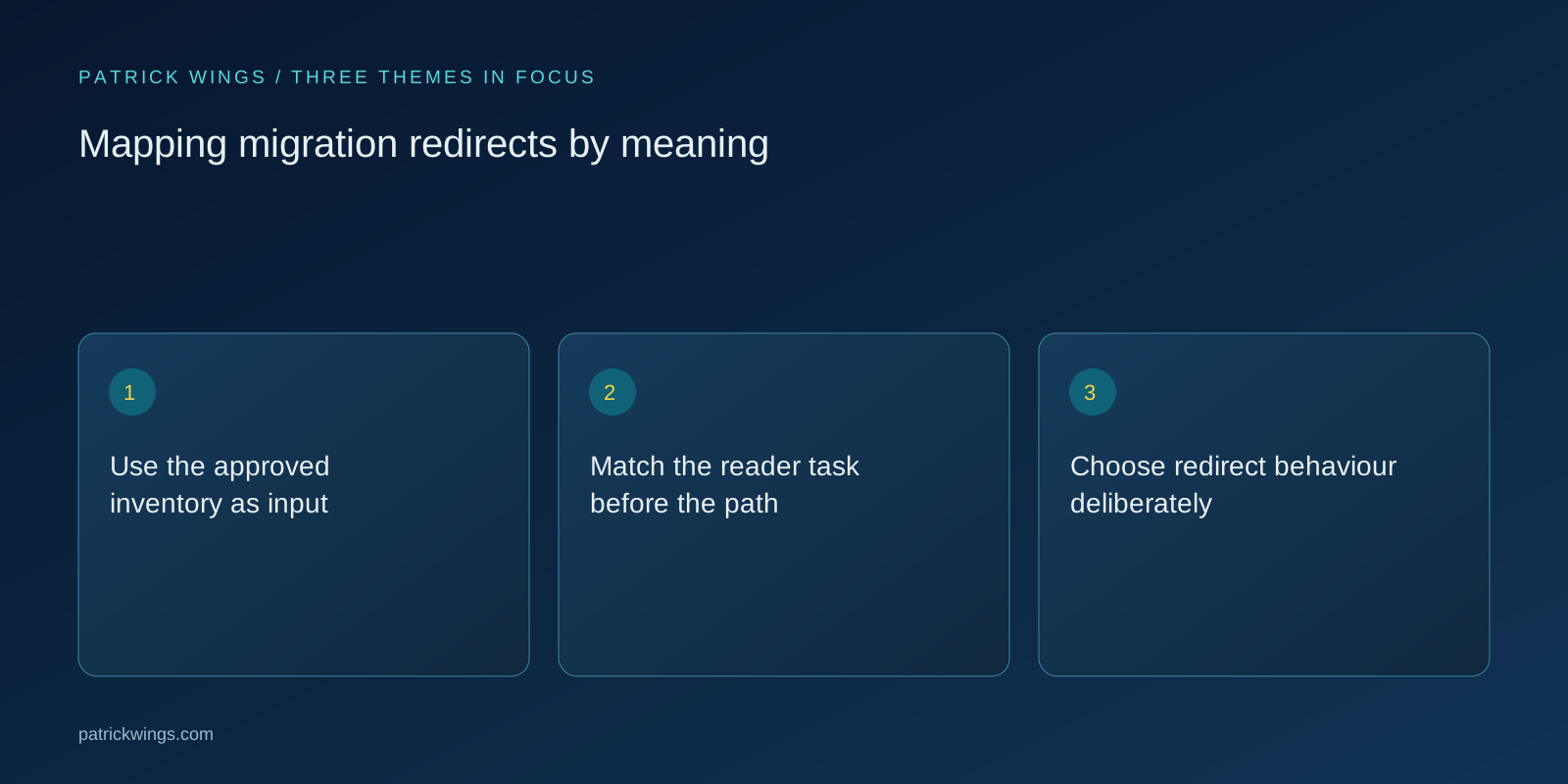
Choose redirect behaviour deliberately
Use a suitable permanent server-side redirect when the move is permanent, following the platform’s documented implementation. Point directly to the final destination and prevent loops. Temporary redirects serve different operational situations, so do not select status codes merely because the CMS exposes one convenient button. Check query handling: attribution parameters may be retained or deliberately removed, but parameters that determine content need careful treatment. Where no genuine replacement exists, plan an appropriate removal response rather than forcing every source into the homepage or a generic catch-all destination.
Validate the map before deployment
Check duplicate sources, conflicting targets, missing destinations and targets that themselves redirect or fail. Test a representative sample from each rule and all high-consequence exceptions. Verify that production hostnames and secure URLs are used, not staging addresses. Compare destination content as well as response codes. Test unknown URLs separately so a catch-all rule does not redirect arbitrary typos to an unrelated page. Update internal links, sitemaps, canonicals and language annotations to final destinations, reducing reliance on redirects for navigation you directly control.

Illustrative example: reorganising integration guides
Imagine an illustrative migration that moves an old CRM setup guide into a new integration library. The new setup guide is a suitable direct destination; the library homepage is not equally useful. A separate troubleshooting article remains independent because its steps are absent from the setup guide. An expired product announcement has no meaningful successor and receives a deliberate removal treatment. This example demonstrates semantic mapping, not a guarantee of preserved rankings. Each relationship still needs content review and testing under the actual hosting configuration before launch.
Monitor mismatches after launch
Check requests to important old URLs, failed destinations and unexpected redirect chains. Review reader reports of landing on irrelevant pages, even when technical checks show successful responses. Keep the mapping and original rationale available for corrections. Maintain redirects for the period appropriate to the migration and documented search guidance rather than deleting them as soon as initial traffic declines. Success means old links lead to the best available equivalent without unnecessary detours. Search engines need time to process moves, and no map can guarantee unchanged visibility when the content or broader market also changes.
INTERACTIVE / FROM READING TO ACTION
Three checkpoints for your implementation
Choose a checkpoint and track your reading progress. Checks are neither saved nor sent and do not score your business.
CHECKPOINT 01
Choose redirect behaviour deliberately
Use a suitable permanent server-side redirect when the move is permanent, following the platform’s documented implementation.
Explore in the article ↗CHECKPOINT 02
Validate the map before deployment
Check duplicate sources, conflicting targets, missing destinations and targets that themselves redirect or fail.
Explore in the article ↗CHECKPOINT 03
Illustrative example: reorganising integration guides
Imagine an illustrative migration that moves an old CRM setup guide into a new integration library.
Explore in the article ↗Frequently asked questions
Can every old URL go to the homepage?
That usually fails the specific reader task. Choose a meaningful equivalent or a deliberate removal response.
Are matching slugs enough?
No. Compare the actual answers and audiences before approving the match.
Should internal links keep using old URLs?
Update controlled links to final destinations rather than relying on avoidable redirect hops.
How can I put “Use the approved inventory as input” into practice?
Begin with source URLs whose current purpose, status and dependencies are understood. Include important historical aliases and existing redirect destinations so a new mapping does not accidentally extend old chains. Separate known canonical content from tracking variants, while preserving exceptions that change meaning.
What matters when working on “Match the reader task before the path”?
Read the old answer and the proposed successor. Compare subject, audience, implementation depth and required action. A broad category page may be useful navigation but still fail to replace a specific troubleshooting guide.