
THE SHORT ANSWER
Product marketing connects a product’s capabilities with the work its buyers need to accomplish. It covers more than feature announcements. It gives customers, sales and marketing a consistent explanation of value, appropriate use and differentiation.
To connect this decision with positioning, market entry and growth, read the pillar guide Go-to-market for B2B SaaS: turn market insight into an executable growth strategy.
Collect unresolved commercial questions
Do not begin with a wish list of new assets. Start with questions that recur in real customer interactions. Does the audience understand the application? Is a feature being mistaken for something the product cannot do? Can prospective customers explain the difference from their current approach? Use sales notes, support questions and product discussions to identify those gaps. Associate each question with a concrete buying decision. An illustrative example might be uncertainty about whether planning software remains useful with incomplete inputs. That requires a clear explanation and evidence, rather than another general product brochure that avoids the actual concern. Explore this further in the guide Sales enablement for B2B SaaS: support buying decisions with relevant evidence.
Create a shared messaging foundation
For a prioritised segment, record the problem, current alternative, product contribution and strongest evidence. Add expectations you cannot fulfil. Keep this foundation short enough for people to use in daily work. Different roles can receive different emphasis, but the underlying promise must remain consistent. Use customer language and check whether outsiders understand the relationship. An internal feature name rarely explains value by itself. Develop website, advertisement and presentation versions only after clarifying the foundation. Otherwise every additional activity multiplies the original ambiguity and makes it more difficult to identify the source of inconsistent expectations later in the buying journey. Explore this further in the guide B2B SaaS positioning: a clear buying perspective beyond interchangeable claims.
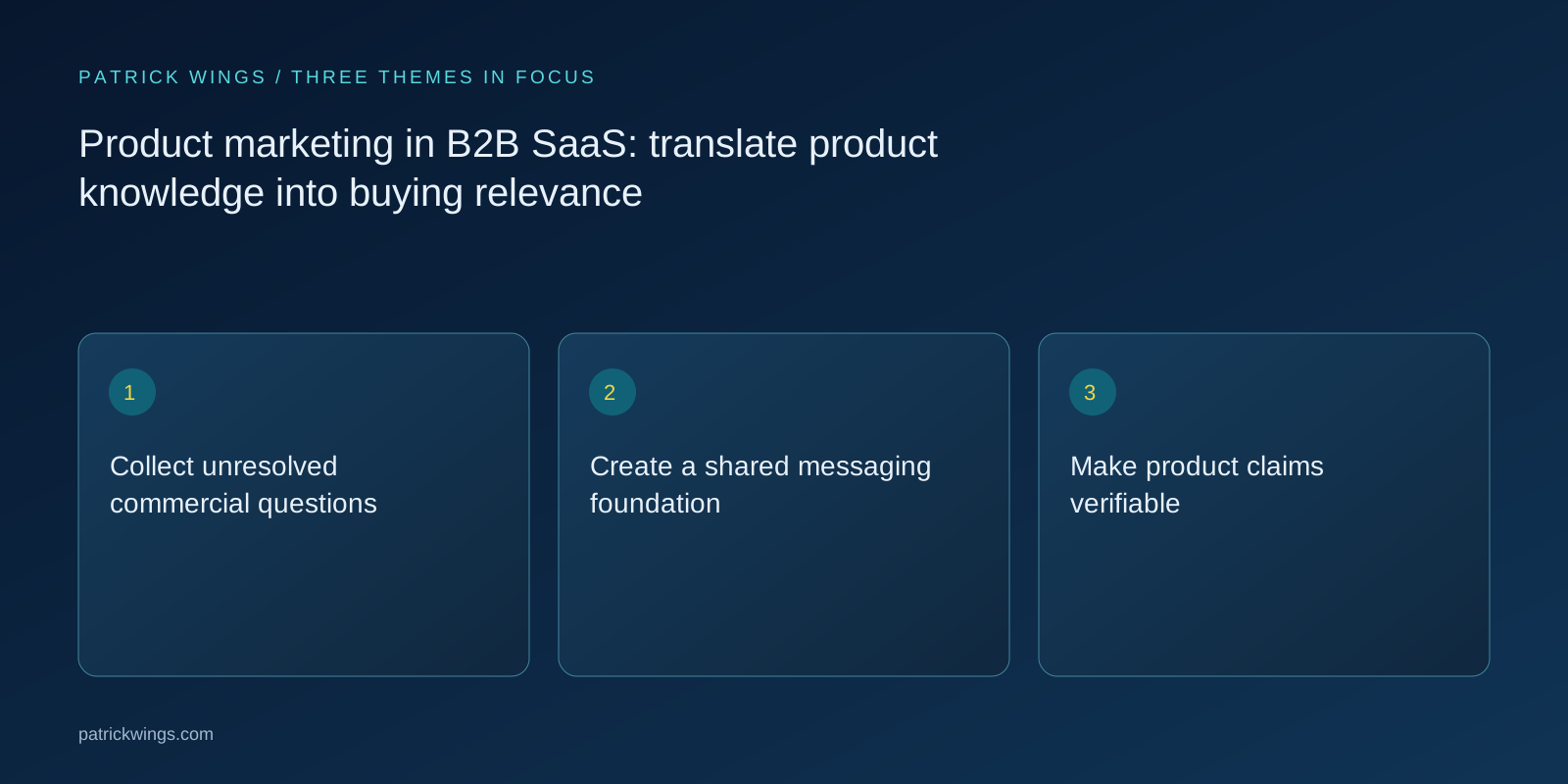
Make product claims verifiable
Each important statement needs an appropriate basis. That could be a genuine product view, an understandable workflow or an approved customer example. Separate existing capabilities from planned additions and individual professional services. An illustrative scenario can explain an application but should not resemble a documented customer outcome. Agree a simple approval process for technical claims with product owners. Record relevant prerequisites, such as available integrations or necessary data quality. This keeps communication useful and reliable when multiple teams produce material or functionality changes. The objective is not cumbersome review; it is preventing attractive wording from creating commitments the product cannot meet.
Develop resources around buying tasks
An early conversation needs a clear problem explanation. Technical evaluation requires different information from internal budget approval. Plan resources around those tasks rather than a fixed catalogue of formats. A short integration overview, evaluation guide or understandable demonstration can be more useful than a large brochure. Establish who will use the resource and where it helps a conversation. Involve sales in prioritisation without automatically turning every individual request into a new document. Shared components keep claims consistent and make updates easier. Also consider material customers can forward internally, since the person meeting your team may need to explain the product to colleagues afterwards.

Feed real usage back into the work
Check which resources people actually use and which questions remain afterwards. Usage alone does not establish commercial impact, but it provides a starting point for discussion. Ask sales for concrete situations instead of general opinions such as “the deck is too long”. The missing piece might be an integration answer or a sequence that does not fit the conversation. Add evidence from customer interviews and product usage. Record whether a problem requires better explanation, a product change or a different audience. Product marketing should be able to expose mismatches rather than cover every weakness with more persuasive wording that increases the gap between expectation and experience.
Organise ownership and maintenance
Assign ownership of the shared message and named counterparts in product, sales and customer success. Establish a simple review rhythm and triggers for urgent changes. Identify obsolete resources and make the current version easy to find. When functionality changes, clarify which pages, demonstrations and conversation aids need attention. Assess the work through useful objectives such as clearer buying decisions and consistent claims. Counting produced assets alone can distract from the purpose. Well-organised product marketing helps the business explain relevant product truths consistently and reliably, while ensuring that customer feedback can influence both communication and the underlying commercial offer.
INTERACTIVE / FROM READING TO ACTION
Three checkpoints for your implementation
Choose a checkpoint and track your reading progress. Checks are neither saved nor sent and do not score your business.
CHECKPOINT 01
Make product claims verifiable
Each important statement needs an appropriate basis.
Explore in the article ↗CHECKPOINT 02
Develop resources around buying tasks
An early conversation needs a clear problem explanation.
Explore in the article ↗CHECKPOINT 03
Feed real usage back into the work
Check which resources people actually use and which questions remain afterwards.
Explore in the article ↗Frequently asked questions
Is product marketing the same as content marketing?
No. Product marketing clarifies the market, product relevance and messaging. Content marketing develops useful resources for audiences. The functions work closely together.
Does a small SaaS team need a dedicated hire?
Not necessarily, but the work needs clear ownership and access to product, sales and customers.
Which resources should be produced first?
Those addressing an important recurring buying decision that is currently poorly supported. Prioritise using real cases.
How can I put “Collect unresolved commercial questions” into practice?
Do not begin with a wish list of new assets. Start with questions that recur in real customer interactions. Does the audience understand the application?
What matters when working on “Create a shared messaging foundation”?
For a prioritised segment, record the problem, current alternative, product contribution and strongest evidence. Add expectations you cannot fulfil. Keep this foundation short enough for people to use in daily work.