
THE SHORT ANSWER
Sales enablement should help sellers and buyers make concrete decisions. It needs understandable information at the right moment rather than the largest possible collection of resources. The work connects customer insight, product knowledge and an explainable conversation process.
To connect this decision with positioning, market entry and growth, read the pillar guide Go-to-market for B2B SaaS: turn market insight into an executable growth strategy.
Begin with real conversation obstacles
Collect situations where suitable opportunities stop progressing or unnecessary questions arise. Work with sales to identify what information is actually missing. Unclear value, an integration concern and an unsuitable contact are different problems. A new presentation will not solve all of them. An illustrative IT team might find that business users understand the product but cannot explain it to their own technical colleagues. A concrete architecture overview then becomes relevant. Use real examples rather than a wish list of documents. Prioritise the obstacle that most limits an important buying decision today and establish what better support would allow the buyer or salesperson to do next. Explore this further in the guide Planning a B2B SaaS launch: connect market communication with operational readiness.
Build discovery as an understandable framework
Develop questions that clarify the problem, current approach and desired change. Add relevant prerequisites and participating roles. A conversation guide should provide direction rather than create a rigid interrogation. Explain why a question matters for evaluating suitability. Keep confirmed statements separate from assumptions. HubSpot documents playbooks as interactive support within CRM records, but the business quality of the content comes from your own process. Start with a few useful questions and test them in real conversations. A comprehensive checklist contributes little when it distracts from listening or fails to establish an appropriate next action for the prospective customer.
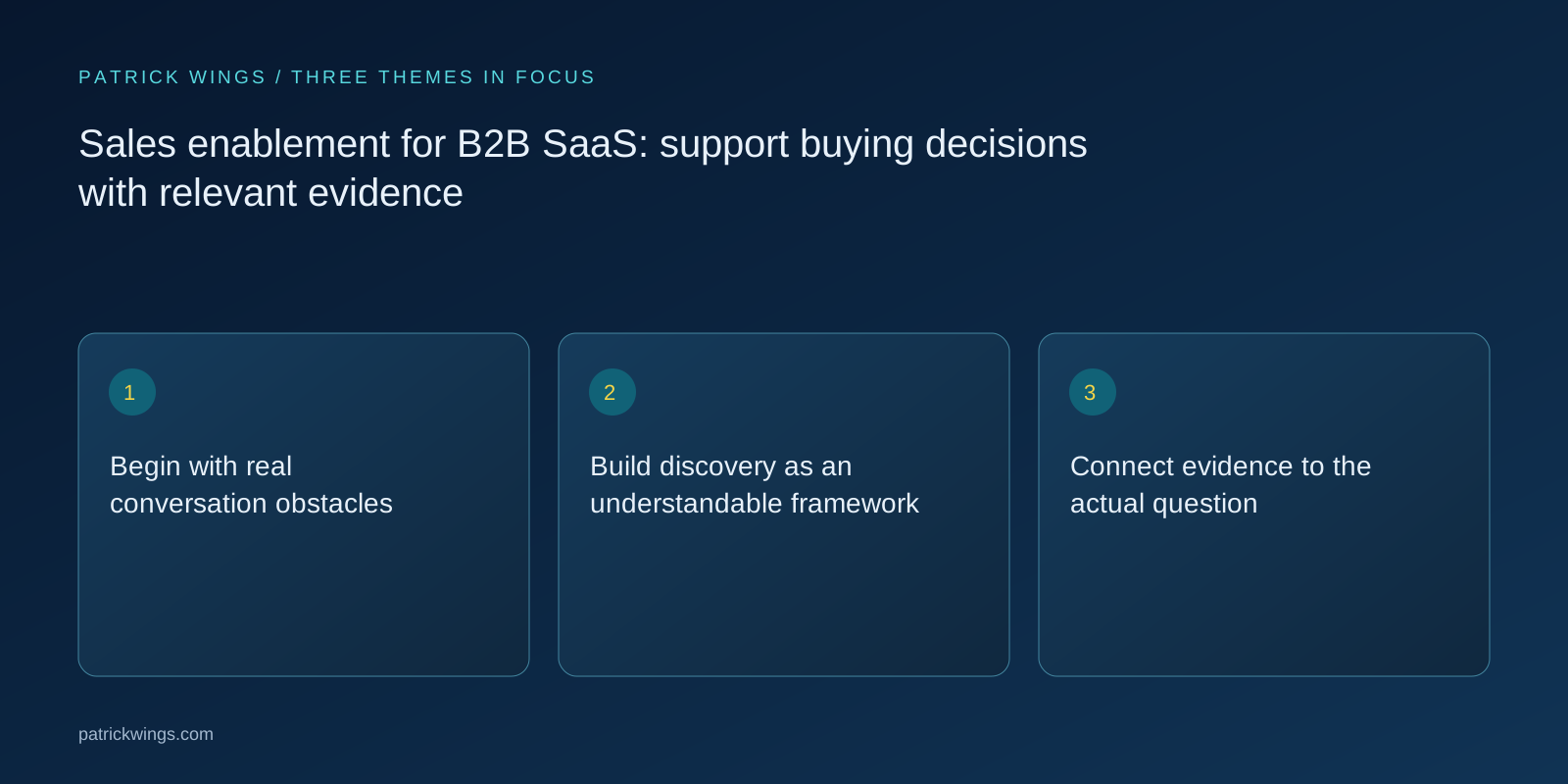
Connect evidence to the actual question
Organise product views, examples and technical information around the decisions they support. Explain a capability through a relevant workflow. An approved customer example can demonstrate a comparable situation without guaranteeing the same outcome elsewhere. Label illustrative scenarios clearly. Avoid unsupported competitor comparisons and record when competitive information was checked. Include important prerequisites in the explanation. An honest account of a necessary integration can move a conversation forward more effectively than a seemingly effortless demonstration whose critical assumptions only become visible afterwards. Useful evidence allows the buyer to evaluate the real offer rather than a simplified version that cannot survive further investigation. Explore this further in the guide Product marketing in B2B SaaS: translate product knowledge into buying relevance.
Treat objections as unresolved decisions
Distinguish actual product limitations, missing information and differences in priority. A price concern does not automatically request a discount. The scope may be unclear or the problem may not yet be important enough. Ask about the context before providing a standard reply. Record useful explanatory approaches together with their limits. An illustrative implementation concern might require a clear sequence of necessary steps rather than another benefit statement. Enablement should help people recognise these differences. A collection of supposedly perfect rebuttals can instead encourage salespeople to ignore relevant information and argue against a buyer who is raising a legitimate issue about suitability or readiness.

Make internal evaluation easier for the buyer
Your contact often has to explain the product without your team present. Provide short, understandable resources summarising the problem, contribution, prerequisites and next action. Different roles need different depth. A technical question belongs in a clear overview; commercial evaluation needs explainable context rather than invented savings calculations. Check whether a resource remains understandable alone or requires lengthy spoken explanation. Avoid unnecessary confidential details. Good support does not turn your contact into an unpaid salesperson. It helps them conduct a factual internal assessment of the offer and its actual suitability, including the conditions under which proceeding would not make sense for the organisation.
Assess usage, maintenance and contribution together
Keep current resources easy to find and remove obsolete versions from active circulation. Assign responsibility for product claims and regular updates. Look beyond internal downloads to whether important questions are resolved more effectively in conversations. Add comparable contact journeys to qualitative feedback without attributing every change entirely to one asset. If sales does not use a resource, investigate the reason rather than immediately assuming resistance. It may be hard to find, poorly matched or too extensive. Enablement remains useful when it follows real buying decisions and learns from application. The resulting library may become smaller while its practical contribution improves because people can quickly locate accurate help for a specific conversation.
INTERACTIVE / FROM READING TO ACTION
Three checkpoints for your implementation
Choose a checkpoint and track your reading progress. Checks are neither saved nor sent and do not score your business.
CHECKPOINT 01
Connect evidence to the actual question
Organise product views, examples and technical information around the decisions they support.
Explore in the article ↗CHECKPOINT 02
Treat objections as unresolved decisions
Distinguish actual product limitations, missing information and differences in priority.
Explore in the article ↗CHECKPOINT 03
Make internal evaluation easier for the buyer
Your contact often has to explain the product without your team present.
Explore in the article ↗Frequently asked questions
Is enablement just an asset library?
No. It includes conversation support, knowledge, processes and maintained information. A library is only one possible component.
Which resource should come first?
The one addressing an important recurring decision that is currently poorly supported. Use concrete conversation cases.
How should usefulness be assessed?
Review use, clearer conversations and resolved decision questions. Add comparable journeys without claiming an isolated asset effect.
How can I put “Begin with real conversation obstacles” into practice?
Collect situations where suitable opportunities stop progressing or unnecessary questions arise. Work with sales to identify what information is actually missing. Unclear value, an integration concern and an unsuitable contact are different problems.
What matters when working on “Build discovery as an understandable framework”?
Develop questions that clarify the problem, current approach and desired change. Add relevant prerequisites and participating roles. A conversation guide should provide direction rather than create a rigid interrogation.