

THE SHORT ANSWER
A useful SaaS keyword strategy answers a simple question: which research tasks should bring the right customers to your website? The answer combines product knowledge, customer insight and search data. A long list is not the objective. You need a prioritised plan specifying which pages to create, what each should explain and how you will evaluate its usefulness.
For the broader picture of technical foundations, useful content and visibility measurement, read the pillar guide SEO, GEO and AEO for SaaS: visibility that supports buying decisions.
Research four complementary topic groups
Collect terms describing problems, solution approaches, use cases and product selection. Add integrations and constraints that regularly appear in sales conversations. For a fictional HR platform, these might include manual personnel processes, digital employee records, onboarding across locations and supplier comparisons. Mark whether each term genuinely fits the current offer. A popular feature you do not provide should not accidentally become the focus of acquisition. Honest boundaries are part of relevance, especially when a small team must choose where to invest effort.
Combine search data with customer language
Keyword tools provide estimates and variations, not a complete picture of your market. Supplement them with support questions, demo notes, tenders and prospect interviews. Business users often describe IT needs differently from product engineers. Record synonyms alongside precise technical terms. Then inspect actual search results for obvious differences in meaning. The same phrase can describe an entirely different problem in another industry. Checking that context prevents content which is technically accurate but attracts people whose needs your product cannot address.
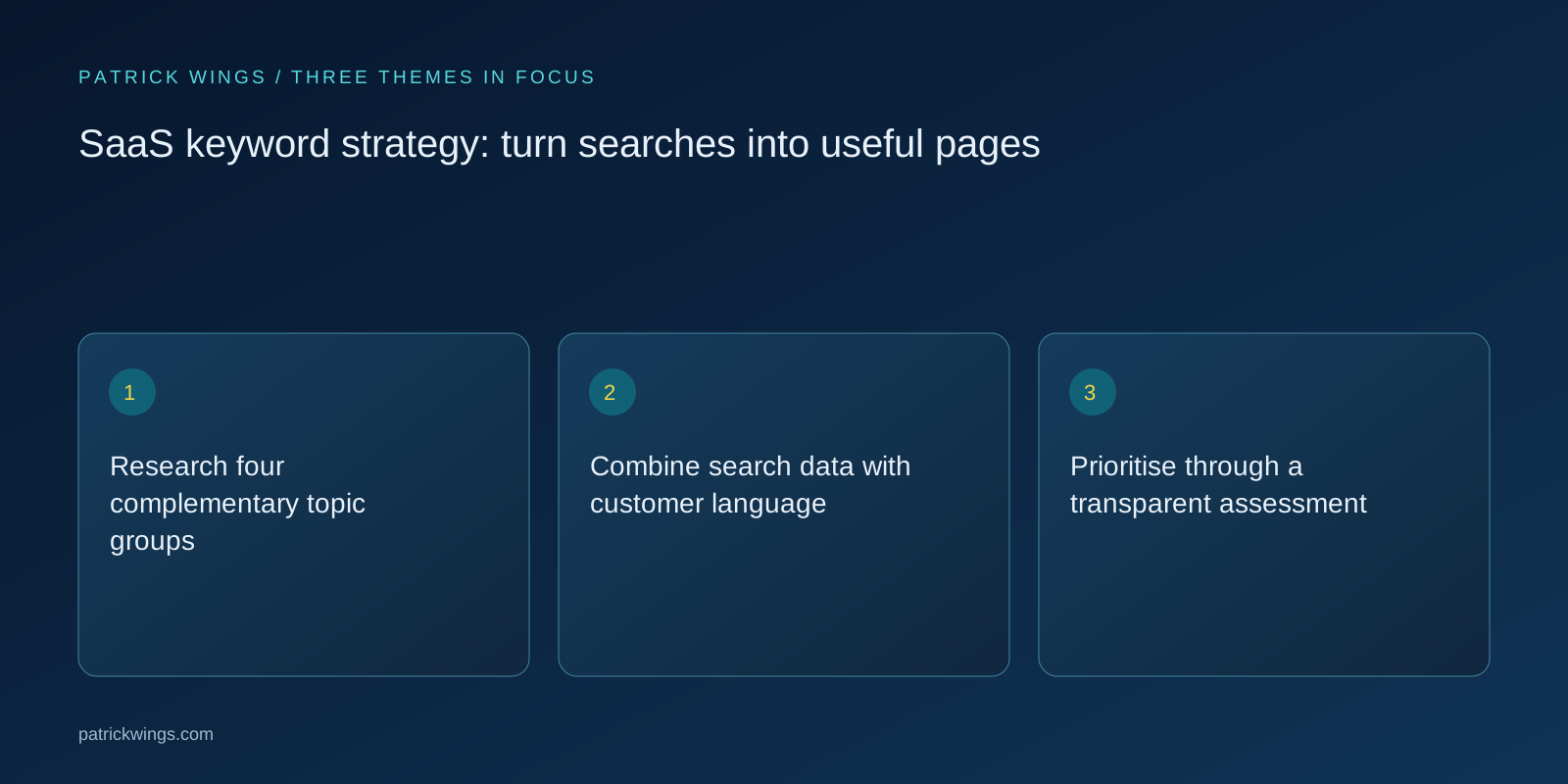
Prioritise through a transparent assessment
Assess topics using a few clear criteria: ideal customer fit, relevance to a buying decision, credible internal expertise and production effort. Add demand estimates and competitive context. Use a simple scale and explain the reasoning. A seemingly precise aggregate score does not replace judgment. The model is useful because product, sales and marketing can discuss the same assumptions. Begin with subjects where a genuinely useful contribution overlaps with a plausible connection to your offer, rather than selecting the biggest number in a tool. Explore this further in the guide SaaS comparison pages: help buyers choose without disparaging competitors.
Group phrases that describe the same task
Not every keyword needs a separate URL. When several variations describe the same question, one well-structured page can address them together. Separate content when visitors need to accomplish different tasks. “Project planning template” and “project management software for plant engineering” belong to related territory but call for different resources. Map topics to intended URLs and record existing pages. This reduces the risk that new articles unintentionally duplicate the purpose of service pages or earlier posts with only minor wording changes.

Turn research into an executable editorial plan
Give each priority page an audience, a central question, a format, a subject expert and an appropriate next step. Specify evidence requirements, internal links and scope boundaries. A useful brief explains which decision the reader should be better able to make afterwards. This converts a keyword list into an actionable assignment. Before production, check whether an existing page could be improved. A stronger example or clearer product boundary may deliver more value than another page with a slightly different title and essentially the same answer. Explore this further in the guide SaaS topic clusters: connect content without creating a link maze.
Evaluate topics and business value together
Observe the development of a subject area rather than isolated keyword positions alone. Which relevant questions generate visibility, which pages are used and which enquiries fit your offer? Compare findings with the priorities you originally set. Limited data calls for cautious interpretation rather than instant success claims. Update the plan when integrations, audiences or buying objections change. This keeps keyword strategy connected to the business instead of allowing an exported spreadsheet to become a permanent, outdated instruction that nobody reviews.
INTERACTIVE / FROM READING TO ACTION
Three checkpoints for your implementation
Choose a checkpoint and track your reading progress. Checks are neither saved nor sent and do not score your business.
CHECKPOINT 01
Prioritise through a transparent assessment
Assess topics using a few clear criteria: ideal customer fit, relevance to a buying decision, credible internal expertise and production effort.
Explore in the article ↗CHECKPOINT 02
Group phrases that describe the same task
Not every keyword needs a separate URL.
Explore in the article ↗CHECKPOINT 03
Turn research into an executable editorial plan
Give each priority page an audience, a central question, a format, a subject expert and an appropriate next step.
Explore in the article ↗Frequently asked questions
Do we need high-volume keywords?
Not necessarily. A precise term with strong customer fit can be more useful than a broad topic unrelated to your offer.
How many keywords belong on one page?
As many relevant variations as the natural answer needs. A fixed density or count is not a useful writing objective.
Should competitor terms be included?
When a fair, verifiable comparison helps customers. Establish clear criteria and a maintenance process.
How can I put “Research four complementary topic groups” into practice?
Collect terms describing problems, solution approaches, use cases and product selection. Add integrations and constraints that regularly appear in sales conversations. For a fictional HR platform, these might include manual personnel processes, digital employee records, onboarding across locations and supplier comparisons.
What matters when working on “Combine search data with customer language”?
Keyword tools provide estimates and variations, not a complete picture of your market. Supplement them with support questions, demo notes, tenders and prospect interviews. Business users often describe IT needs differently from product engineers.