
THE SHORT ANSWER
A SaaS pricing strategy defines more than an amount. It determines what customers pay for, how costs change with use and which capabilities belong in each offer. These choices should connect product value, customer expectations and the economics of delivery.
To connect this decision with positioning, market entry and growth, read the pillar guide Go-to-market for B2B SaaS: turn market insight into an executable growth strategy.
Make perceived value concrete
Start with the task customers actually use your product to perform. Which alternative are they replacing or supplementing? What improvement is relevant and explainable? Examine real workflows rather than relying exclusively on an internal feature list. For an illustrative collaboration product, value may come from coordinated teamwork while a simple user count only partly represents it. Separate the value of a capability from the cost of providing it. Both matter, but they answer different questions. A large development effort alone does not explain why a customer should accept a particular price or why the commercial offer suits their situation.
Choose an understandable billing unit
Compare possible units such as users, teams, active processes or actual consumption. Stripe documents fixed, per-seat, tiered and usage-based approaches. Technical support for a model does not make it commercially appropriate. A useful unit is explainable to customers, reliably measurable and sufficiently predictable. Check whether it encourages valuable product use or penalises the collaboration that makes the product useful. Consider seasonal use and changing teams as well. A model that requires numerous exceptions can burden sales, support and billing. Test the explanation with people outside the product team before assuming that terminology familiar internally will be clear to a prospective buyer.
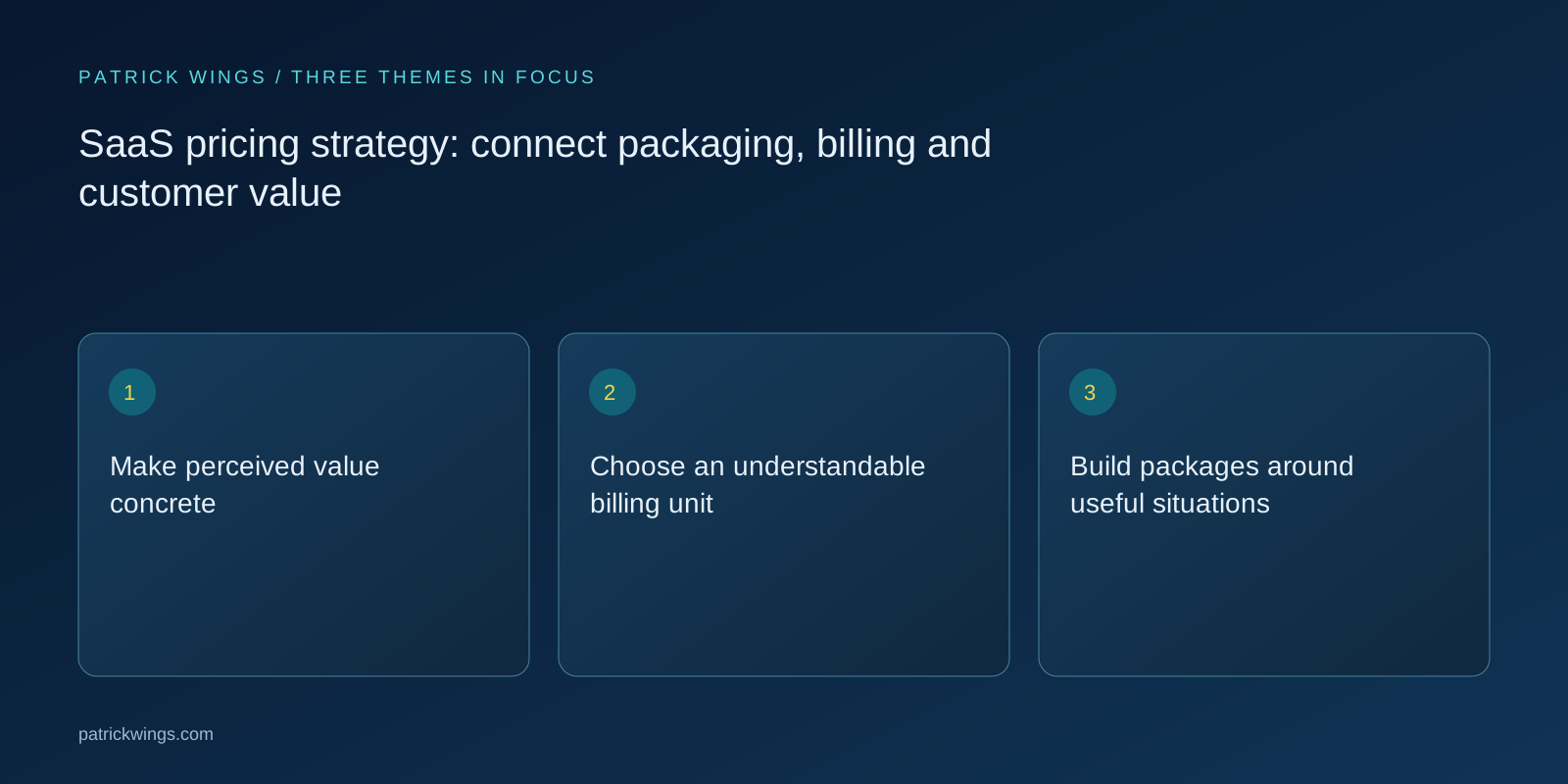
Build packages around useful situations
Packages should represent different needs clearly. Avoid separating capabilities arbitrarily when they are necessary together for one coherent task. An entry offer must solve a genuine application. Higher tiers can provide more scale, additional governance or different support where that fits the product. Make required additions and implementation prerequisites visible. Ask real prospects whether they can identify an appropriate starting point. If many enquiries require individual explanation, unclear package logic may be the cause. Adding more comparison columns will not necessarily help and can make navigation harder. Keep the distinction between packages connected to a buyer's actual work rather than an internal desire to distribute features evenly.
Investigate willingness to pay through decisions
Do not ask only whether a price “sounds fine”. Understand how customers make decisions today, which budgets they use and which alternatives they seriously consider. Discuss clear offers and record questions, objections and actions. Polite agreement during an interview is not a commitment to buy. Pricing experiments need a defined question and consistent execution. Check whether different product scopes or audience mixes are quietly distorting the comparison. Label willingness-to-pay assumptions as assumptions until actual decisions or other defensible evidence support them. This prevents apparently precise survey outputs from creating a false sense of certainty about a price the market has not actually accepted. Explore this further in the guide B2B buyer research: use customer interviews to make better market decisions.

Include implementation and service effort
Examine required implementation, support and third-party costs alongside recurring revenue. A low entry price may not be viable when every account needs intensive assistance. That does not automatically justify raising the price; the entry experience, audience or scope may need to change instead. Separate one-time services from continuing usage when this helps customer understanding. Record the treatment of additional consumption, upgrades and contract changes. Marketing, sales and finance should be able to give the same explanation. Unclear exceptions later damage both the customer relationship and internal analysis of commercial viability, particularly when different teams record the same arrangement in incompatible ways.
Introduce changes deliberately and transparently
A new price structure affects pages, proposals, billing, sales conversations and existing relationships. Establish the customer groups and effective dates involved, and review existing agreements first. Include the responsible contractual and finance specialists. Prepare clear answers about scope, changing costs and available alternatives. After implementation, assess misunderstanding, service demand and actual usage alongside conversion. Compare similar cohorts rather than unrelated situations. A useful pricing strategy remains explainable and testable. It can evolve with new knowledge without becoming a succession of surprises for customers, and it should keep the commercial promise aligned with the product and service your team can actually deliver. Explore this further in the guide Product-led growth in B2B: when self-service works and assistance helps.
INTERACTIVE / FROM READING TO ACTION
Three checkpoints for your implementation
Choose a checkpoint and track your reading progress. Checks are neither saved nor sent and do not score your business.
CHECKPOINT 01
Build packages around useful situations
Packages should represent different needs clearly.
Explore in the article ↗CHECKPOINT 02
Investigate willingness to pay through decisions
Do not ask only whether a price “sounds fine”.
Explore in the article ↗CHECKPOINT 03
Include implementation and service effort
Examine required implementation, support and third-party costs alongside recurring revenue.
Explore in the article ↗Frequently asked questions
Should SaaS always charge per user?
No. Seats may fit, but the unit should reflect value, predictability and useful product behaviour.
Are three tiers always optimal?
No. Appropriate packaging follows different applications and clear boundaries rather than a predetermined tier count.
How should a new pricing approach be assessed?
Use concrete customer conversations, consistent offers and observed decisions. Also examine usage and the service effort required.
How can I put “Make perceived value concrete” into practice?
Start with the task customers actually use your product to perform. Which alternative are they replacing or supplementing? What improvement is relevant and explainable?
What matters when working on “Choose an understandable billing unit”?
Compare possible units such as users, teams, active processes or actual consumption. Stripe documents fixed, per-seat, tiered and usage-based approaches. Technical support for a model does not make it commercially appropriate.