
THE SHORT ANSWER
Product-led growth uses product experience as an important route to acquisition and expansion. A free account alone does not create a functioning model. Suitable users must be able to reach meaningful value independently and develop it within their organisation.
To connect this decision with positioning, market entry and growth, read the pillar guide Go-to-market for B2B SaaS: turn market insight into an executable growth strategy.
Define first value from the customer's perspective
Describe the smallest meaningful task a new user can complete with the product. It should make the advertised benefit tangible. Creating an account or completing a profile is often only a prerequisite. For an illustrative reporting tool, a useful first analysis may matter more than opening a dashboard. Ask new users and people who abandoned the product what they wanted to accomplish. Check whether their initial value matches your internal definition. If customers and the product team mean different tasks, additional acquisition will amplify the underlying ambiguity rather than resolve it. Agree the first useful outcome before optimising a registration funnel around an arbitrary event.
Check prerequisites for independent adoption
Some products need data, permissions or integrations before they can be used meaningfully. Examine those dependencies explicitly. A sample environment can help understanding but should remain clearly separate from genuine customer results. Explain necessary steps and their purpose instead of promising immediate operation that is not possible. Personal assistance can help when someone must obtain internal access first. PLG does not require avoiding every human interaction. It should offer appropriate support at the right point and remove unnecessary obstacles without concealing real implementation requirements. Understanding the work a user must do outside the application is part of designing a viable entry experience.
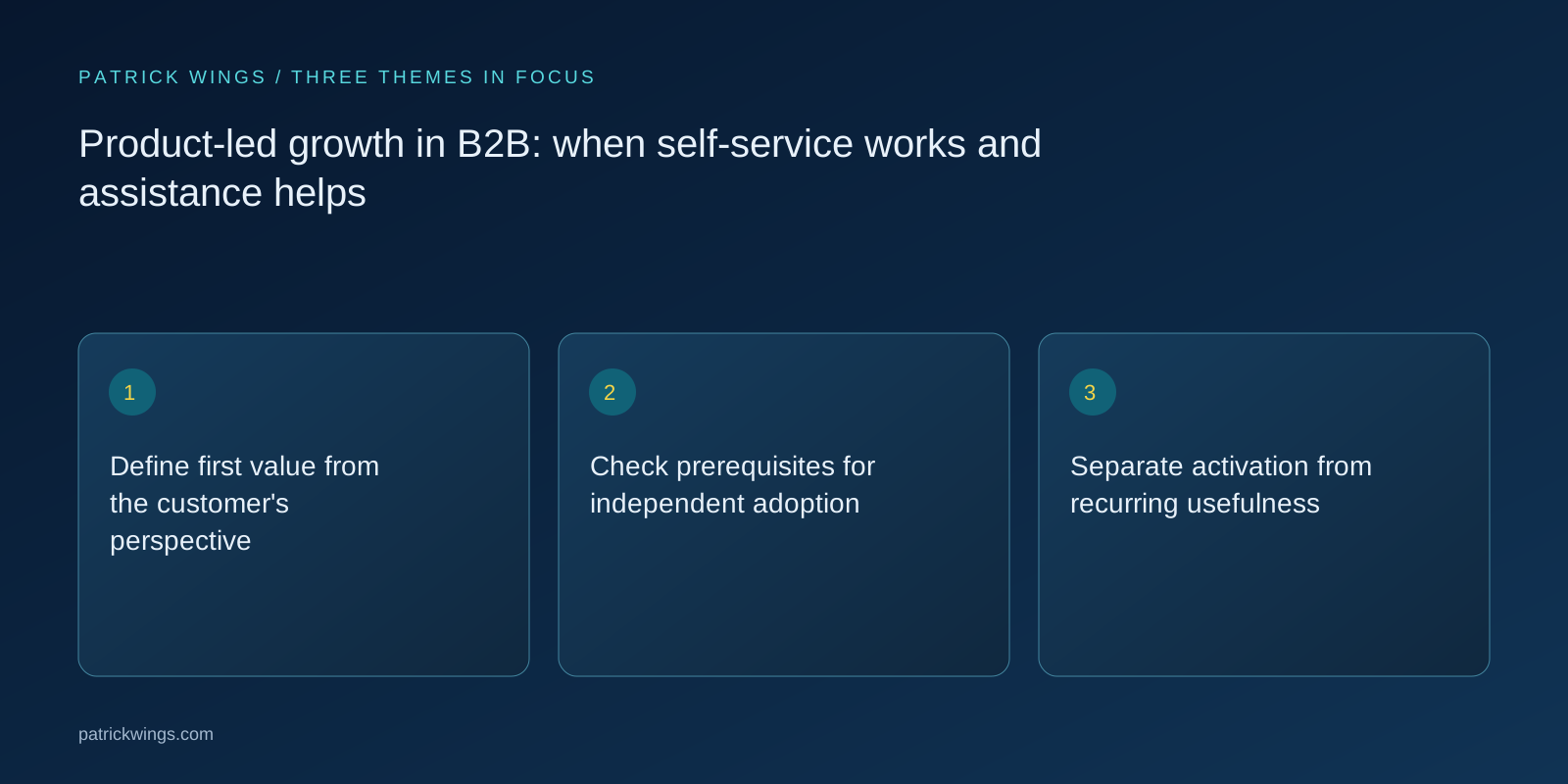
Separate activation from recurring usefulness
Define an observable activation event representing a meaningful first application. Then examine whether users return to solve the same task or a broader one. A successful one-off test does not demonstrate sustained demand. Amplitude documents behavioural cohorts and retention analysis, but your team must justify the underlying business events. Compare users with similar entry conditions and maturity. Account for the natural rhythm of the task. A process needed monthly should not be evaluated through daily return behaviour simply because that indicator is easy to display. The measurement should describe useful customer progress rather than reward activity unrelated to the product's actual purpose.
Account for the organisation around the user
In B2B, an enthusiastic individual cannot always approve wider adoption. Team capabilities, security questions, procurement and integration may become important later. Provide a clear route from individual exploration to organisational evaluation. Useful resources can explain roles, data movement and appropriate team applications. Do not assume that inviting colleagues constitutes a completed buying decision. Use observations as prompts for relevant assistance instead. An illustrative team product might offer optional setup guidance when a specific shared workflow is being planned. This supports progress without treating every product action as confirmed intent or converting a helpful support opportunity into an unwanted sales intervention. Explore this further in the guide Product marketing in B2B SaaS: translate product knowledge into buying relevance.

Make upgrade boundaries understandable
Free use should fulfil a real task and make the additional value of a paid offer clear. Hidden limitations can damage trust. Define scope, billing and transitions consistently with the pricing strategy. Investigate whether people reject an upgrade because they lack a need or because the next tier is confusing. These are different problems. Personal assistance also needs a clear role: it can resolve complex questions but should not become a compulsory detour for simple product actions. Review with marketing whether campaigns explain the same boundaries as the application and pricing page. Consistent expectations reduce avoidable frustration during the transition from exploration to paid use. Explore this further in the guide SaaS pricing strategy: connect packaging, billing and customer value.
Evaluate the whole growth model
Consider suitable acquisition, first use, return behaviour, organisational adoption and paid development together. Cheap registrations have little commercial meaning when nobody reaches value. High activation also contributes little if the accounts do not belong to a viable target segment. Add interviews to quantitative patterns. Ask which obstacles require product change and which can be resolved through clearer expectations. A useful PLG approach can complement personal selling. The objective is an understandable and economically viable route through which suitable customers experience the promised value, rather than adopting an ideological label or increasing registrations without understanding what happens to those people afterwards.
INTERACTIVE / FROM READING TO ACTION
Three checkpoints for your implementation
Choose a checkpoint and track your reading progress. Checks are neither saved nor sent and do not score your business.
CHECKPOINT 01
Separate activation from recurring usefulness
Define an observable activation event representing a meaningful first application.
Explore in the article ↗CHECKPOINT 02
Account for the organisation around the user
In B2B, an enthusiastic individual cannot always approve wider adoption.
Explore in the article ↗CHECKPOINT 03
Make upgrade boundaries understandable
Free use should fulfil a real task and make the additional value of a paid offer clear.
Explore in the article ↗Frequently asked questions
Does PLG always require freemium?
No. Time-limited trials and other independent entry experiences can support product-based learning. Meaningful value is the key.
Can sales coexist with PLG?
Yes. Personal help can resolve organisational and technical questions while the product provides a relevant entry point.
How should early product value be measured?
Use a justified activation event and appropriate return behaviour. Events must fit the actual customer task.
How can I put “Define first value from the customer's perspective” into practice?
Describe the smallest meaningful task a new user can complete with the product. It should make the advertised benefit tangible. Creating an account or completing a profile is often only a prerequisite.
What matters when working on “Check prerequisites for independent adoption”?
Some products need data, permissions or integrations before they can be used meaningfully. Examine those dependencies explicitly. A sample environment can help understanding but should remain clearly separate from genuine customer results.