
THE SHORT ANSWER
A free account starts a product relationship; it is not proof of sustainable growth. For self-service SaaS, plan acquisition, activation and later usage together. This prevents inexpensive registrations from obscuring the product and commercial questions that matter.
For the broader picture of how target customers, channels and sales handoffs work together, read the pillar guide B2B demand generation: from attention to qualified pipeline.
Describe the freemium promise precisely
Explain the concrete task a free account enables and where its boundaries lie. An unclear distinction between free usage and paid capabilities creates wrong expectations. Avoid acquisition messaging that promises more than a new user can actually experience after registration. An illustrative recruiting tool might support a clearly limited first research workflow. The exact boundary must suit the product. Explain it consistently in advertisements, the landing page and onboarding. Before registering, a suitable user should be able to judge whether the first task matters in their situation and whether it can be completed without unexpected obstacles or undisclosed purchasing requirements. Explore this further in the guide B2B landing pages: turn advertising promises into useful enquiries.
Define activation before launching campaigns
Agree which observable action first demonstrates meaningful product value. Registration alone rarely answers that question. For an illustrative content application, it might be completing a useful first content task; for a recruiting application, setting up a relevant search workflow. The event needs a business justification rather than merely being technically convenient. Check whether a user can reach it without personal assistance and identify prerequisites. Record events and timing consistently. Otherwise product changes or alternative user journeys may later look like marketing effects when the underlying activation definition has actually changed. Document why the event represents value and review that reasoning as the product develops.
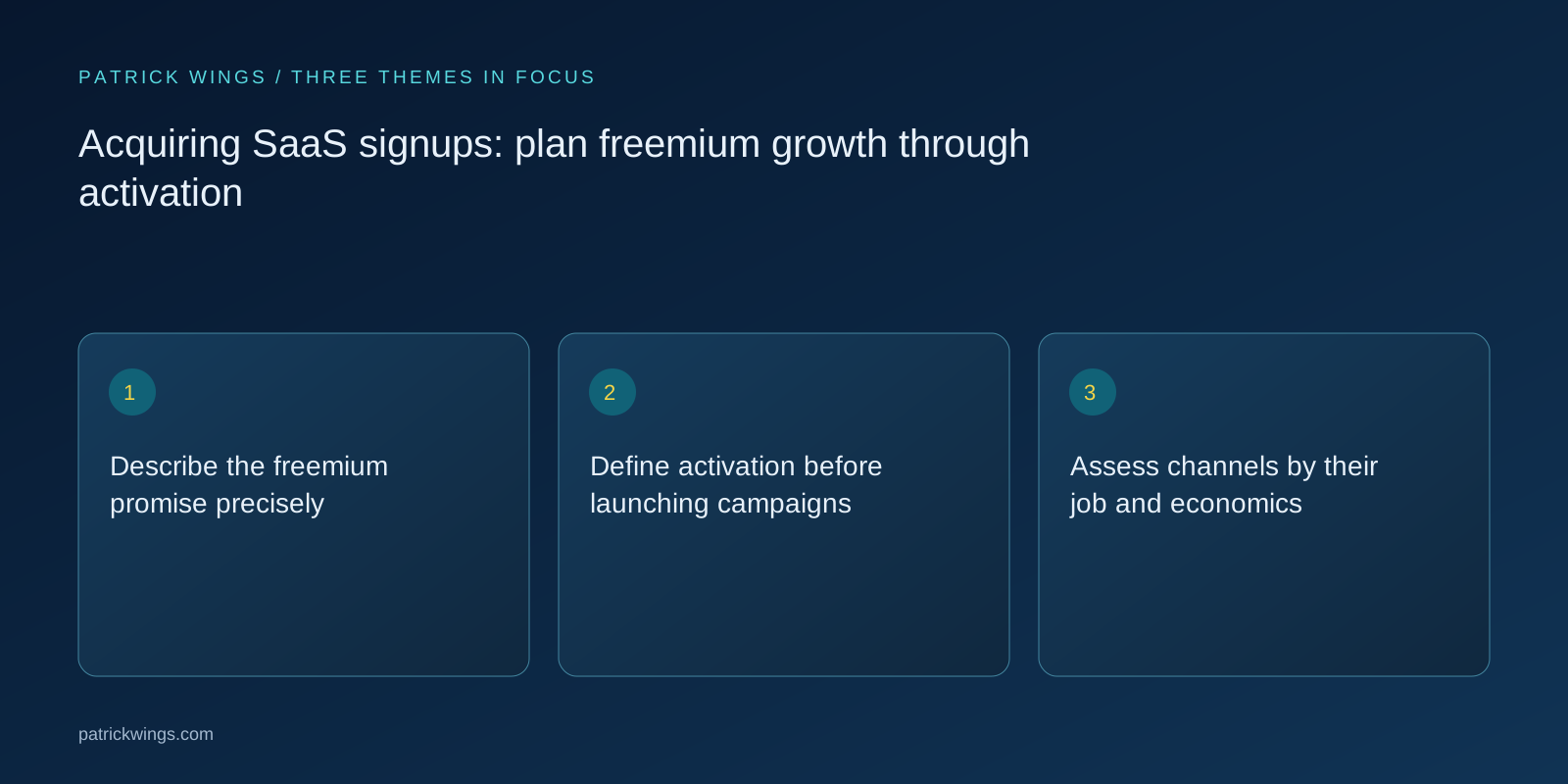
Assess channels by their job and economics
Google Ads can capture active research, LinkedIn can introduce an approach to relevant professional roles, and useful search content can answer ongoing questions. None guarantees profitable registrations. For each channel, state a hypothesis about audience, motivation and the expected next action. An expensive channel can make sense when it reaches suitable businesses, but it must fit later economics. Begin with a limited pilot that can be interpreted meaningfully. Avoid automatically spreading a small budget over too many platforms. If registration volume disappoints, investigate the offer, reach and onboarding before adding more channels in the hope that distribution alone will solve the issue.
Connect signup cost to the next stage
Calculate cost per meaningfully activated account alongside cost per registration. Consider an illustrative calculation: a campaign generates 20 registrations, but only 5 reach the agreed activation event. Registration cost alone does not explain that quality difference. These are example figures, not a benchmark. Then examine usage, company suitability and later upgrades within the same cohort. Compare groups with similar time to mature. A cheap mix of unsuitable individual users can be commercially worse for a team product than fewer registrations from relevant organisations. Avoid revenue forecasts that rely on assumed upgrade behaviour before there is a reliable basis in actual usage.

Focus onboarding on the first useful task
Guide new users through a few understandable steps towards the advertised application. A long product tour can explain available features without helping someone perform their first task. Identify necessary data, permissions and integrations, and explain why they are needed. If real usage requires substantial setup, consider a clear sample environment without presenting its output as genuine customer data. Observe abandonment and ask users about specific obstacles. Marketing and product should examine the same expectations. If advertising promises immediate value but the product requires several coordination rounds, either the promise or the entry experience needs to change before acquisition is scaled.
Trigger upgrades and personal help appropriately
Frequent usage does not automatically justify a sales call. Define signals that suggest relevant business need and useful assistance, such as an explicitly requested team feature or technical question. Separate product activity from confirmed purchase intention. Provide transparent routes to paid functionality and personal support. Check that pricing boundaries and capability differences are understandable before directing users into sales conversations. Investigate why suitable accounts fail to activate or progress. A sustainable self-service model connects appropriate acquisition expectations with a product that fulfils the promised first job. More registrations alone will not repair a broken connection between the campaign promise and the experience inside the application. Explore this further in the guide Measuring B2B marketing: from channel metrics to pipeline decisions.
INTERACTIVE / FROM READING TO ACTION
Three checkpoints for your implementation
Choose a checkpoint and track your reading progress. Checks are neither saved nor sent and do not score your business.
CHECKPOINT 01
Assess channels by their job and economics
Google Ads can capture active research, LinkedIn can introduce an approach to relevant professional roles, and useful search content can answer ongoing questions.
Explore in the article ↗CHECKPOINT 02
Connect signup cost to the next stage
Calculate cost per meaningfully activated account alongside cost per registration.
Explore in the article ↗CHECKPOINT 03
Focus onboarding on the first useful task
Guide new users through a few understandable steps towards the advertised application.
Explore in the article ↗Frequently asked questions
What should a SaaS signup cost?
That depends on activation, audience suitability, later upgrades and customer economics. There is no universally correct signup price.
Is freemium always better than a demo?
No. Freemium suits products where users can experience meaningful initial value independently. Complex implementation may justify a different entry point.
Which metric should accompany registration volume?
Include a justified activation measure and company suitability, followed by usage and later paid progression within the same cohort.
How can I put “Describe the freemium promise precisely” into practice?
Explain the concrete task a free account enables and where its boundaries lie. An unclear distinction between free usage and paid capabilities creates wrong expectations. Avoid acquisition messaging that promises more than a new user can actually experience after registration.
What matters when working on “Define activation before launching campaigns”?
Agree which observable action first demonstrates meaningful product value. Registration alone rarely answers that question. For an illustrative content application, it might be completing a useful first content task; for a recruiting application, setting up a relevant search workflow.