
THE SHORT ANSWER
Useful marketing measurement begins with the decision you need to make. Reporting should help determine whether an audience, offer or campaign deserves further development. That requires shared definitions and an honest approach to incomplete data.
For the broader picture of how target customers, channels and sales handoffs work together, read the pillar guide B2B demand generation: from attention to qualified pipeline.
Define business questions before dashboards
Start by writing down the decision the report should support. Are you evaluating a new segment, the quality of a lead magnet or a budget shift between campaigns? Those questions require different indicators and observation periods. Map an understandable chain from delivery through contact to qualified conversation and opportunity. Not every step is always available or appropriate to automate. Make gaps visible. A dashboard containing many numbers can appear complete while important handovers remain absent. A small collection of well-defined measures often provides a better basis than disconnected platform metrics that use similar names while representing materially different events. Explore this further in the guide Marketing and sales alignment: clear handovers instead of MQL arguments.
Describe conversion events unambiguously
For each event, specify its name, trigger, timestamp and responsible system. Distinguish a form submission from a successfully created contact and a requirement accepted by sales. Check whether repeat submissions, multiple people from one account or system imports create duplicate outcomes. Agree which events are diagnostic and which will inform optimisation. Write definitions that marketing and sales can both understand. When a criterion changes, record the date. Otherwise an increase caused by new rules can appear to be a genuine campaign improvement. Consistent definitions make historical comparisons more useful and reduce avoidable disagreements about what a number represents.
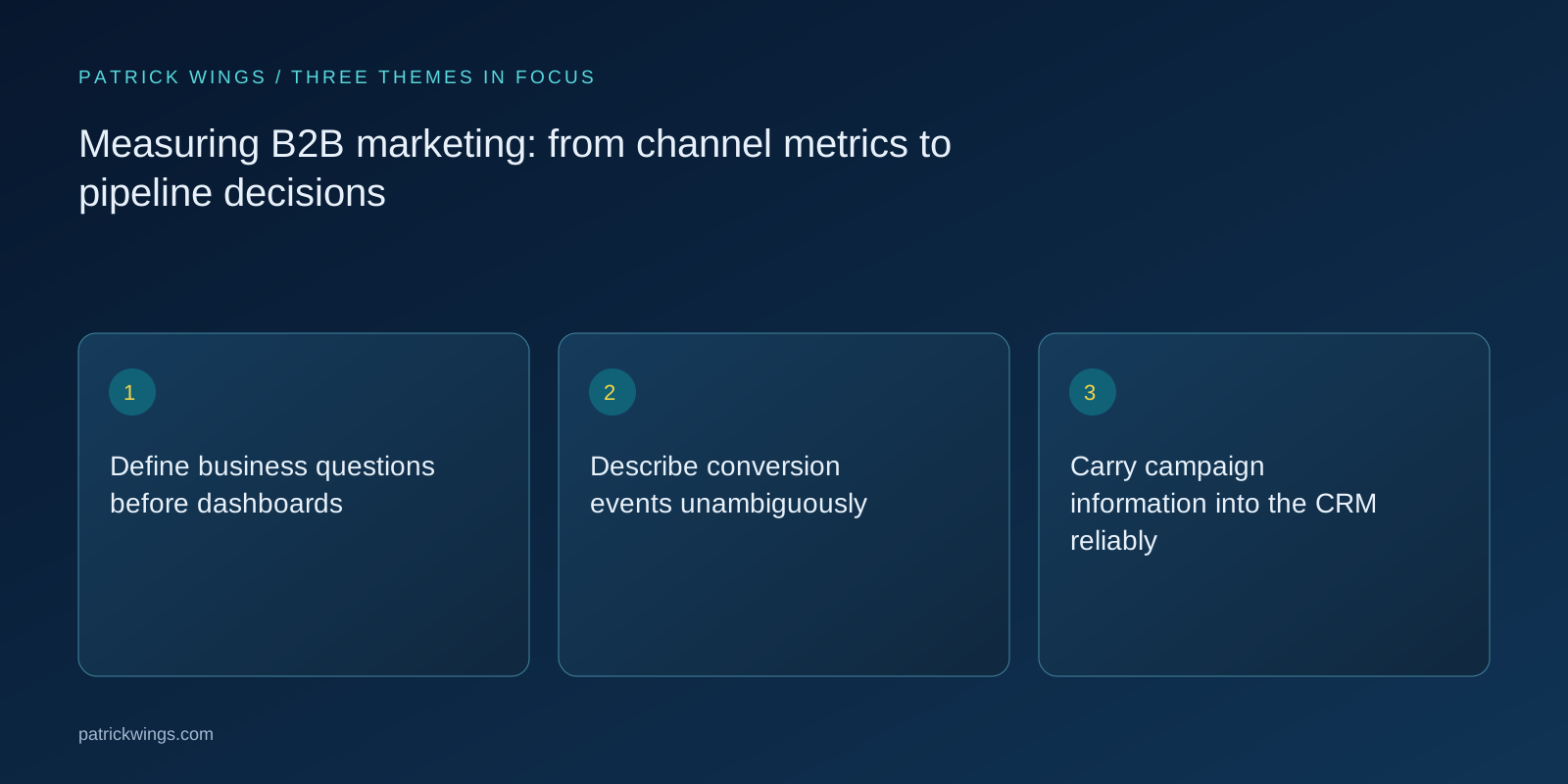
Carry campaign information into the CRM reliably
Use consistent naming for sources, campaigns and assets. Test which information is stored and what later visits overwrite using a controlled contact. First source and most recent interaction answer different questions. Associate contacts with companies and opportunities where the process supports it. Google's official documentation covers importing later conversion outcomes. Your implementation depends on current supported integrations, data quality and permitted processing. A technical import cannot repair an unclear business definition. First ensure that a reported qualified event really means what its name promises in the CRM, then investigate how to transmit it reliably and diagnose failed or duplicated records. Explore this further in the guide Google Ads for B2B SaaS: search intent before click volume.
Compare similarly matured cohorts
A contact created yesterday has had less time to progress than one acquired last quarter. Group contacts by acquisition period and compare cohorts with similar maturity. Account for differences in segment, offer and follow-up process. As an illustrative example, a new webinar cohort should not be judged on immediate closed business against a demo cohort that sales has worked for months. Review appropriate intermediate progression first and mature outcomes later. Show group size and interpretive uncertainty. Small samples rarely support a stable general claim about the economic superiority of a channel, particularly when a single large opportunity could materially change the result.

Separate attribution from additional impact
Attribution distributes observed outcomes across known interactions according to a rule. Different models can produce different channel pictures without changing a single purchase. Personal recommendations, internal sharing and unobserved research may also be missing. Treat the report as one perspective rather than a complete explanation of the buying journey. Add conversations about how prospective customers discovered you and which information helped them decide. If the question of additional impact is commercially important, investigate suitable controlled tests. Their feasibility depends on reach, time, budget and sound design. A complex attribution model alone does not establish what would have happened without a campaign.
Translate observations into concrete changes
Connect each unusual pattern to a testable explanation. Many clicks but few suitable contacts might indicate an intent mismatch, an inappropriate offer or qualification rules. Slow opportunity development can also reflect sales capacity or internal procurement. Do not automatically locate the cause in the advertisement. Discuss quantitative patterns alongside specific sales cases. Record the planned change, its expected effect and the point at which you will revisit the evidence. A good measurement framework does not provide absolute certainty. It makes assumptions visible and supports the next decision with fewer avoidable errors, while preserving enough context to understand why your team acted.
INTERACTIVE / FROM READING TO ACTION
Three checkpoints for your implementation
Choose a checkpoint and track your reading progress. Checks are neither saved nor sent and do not score your business.
CHECKPOINT 01
Carry campaign information into the CRM reliably
Use consistent naming for sources, campaigns and assets.
Explore in the article ↗CHECKPOINT 02
Compare similarly matured cohorts
A contact created yesterday has had less time to progress than one acquired last quarter.
Explore in the article ↗CHECKPOINT 03
Separate attribution from additional impact
Attribution distributes observed outcomes across known interactions according to a rule.
Explore in the article ↗Frequently asked questions
Which metric matters more than CPL?
It depends on the decision. Add suitability, qualified conversations and opportunities from the same sufficiently mature cohort to contact cost.
Does attribution prove a campaign caused an outcome?
It assigns observed outcomes according to rules. By itself, it does not establish the additional effect that would be absent without advertising.
Why do platform and CRM totals differ?
Definitions, windows, attribution rules, duplicates and missing data can differ. Align the business and technical basis first.
How can I put “Define business questions before dashboards” into practice?
Start by writing down the decision the report should support. Are you evaluating a new segment, the quality of a lead magnet or a budget shift between campaigns? Those questions require different indicators and observation periods.
What matters when working on “Describe conversion events unambiguously”?
For each event, specify its name, trigger, timestamp and responsible system. Distinguish a form submission from a successfully created contact and a requirement accepted by sales. Check whether repeat submissions, multiple people from one account or system imports create duplicate outcomes.