
THE SHORT ANSWER
Expert interviews produce useful material when they uncover specific decisions, examples and the limits of experience. Ask about observed work and distinguish it from advice. The output is a traceable foundation for a defined editorial assignment. Preparing carefully protects the expert’s time and the accuracy of the article that will eventually use their knowledge.
To see how this step fits into your content strategy, read the pillar guide B2B content marketing: From useful expertise to qualified demand.
Define the assignment before questions
Before inviting someone, state the reader’s question, intended article and missing information. An interview about interface selection needs different experience from an implementation guide. Record existing research so the expert does not spend the session repeating accessible basics. Agree a time boundary and explain intended use, including whether comments will be personally attributed. A transparent brief lets the expert prepare relevant documents and identify sensitive topics before the conversation starts rather than discovering publication expectations afterwards. Explore this further in the guide Making expert authorship visible on technology websites.
Ask about a specific situation
Begin with a bounded case: what task arose, what information existed and what happened first? Ask about decisions and alternatives considered at the time. Request explanations of unfamiliar terms. Questions about exceptions and unsuccessful attempts are particularly useful. When an answer remains general, ask for an observable example. Avoid leading questions that already contain your preferred marketing message. Otherwise apparent agreement may reflect the wording of the question rather than the knowledge you hoped to discover. Explore this further in the guide B2B buyer research: use customer interviews to make better market decisions.
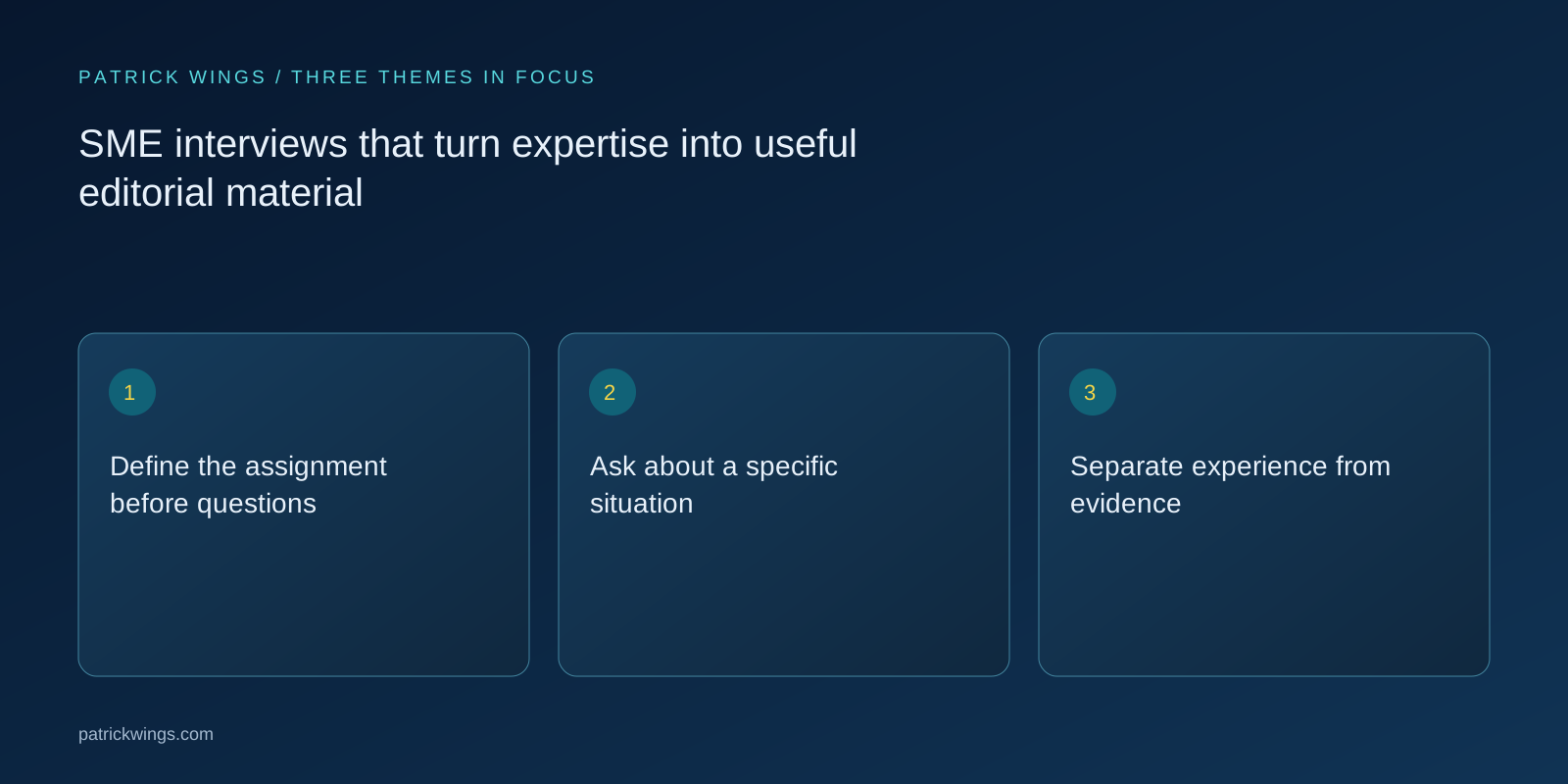
Separate experience from evidence
Label statements as personal experience, documented observation or professional judgment. For numbers, ask about timeframe, baseline and supporting records. A remembered magnitude is not a publication-ready metric. Request sources for technical or general claims that require later verification. Give unresolved items owners. The expert need not answer everything immediately; a clear research task after the session is better than allowing an uncertain remark to become a confident factual statement in the finished article without further checking.
Examine a hypothetical exchange
Suppose an architect says, “Data quality was our biggest problem.” Ask for a specific record, the error encountered and its effect on the next step. The answer becomes a usable explanation: inconsistent customer identifiers prevented matching, so a mapping table was checked first. This hypothetical exchange invents no project results. It shows how follow-up questions turn a general judgment into an understandable process description and reveal which details need confirmation before they can be published or attributed publicly.

Organize material with its origin
Turn notes into a structured collection of claims, examples, quotations and outstanding checks. Preserve context so a shortened quotation does not lose its original qualification. Resolve permitted use of recordings and confidential documents with the responsible people. Select material that serves the reader’s question; record interesting diversions as future topics. This keeps the article focused while showing the expert that contributions receive careful treatment and will not be moved casually into unrelated arguments or reused beyond the agreed purpose.
Request focused expert review
Send the relevant statements with concrete questions: is the sequence correct, is a prerequisite missing and may the example appear? Do not request a complete stylistic rewrite when factual review is needed. Keep review within the agreed scope and track substantive changes. Then check clarity, headings and definitions yourself. Expert approval does not replace editorial work. A successful interview ends with verifiable statements and explicit boundaries, not an expectation that the specialist will write the finished article for you.
INTERACTIVE / FROM READING TO ACTION
Three checkpoints for your implementation
Choose a checkpoint and track your reading progress. Checks are neither saved nor sent and do not score your business.
CHECKPOINT 01
Separate experience from evidence
Label statements as personal experience, documented observation or professional judgment.
Explore in the article ↗CHECKPOINT 02
Examine a hypothetical exchange
Suppose an architect says, “Data quality was our biggest problem.” Ask for a specific record, the error encountered and its effect on the next step.
Explore in the article ↗CHECKPOINT 03
Organize material with its origin
Turn notes into a structured collection of claims, examples, quotations and outstanding checks.
Explore in the article ↗Frequently asked questions
Must the interview be recorded?
No. Careful notes may suffice; agree permitted use before recording.
What if experts disagree?
Document assumptions and investigate whether different circumstances explain the disagreement.
Is a direct quotation always better?
No. A verified summary may explain a process more clearly; quotations need context.
How can I put “Define the assignment before questions” into practice?
Before inviting someone, state the reader’s question, intended article and missing information. An interview about interface selection needs different experience from an implementation guide. Record existing research so the expert does not spend the session repeating accessible basics.
What matters when working on “Ask about a specific situation”?
Begin with a bounded case: what task arose, what information existed and what happened first? Ask about decisions and alternatives considered at the time. Request explanations of unfamiliar terms.