
THE SHORT ANSWER
Visible authorship helps readers understand who is responsible for a specialist article. It should explain actual contributions and relevant experience rather than merely display a name and a broad title. Connect the article to an honest author description, and identify additional expert review only where that review genuinely took place.
For the broader picture of technical foundations, useful content and visibility measurement, read the pillar guide SEO, GEO and AEO for SaaS: visibility that supports buying decisions.
Distinguish writing from expert review
Identify who researches, who writes and who verifies important technical statements. One person may perform all three roles, but that is not required. A product manager can confirm functionality without having written the whole article. Describe the contribution precisely instead of giving everyone the same author label. Jointly produced material can identify several people and explain their responsibilities. What matters is that readers understand accountability and relevant expertise. Do not attach a recognisable name to material that person neither wrote nor reviewed merely because the presentation might otherwise seem more persuasive or commercially reassuring.
Describe relevant experience concretely
A useful profile explains the person’s specialism and relevant professional background. Select information that helps readers assess the subject at hand. A broad success story or a long collection of client logos does not answer that question by itself. Link published work or publicly verifiable qualifications where relevant. Distinguish project experience from methodological recommendations and external research findings. Confidential client work need not be disclosed, but do not invent names or metrics in its place. A short inspectable description provides a stronger basis for judgement than an expansive expert claim reused unchanged across every technical subject.
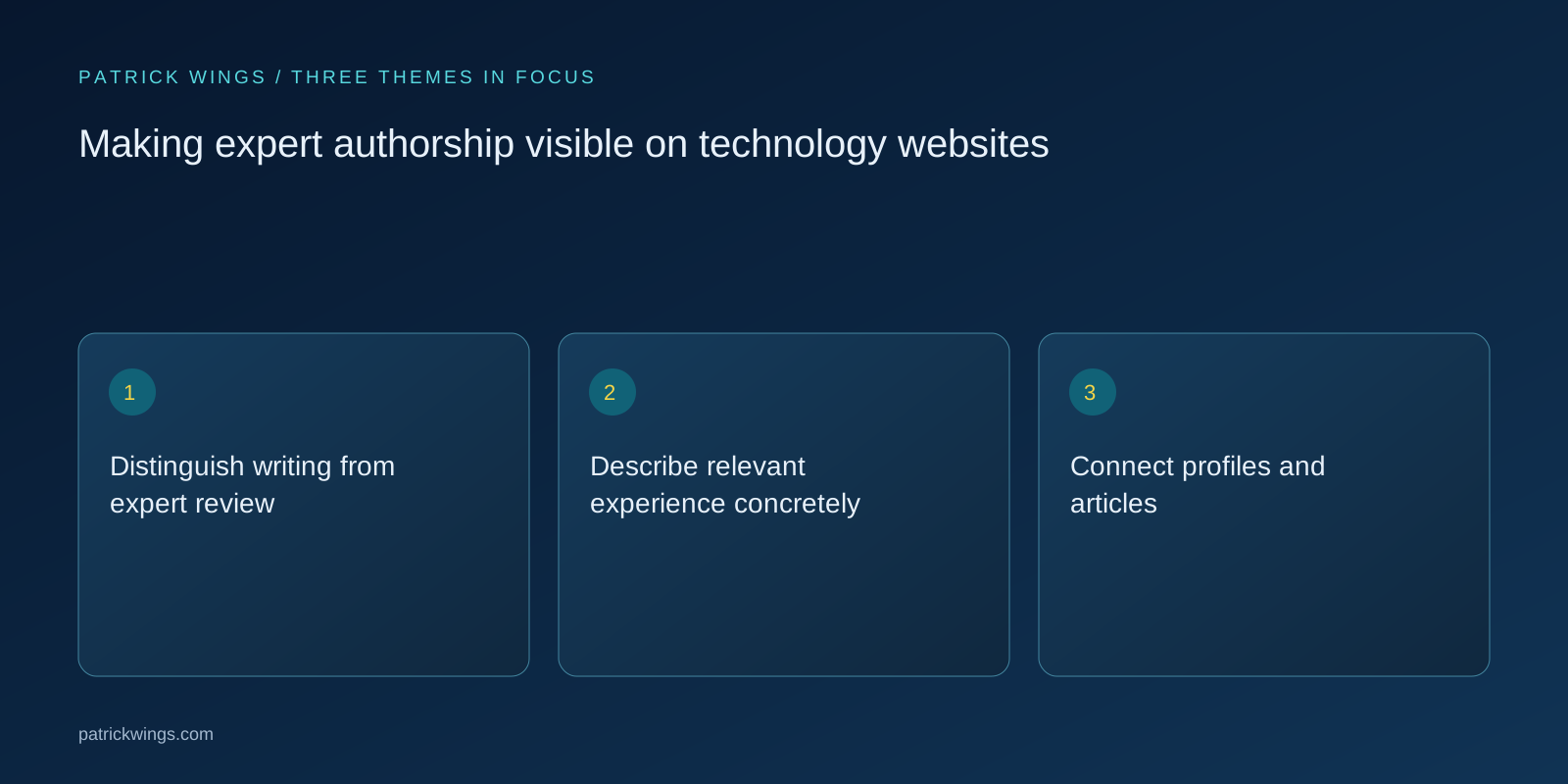
Connect profiles and articles
Give the author description a stable destination and link it from the visible byline. The profile can gather relevant work and offer a contact route without exposing private contact details. Keep German and English descriptions semantically consistent. Where structured article data is used, the name and profile address should match the visible presentation. Google documents authorship information within Article markup. Markup does not replace a readable explanation for people and cannot manufacture qualifications. After changes, check that links and names still identify the appropriate person and that former contributors remain accurately described rather than silently acquiring a different identity.
Example: an editor and a product specialist
A hypothetical IT company publishes a migration guide. An editor structures the explanation and researches public material. A technical specialist checks the procedure against the specified product version. The byline identifies the editor, while a separate note explains the expert review and its scope. The specialist’s profile describes relevant responsibilities rather than guaranteeing every claim on the website. If the guide later changes substantially, the old review note is not carried forward unchanged. This example illustrates accountable roles; it does not claim that such a review has occurred on this site or establish any ranking effect.

Explain material automation honestly
Where AI tools materially assist production, consider what readers need to know about the process. A short explanation may describe research assistance or drafting while identifying who remains responsible for facts and conclusions. Do not invent a human expert to disguise automatically published material. Avoid fabricated biographies or generated portraits presented as a nonexistent real author. A disclosure does not substitute for technical quality. Important claims still need suitable evidence, and any description of personal experience must reflect experience that actually exists. The explanation should clarify the work rather than function as an empty badge of editorial seriousness. Explore this further in the guide Maintaining technical claims through editorial review.
Preserve responsibility through changes
Assign an owner for updating profiles when roles or specialisms change. An article should distinguish original creation, subsequent revision and expert review where those details are provided. Do not change visible dates solely to suggest freshness. Give readers a practical way to report factual problems and route those reports to the responsible editor. Authorship supplies inspectable context for the work rather than a standalone technical guarantee of visibility. A useful final test is whether someone unfamiliar with the company can understand who contributed what and why that person is relevant to the article’s particular subject. Explore this further in the guide Editorial approvals with clear responsibilities and bounded review.
INTERACTIVE / FROM READING TO ACTION
Three checkpoints for your implementation
Choose a checkpoint and track your reading progress. Checks are neither saved nor sent and do not score your business.
CHECKPOINT 01
Connect profiles and articles
Give the author description a stable destination and link it from the visible byline.
Explore in the article ↗CHECKPOINT 02
Example: an editor and a product specialist
A hypothetical IT company publishes a migration guide.
Explore in the article ↗CHECKPOINT 03
Explain material automation honestly
Where AI tools materially assist production, consider what readers need to know about the process.
Explore in the article ↗Frequently asked questions
Does every article require an academic author?
No. Describe the genuinely relevant experience and responsibility accurately.
Can a reviewer be identified separately?
Yes, when a real review occurred and its scope is described accurately.
Does Article markup guarantee rankings?
No. Structured data should accurately describe visible information without promising rankings.
How can I put “Distinguish writing from expert review” into practice?
Identify who researches, who writes and who verifies important technical statements. One person may perform all three roles, but that is not required. A product manager can confirm functionality without having written the whole article.
What matters when working on “Describe relevant experience concretely”?
A useful profile explains the person’s specialism and relevant professional background. Select information that helps readers assess the subject at hand. A broad success story or a long collection of client logos does not answer that question by itself.