
WORK / CAN DO
Can Do: tripling MQLs with LinkedIn-first demand generation
More qualified demand with less internal coordination: the Can Do engagement connected channel decisions, relevant content and hands-on delivery in one demand-generation system.
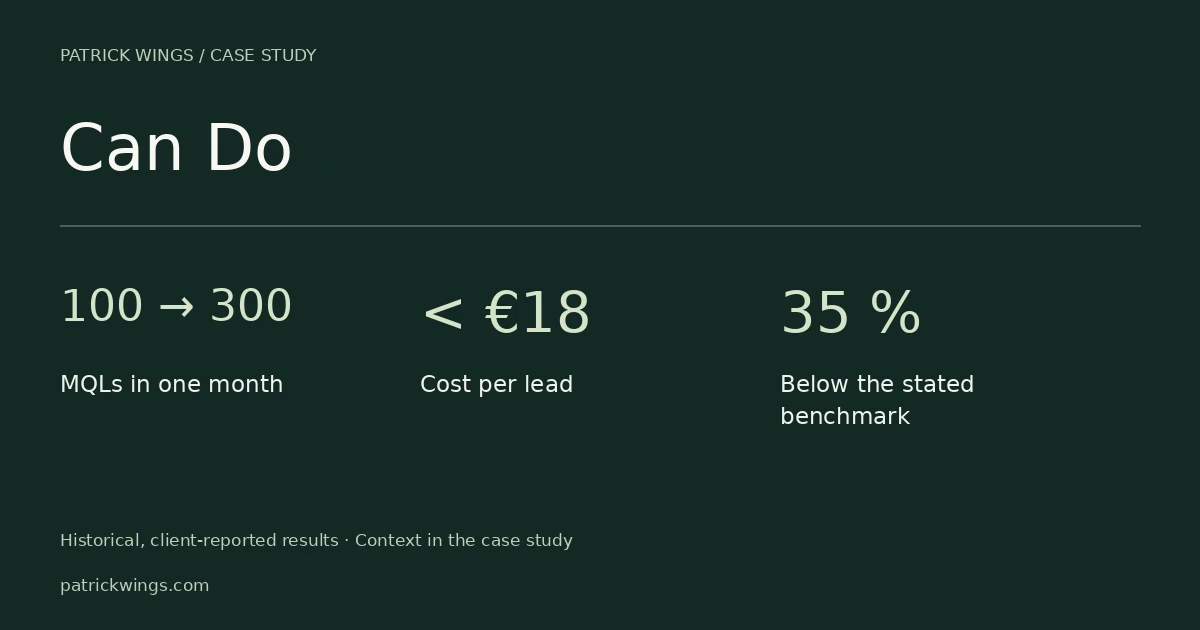
MQLs in one month
Threefold MQL count in the results overview.
Cost per lead
Per qualified marketing lead, as reported.
Below the stated benchmark
Benchmark comparison reported in the reference.
Historical, client-reported results. Measurement limits are explained in the case.
The approach at a glance
- 01
Test & prioritise
Channel focus
Compare Google Ads and LinkedIn by CPL and buyer-persona fit, then concentrate paid budget on LinkedIn.
- 02
Ongoing optimisation
Content & targeting
Translate pain points into suitable assets and creative ads, refining content and audiences using performance.
- 03
Shared workspace
Execution & handoff
Centralise tasks, deadlines and ownership, connecting delivery with nurture and sales.
The starting point: visible, but not yet scalable
Can Do provides AI-supported project and resource management software for proactive planning, early bottleneck identification and efficient resource use. The business already had visibility in DACH. Campaign efficiency, lead quality and internal capacity nevertheless fell short of its growth objectives.
LinkedIn initially underperformed expectations, while Google Ads produced a high CPL. Organic and paid activity did not deliver the required contact volume or fit. Repeatable demand generation also needed to support European growth plans.
The mandate: qualified leads and operational support
Can Do needed a B2B SaaS partner with audience focus, performance marketing expertise and execution capacity. Qualified marketing lead volume needed to grow while improving buyer-persona fit and acquisition costs.
The internal team needed to focus on subject-matter input and decisions. Repeated coordination and operational campaign tasks should not dominate the engagement. Strategy, execution and transparency were therefore treated as one connected brief.
Channel focus: evaluate cost and quality together
Early Google Ads and LinkedIn performance was compared. Alongside CPL, fit with the defined buyer persona mattered. A cheap contact alone was not sufficient evidence of success.
In this engagement, the data indicated greater efficiency and higher-quality leads from LinkedIn. Google Ads were paused and all paid budget shifted to LinkedIn. This was a project-specific decision, rather than a general claim against Google Ads for B2B SaaS.
Content and targeting: address concrete buyer problems
Campaign content addressed central buyer-persona pain points. Strategically selected assets were intended to create informed interest rather than reach alone. Content, creative formats and audience selection were aligned.
Performance feedback informed ongoing optimisation, with lead fit remaining important: which contacts matched the intended audience and merited follow-up? The reference describes this approach but does not supply a complete ad library or results for every audience segment.
Transparent execution: workspace, nurture and sales
A shared collaboration workspace brought tasks, projects, deadlines and responsibilities together. Both teams could follow progress without repeatedly requesting updates through status meetings or follow-up emails.
GROWSaaS handled campaign execution. Lead generation was connected with nurture and sales handoff so marketing contacts could progress through qualification. Can Do focused more on content input and decisions. Work organisation was part of the commercial delivery model.
Results: more MQLs and early evidence of sales quality
The results overview reports growth from 100 to 300 MQLs within one month and CPL below €18. According to the source, this was 35 percent below the stated LinkedIn industry benchmark. Client feedback describes almost tripling MQLs and more than 35 percent below the benchmark.
The client reports that MQLs progressed to SQLs and real opportunities in the first month. The reference provides no exact count, conversion rate or evidenced closed revenue for those stages. These downstream outcomes are therefore described qualitatively rather than extrapolated into a revenue forecast.
Measurement context: distinguish different starting figures
The starting-point slide mentions around 50 monthly leads from organic and paid sources before the new model. The results overview later describes 100 to 300 MQLs within one month. Definitions, periods and the relationship between these starting figures are not fully explained.
The 50 leads are therefore not treated as a direct baseline for 300 MQLs. The external benchmark source and methodology are also not supplied. Figures remain client-reported project results. Ariane Becker from Customer Care & Sales additionally highlights pipeline quality and early progression to SQLs and opportunities.
Documentation & measurement context
GROWSaaS Can Do Case Study 2026, German client reference. Results: page 8; feedback from Ariane Becker: page 9.
The figures document historical project results. Missing data is not replaced by assumptions. A new engagement receives its own objectives, definitions and measurement criteria.
Frequently asked questions
How much did Can Do’s MQL count grow?
The results overview reports 100 to 300 MQLs in one month. The separately stated 50 monthly leads are not treated as a directly comparable baseline.
Why were Google Ads paused?
Early project data indicated better efficiency and lead quality from LinkedIn. The budget shift was specific to this engagement.
What CPL was reported?
The reference reports under €18 per qualified marketing lead and 35 percent below a LinkedIn benchmark. Its methodology is not included.
Are MQLs already customers?
No. MQLs, SQLs, opportunities and paying customers are different stages. The source reports early SQLs and opportunities, but no evidenced revenue from them.
How can I tell whether a project is relevant to our marketing challenge?
Compare audience, market, starting point and the specific task with your situation first. Then review the described activities and metrics. A similar industry alone is not enough to expect the same results or timeline.
FROM IDEA TO EXECUTION