
THE SHORT ANSWER
A good conversation summary does not by itself create a dependable handoff. A CRM task needs an action, an owner, a relationship and a deadline that were actually agreed or explicitly remain unresolved. AI can prepare these elements from approved conversation material. The workflow must distinguish a discussed possibility, a confirmed commitment and a task already created, so nothing silently appears completed.
To connect individual AI applications with reliable marketing operations, read the pillar guide AI transformation in B2B marketing: from individual prompts to reliable operations.
Separate actions from conversation content
Give AI distinct categories for decisions, open questions, committed actions and tentative suggestions. Mentioning a possible workshop is not an instruction to organise it. Return the supporting passage for every action candidate and show whether the commitment is explicit or inferred. When the conversation supports no task, creating no task must be a valid result. That option prevents every summary from automatically producing an expanding list of ambiguous follow-up work that nobody on the team requested or agreed to own. Explore this further in the guide Retries without duplicate actions: resilient AI workflows.
Define a fixed task record
Specify required elements: concrete activity, owner, associated CRM record, origin and deadline status. HubSpot’s tasks API describes fields for due date, owner, subject and associations with existing records. Your business structure should also expose which details still require confirmation. An unknown deadline is different from a date invented by AI. Make that distinction visible in the preview. Use stable identifiers for assignment so a similarly named colleague or company does not accidentally receive the task or become associated with the wrong customer relationship.
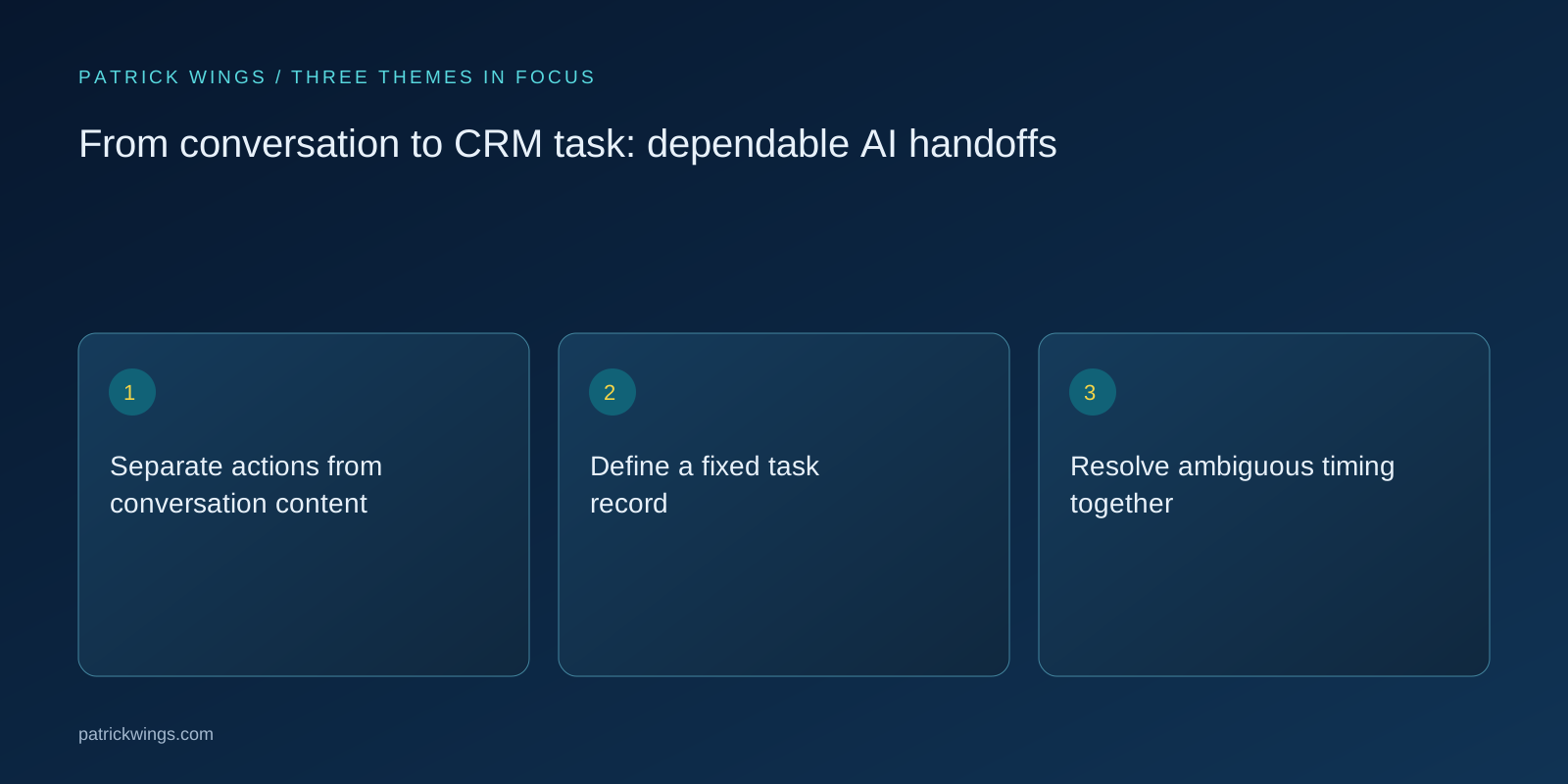
Resolve ambiguous timing together
Expressions such as next week or after the pilot require the conversation date and surrounding context. A relative deadline may also depend on another step actually finishing. Ask a targeted clarification instead of converting an unresolved dependency into an arbitrary calendar date. Retain the original wording alongside the confirmed date. Distinguish an internal reminder from a delivery deadline promised to the customer. These may be connected, but they have different consequences when they are recorded incorrectly or prematurely treated as binding commitments in CRM.
Show the concrete handoff before writing
The responsible person should see the exact task to be created, including its association and deadline. Approving a conversation summary does not automatically approve subsequent record changes. Also show which information will be stored only as a note and which fields would change. Restrict write access to the agreed scope. If the CRM association changes after preview, review the handoff again. Consent then concerns an identifiable action, rather than a general statement about helpful automation that leaves the actual effects of a write operation unclear.

Unpack a hypothetical pilot conversation
Suppose a customer says their IT team must first check data access. Sales offers to propose an implementation session after receiving that internal response. AI must not turn this into an already booked workshop with a fixed deadline. A documented data-access dependency and an internal reminder for the salesperson are appropriate. The actual response triggers scheduling later. This example connects conversation context, responsibility and follow-up without attributing a commitment to the customer that they never made during the meeting or agreed to afterwards. Explore this further in the guide B2B sales agents: improve preparation while keeping relationships accountable.
Verify writes and control repetition
After creation, the process needs a confirmed task identifier and a check of the stored association. A successfully drafted description does not prove that the CRM operation succeeded. If a technical response is missing, inspect the existing state before executing the same request again. Where the platform supports it, connect the handoff to a unique conversation-and-action combination. Test interrupted runs and repeated approvals. Otherwise the effort to secure dependable follow-up can itself create duplicate tasks with conflicting ownership, deadlines or reminders that distract colleagues from the actual commitment.
Measure quality through executable follow-up
Check whether tasks are understandable, correctly assigned and usable later. The number of generated tasks is a poor success measure. Include test conversations with missing deadlines, changing speakers, rejected suggestions and several customer relationships. Ask subject users to explain what they would do from the saved record. If their answers differ from the agreement, improve the structure or clarification step. The process is useful only when another colleague can take over the handoff without rereading the entire conversation or guessing what the original salesperson intended.
INTERACTIVE / FROM READING TO ACTION
Three checkpoints for your implementation
Choose a checkpoint and track your reading progress. Checks are neither saved nor sent and do not score your business.
CHECKPOINT 01
Resolve ambiguous timing together
Expressions such as next week or after the pilot require the conversation date and surrounding context.
Explore in the article ↗CHECKPOINT 02
Show the concrete handoff before writing
The responsible person should see the exact task to be created, including its association and deadline.
Explore in the article ↗CHECKPOINT 03
Unpack a hypothetical pilot conversation
Suppose a customer says their IT team must first check data access.
Explore in the article ↗Frequently asked questions
What if no owner was named?
Leave the candidate unresolved and ask. The currently signed-in user is not automatically responsible.
Can a summary trigger tasks directly?
Only within an explicitly defined workflow. The concrete task and association must meet the agreed approval rules.
How do we prevent duplicate tasks?
Check existing state and the confirmed task identifier, especially after timeouts or repeated approvals.
How can I put “Separate actions from conversation content” into practice?
Give AI distinct categories for decisions, open questions, committed actions and tentative suggestions. Mentioning a possible workshop is not an instruction to organise it. Return the supporting passage for every action candidate and show whether the commitment is explicit or inferred.
What matters when working on “Define a fixed task record”?
Specify required elements: concrete activity, owner, associated CRM record, origin and deadline status. HubSpot’s tasks API describes fields for due date, owner, subject and associations with existing records. Your business structure should also expose which details still require confirmation.