
THE SHORT ANSWER
Recorded agent state distinguishes planned work from confirmed results. Store states, evidence and unresolved decisions for each work unit rather than relying on a fluent closing message. A resumed process must recognise what was proposed, what was actually executed and what was independently confirmed. This matters whenever tools respond late or a person takes over between steps.
To connect individual AI applications with reliable marketing operations, read the pillar guide AI transformation in B2B marketing: from individual prompts to reliable operations.
Define a small set of distinct states
Start with understandable states such as received, prepared, awaiting approval, execution uncertain, confirmed complete and stopped. Specify the evidence required for each. A successful tool request may mean an operation was accepted rather than that the intended change is already visible. A sentence written by the agent cannot replace a system record. Avoid states expressing a feeling, such as almost finished. State should enable a concrete next decision by someone who did not follow the earlier conversation and cannot infer what the agent probably meant.
Link state to verifiable evidence
For each step, record the work identifier, affected record, relevant version, timestamp and result reference. Evidence might be a generated draft identifier, a validation result or a read-back of the destination state. Retain sensitive raw data only where necessary and authorised. A reference to an appropriately permissioned source system can be more useful than copying everything into logs. Separate observation from interpretation: the tool reported acceptance is an observation; the customer was informed is a stronger conclusion that may be false without a confirmed sending record.
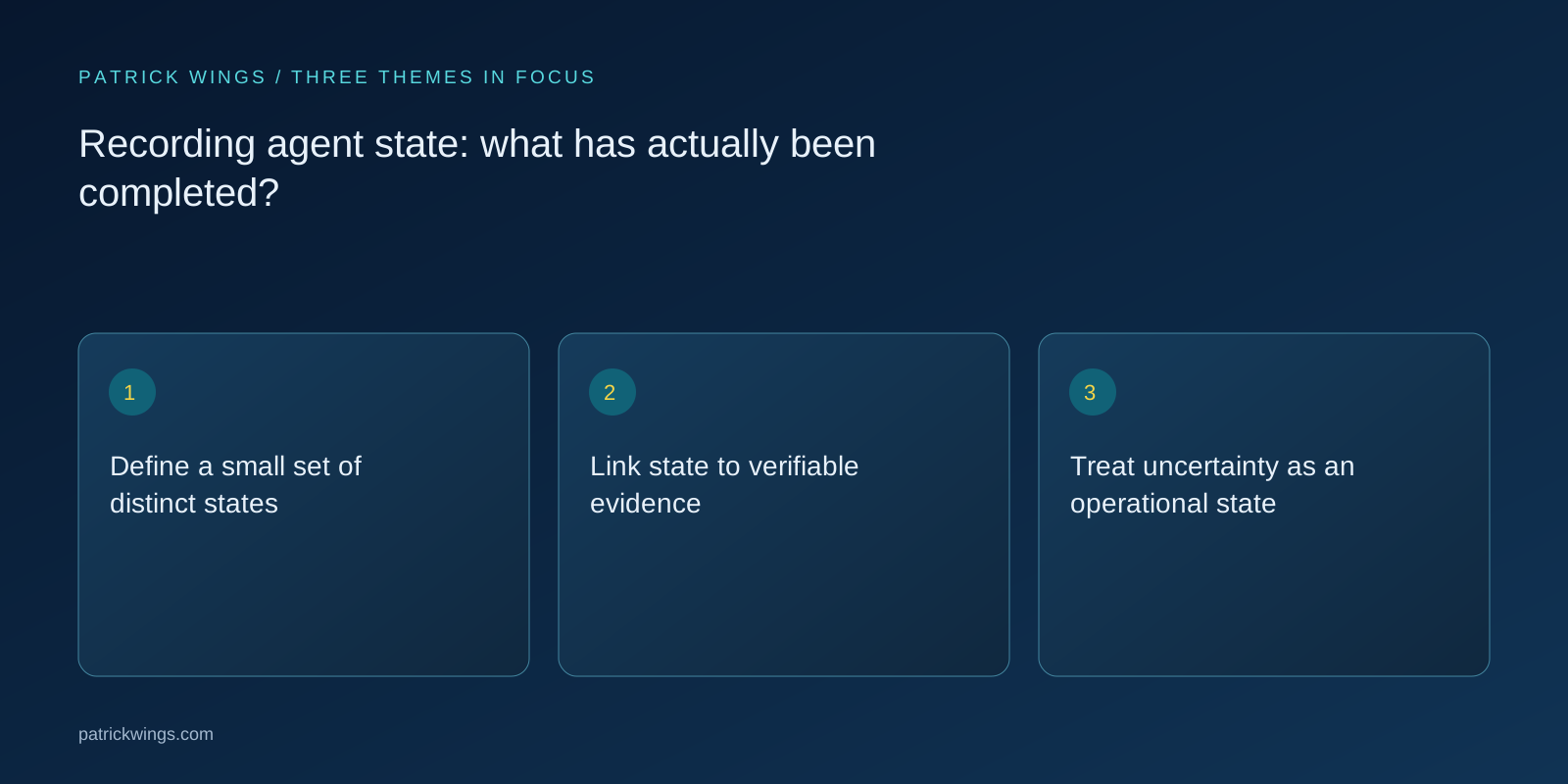
Treat uncertainty as an operational state
If a request times out without a result, you initially do not know whether the action happened. Mark the step uncertain and inspect the destination before repeating it. Assign a person when reliable verification is unavailable. The agent must not remove uncertainty through an optimistic closing message. Apply the same discipline to partial execution: a created draft and a failed filing operation are separate outcomes. Explain which part is usable and which follow-up remains blocked so the next operator can continue without discarding valid work or assuming more happened than did.
Design resumption and human takeover
A handoff should contain the current state, confirmed results, missing prerequisites and next permitted step. State which actions have explicitly not happened. If a person changes a decision, record a new version rather than overwriting the history. Recheck time-sensitive prerequisites before resuming. An approved draft may now be stale or refer to a changed record. A stored summary helps the next operator get oriented, but cannot replace checking the conditions for a consequential change again. Preserve the relationship between the original approval and the exact version it covered. Explore this further in the guide Retries without duplicate actions: resilient AI workflows.

Inspect a fictional interrupted task
A fictional agent must create an internal research report and file it in a project folder. The report exists, but the filing request ends without a clear response. State therefore records report available, filing uncertain. On resumption, the process first looks for the expected file and checks its identifier or content rather than immediately creating another copy. This hypothetical case shows why completed subtasks and ambiguous side effects need separate records. A blanket failure would create unnecessary repeat work; a blanket success would conceal an unresolved operation and mislead the receiving team. Explore this further in the guide Describing agent tools: clear inputs and verifiable results.
Test transitions rather than closing messages
Simulate interruptions before and after tool requests, delayed responses and human changes during a pause. Check that the next run recognises the same evidenced results and does not repeat confirmed changes. Verify that missing evidence prevents completion. A reviewer should be able to read the handoff and identify the next safe step. If the entire chat must be reconstructed, the state record is insufficient. Add newly observed failure modes to tests and reconsider state definitions when an integration changes its response semantics or introduces asynchronous processing.
INTERACTIVE / FROM READING TO ACTION
Three checkpoints for your implementation
Choose a checkpoint and track your reading progress. Checks are neither saved nor sent and do not score your business.
CHECKPOINT 01
Treat uncertainty as an operational state
If a request times out without a result, you initially do not know whether the action happened.
Explore in the article ↗CHECKPOINT 02
Design resumption and human takeover
A handoff should contain the current state, confirmed results, missing prerequisites and next permitted step.
Explore in the article ↗CHECKPOINT 03
Inspect a fictional interrupted task
A fictional agent must create an internal research report and file it in a project folder.
Explore in the article ↗Frequently asked questions
Is the conversation history enough as state storage?
Usually not. Binding states and evidence should be available in a structured, findable form.
Can a timeout be treated as failure?
Not automatically. The action may have occurred, so inspect the destination state.
When is a task complete?
When its agreed completion conditions are supported by appropriate evidence, rather than when the agent writes a closing sentence.
How can I put “Define a small set of distinct states” into practice?
Start with understandable states such as received, prepared, awaiting approval, execution uncertain, confirmed complete and stopped. Specify the evidence required for each. A successful tool request may mean an operation was accepted rather than that the intended change is already visible.
What matters when working on “Link state to verifiable evidence”?
For each step, record the work identifier, affected record, relevant version, timestamp and result reference. Evidence might be a generated draft identifier, a validation result or a read-back of the destination state. Retain sensitive raw data only where necessary and authorised.