
THE SHORT ANSWER
When marketing delivers contacts and sales interprets their quality differently, the missing piece is often a shared operating model. Effective alignment starts with clear definitions, verifiable handovers and feedback that both teams can turn into decisions.
For the broader picture of how target customers, channels and sales handoffs work together, read the pillar guide B2B demand generation: from attention to qualified pipeline.
Establish a shared starting point
Review several real contact journeys together: a won customer, a lost opportunity, a suitable contact without a current project and an obviously unsuitable enquiry. Describe what was actually known at handover. This separates poor information from conflicting expectations. Marketing cannot promise a confirmed procurement project when the campaign offered only an educational guide. Sales should not classify someone as unsuitable merely because the timing is wrong. Working through concrete cases exposes these differences before you introduce more reporting or automation. It also gives both teams a shared language grounded in situations they recognise rather than an abstract funnel diagram. Explore this further in the guide B2B lead nurturing: support unresolved buying decisions.
Define lifecycle stages as business rules
Write down what a lead, marketing-qualified contact, sales-qualified contact and opportunity mean in your organisation. HubSpot provides lifecycle stages for representing progression, but your team must agree the business interpretation. Each stage needs observable entry criteria and an accountable role. An illustrative MQL could be a suitable company making an explicit request. An opportunity requires further commercial assessment. Avoid definitions based solely on an arbitrary number of clicks. Otherwise engagement patterns can change the apparent pipeline without any corresponding improvement in need. Explain each stage using a real example and a counterexample that should not enter it.
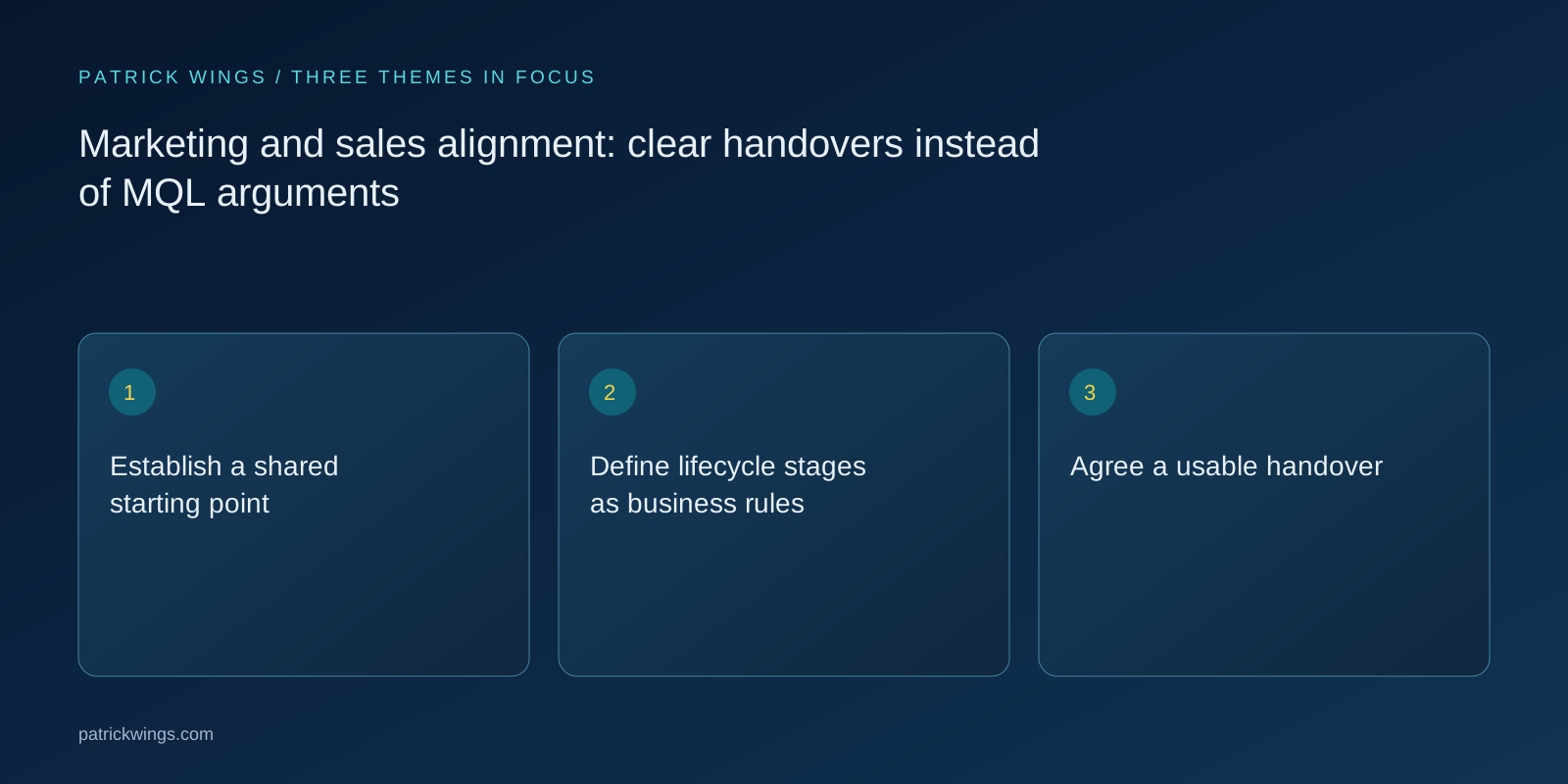
Agree a usable handover
Specify what sales receives: source, requested offer, company context, known role and any voluntarily stated requirement. Add ownership and a realistic response agreement. An urgent demonstration request deserves different handling from an informational download. Cover absence, reassignment and technical failures as well as the normal path. Test the process with a controlled record from submission through the CRM task. Check whether the responsible person can understand the context without asking marketing to reconstruct it. A handover works when someone can take a sensible action, not merely when an integration reports successful synchronisation.
Capture differentiated feedback
Use a small set of clear return reasons such as product mismatch, no current project, existing customer, unreachable or incorrect stakeholder. Add a brief free-text note where an important pattern would otherwise disappear. A blanket “poor quality” label rarely supports action. Failed contact attempts might result from incorrect information, an unsuitable approach or inappropriate timing. Investigate these causes separately. Return suitable contacts without present buying readiness to an appropriate nurture path where communication is permitted. Record the change so that different teams do not send contradictory messages simultaneously. The feedback mechanism should make future contact more helpful rather than simply close a task. Explore this further in the guide B2B lead qualification: separate fit, interest and buying readiness.

Turn shared reviews into decisions
Hold regular short reviews using a stable dataset and concrete cases. Examine volume, suitability, handling and progression for the same contact cohort. Separate operational failures from weaknesses in the offer. If many prospects ask the same integration question, explanatory content may help more than another targeting restriction. If suitable enquiries remain untouched, additional advertising will not solve the problem. End each review with a limited number of changes, named owners and a review point. A shared dashboard supports the conversation, but alignment is created through decisions and follow-through rather than through the existence of a reporting tool alone.
Account for incentives and capacity
A team measured only on contact volume can optimise differently from a team evaluated solely on closed revenue. Introduce shared quality and progression measures while keeping ownership clear. Consider how many enquiries sales can reasonably handle and where customer success can identify valuable need signals. Coordinate campaign launches with available capacity. Operating rules should allow exceptions, such as a strategically important enquiry outside the central profile. Documented exceptions create learning opportunities. Invisible workarounds make definitions unreliable and weaken later evaluation. Review whether the operating model improves actual buyer treatment, because a tidy internal process has little value if it leaves prospective customers confused or waiting.
INTERACTIVE / FROM READING TO ACTION
Three checkpoints for your implementation
Choose a checkpoint and track your reading progress. Checks are neither saved nor sent and do not score your business.
CHECKPOINT 01
Agree a usable handover
Specify what sales receives: source, requested offer, company context, known role and any voluntarily stated requirement.
Explore in the article ↗CHECKPOINT 02
Capture differentiated feedback
Use a small set of clear return reasons such as product mismatch, no current project, existing customer, unreachable or incorrect stakeholder.
Explore in the article ↗CHECKPOINT 03
Turn shared reviews into decisions
Hold regular short reviews using a stable dataset and concrete cases.
Explore in the article ↗Frequently asked questions
What belongs in a marketing-sales agreement?
Shared definitions, handover information, ownership, realistic response expectations, return reasons and escalation routes.
Should every MQL become an opportunity?
No. An MQL meets the agreed handover criteria. Further assessment determines whether there is a genuine sales opportunity.
How should we handle poor timing?
Separate a lack of current buying readiness from a lack of fit. Suitable contacts can receive relevant nurturing where communication is permitted.
How can I put “Establish a shared starting point” into practice?
Review several real contact journeys together: a won customer, a lost opportunity, a suitable contact without a current project and an obviously unsuitable enquiry. Describe what was actually known at handover. This separates poor information from conflicting expectations.
What matters when working on “Define lifecycle stages as business rules”?
Write down what a lead, marketing-qualified contact, sales-qualified contact and opportunity mean in your organisation. HubSpot provides lifecycle stages for representing progression, but your team must agree the business interpretation. Each stage needs observable entry criteria and an accountable role.