
THE SHORT ANSWER
A usable AI baseline measures the whole journey from an incoming task to an accepted result. Record active handling, waiting, rework and professional quality separately. This reveals whether a pilot actually reduces work or simply transfers it to reviewers. The method below is a practical measurement recommendation for your team, rather than a general return forecast or a claim that generating an output equals completing a task.
To connect individual AI applications with reliable marketing operations, read the pillar guide AI transformation in B2B marketing: from individual prompts to reliable operations.
Define the unit and its accepted endpoint
Choose a concrete work unit, such as an approved campaign brief with supporting sources and complete required fields. Start measurement when a reviewable request arrives and end when the designated owner accepts the result. State which preparation sits outside that boundary. Otherwise a pilot may look faster because someone cleaned its inputs beforehand. Record who decides acceptance and which defects require a return. A generated file is not yet a completed work product. Test this definition against several recently finished requests before collecting comparison data.
Separate handling time from elapsed time
Record time spent actively researching, drafting and reviewing. Track waits for sources, clarification and approval separately. A model may shorten drafting while an unresolved product decision continues to determine delivery. Add the number of returns and time spent correcting them. Use identical categories for the existing process and the pilot. If precise tracking disrupts normal work, agree on reasonable time bands and label the uncertainty. Do not subsequently compare those estimates with precise system logs as though both measurements had the same accuracy and scope.
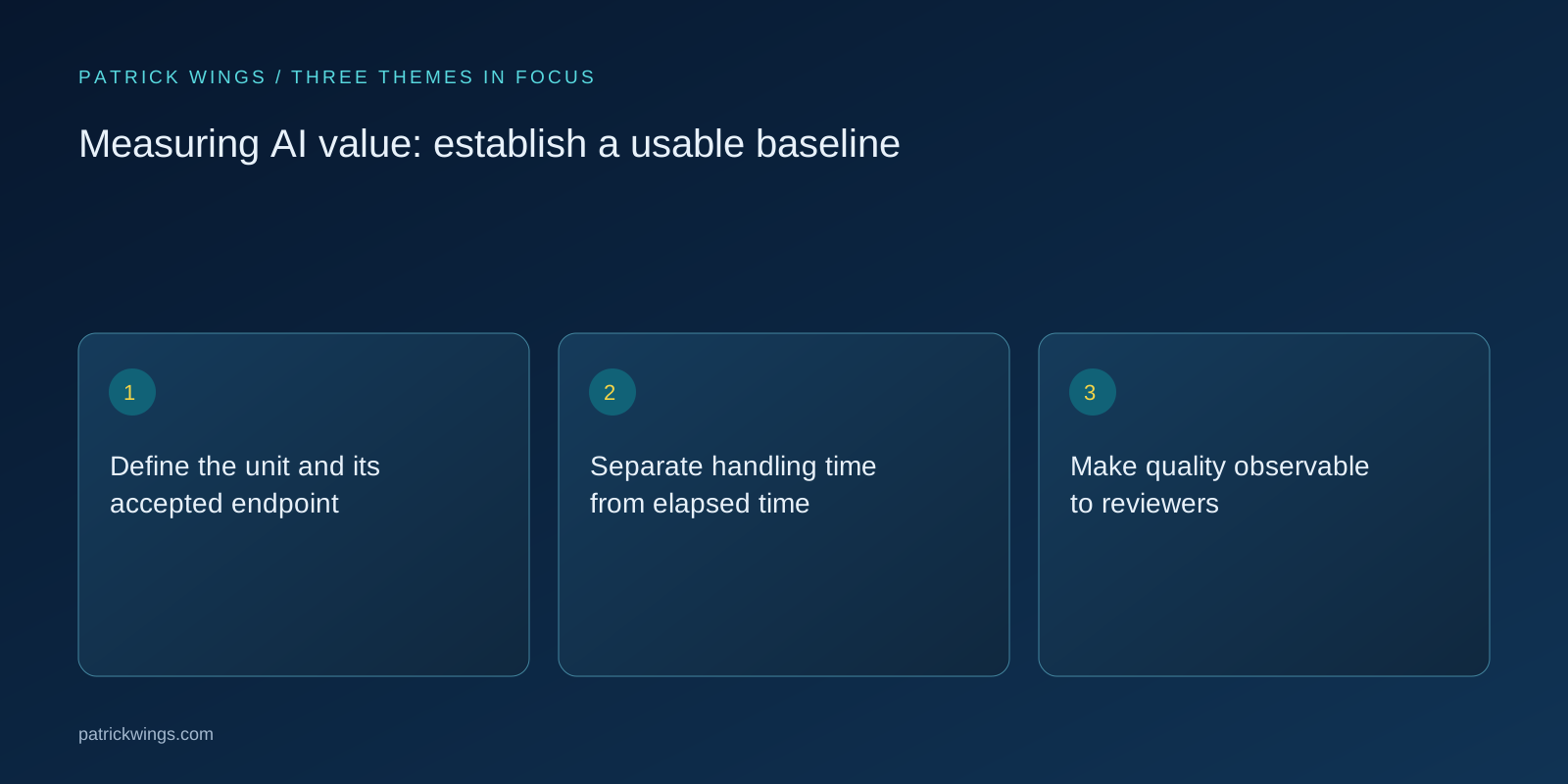
Make quality observable to reviewers
Choose criteria that users of the result can actually inspect: correct product statements, evidence supporting claims, complete mandatory information and an actionable handoff. Distinguish small editorial changes from errors that change a decision. A single average quality score can hide that difference. Ask a second knowledgeable person to assess some cases independently and discuss disagreements. Shared interpretation matters more than an apparently precise number. Retain examples of acceptable and unacceptable outputs so later reviewers apply the same quality boundary rather than inventing a new one. Explore this further in the guide Evaluating AI outputs: rubrics reviewers can use consistently.
Compare similar work and disclose differences
Do not silently compare easy pilot tasks with difficult historical tasks. Label relevant factors such as language, source availability, product complexity and approval requirements. Use a comparable mix and the same acceptance conditions during the pilot. Show setup and learning effort, even when these are accounted for separately from recurring operating costs. With few observations, describe individual cases and ranges rather than claiming a stable effect. One unusually fast demonstration cannot support an annual saving estimate for every task across a department or company.

Work through an explicitly hypothetical example
A fictional SaaS team currently spends forty minutes researching a brief, thirty minutes drafting and twenty minutes reviewing. In a hypothetical pilot, drafting falls to ten minutes but review rises to thirty-five minutes. The net difference in this invented case is five minutes before setup and operation are included. Additional source maintenance could remove that benefit. These figures illustrate the calculation; they are not observed results or expected performance for your process. The example also shows why counting only the accelerated step can produce a misleading business case.
Decide using limits and a countercheck
Present time, quality, rework and remaining uncertainty together. Agree beforehand which defects remain unacceptable regardless of faster handling. Compare a simple alternative, such as an improved intake form. If both options perform similarly, lower maintenance and easier handover may determine the choice. Repeat measurement after material process changes. Preserve original definitions and document revisions so later comparisons do not silently count different work units. The next decision may reasonably be a narrower pilot, better preparation or wider adoption, depending on the evidence and remaining dependencies. Explore this further in the guide Prioritising AI automation: a backlog for clear decisions.
INTERACTIVE / FROM READING TO ACTION
Three checkpoints for your implementation
Choose a checkpoint and track your reading progress. Checks are neither saved nor sent and do not score your business.
CHECKPOINT 01
Make quality observable to reviewers
Choose criteria that users of the result can actually inspect: correct product statements, evidence supporting claims, complete mandatory information and an actionable handoff.
Explore in the article ↗CHECKPOINT 02
Compare similar work and disclose differences
Do not silently compare easy pilot tasks with difficult historical tasks.
Explore in the article ↗CHECKPOINT 03
Work through an explicitly hypothetical example
A fictional SaaS team currently spends forty minutes researching a brief, thirty minutes drafting and twenty minutes reviewing.
Explore in the article ↗Frequently asked questions
Must we measure every second?
No. Consistent, proportionate measurement is more useful than different levels of precision across comparison groups.
Does human review count as AI effort?
Yes. Excluding review, rework and source maintenance understates operational effort.
Is an average time enough?
No. Show case differences, quality defects and waiting time so easy fast tasks do not dominate the conclusion.
How can I put “Define the unit and its accepted endpoint” into practice?
Choose a concrete work unit, such as an approved campaign brief with supporting sources and complete required fields. Start measurement when a reviewable request arrives and end when the designated owner accepts the result. State which preparation sits outside that boundary.
What matters when working on “Separate handling time from elapsed time”?
Record time spent actively researching, drafting and reviewing. Track waits for sources, clarification and approval separately. A model may shorten drafting while an unresolved product decision continues to determine delivery.