
THE SHORT ANSWER
An evaluation rubric translates quality into observable criteria with understandable boundaries. Specify required content, defects that make an output unusable and areas where alternative wording remains acceptable. A shared rubric is primarily a tool for consistent decisions. It becomes useful evidence only when reviewers actually interpret it similarly on the same examples, rather than merely agreeing that its labels sound sensible.
To connect individual AI applications with reliable marketing operations, read the pillar guide AI transformation in B2B marketing: from individual prompts to reliable operations.
Start with the purpose of the output
Ask which decision or follow-up work the output must support. A research brief needs traceable evidence and a distinction between observation and inference. A CRM suggestion needs the correct record and field meaning. Do not simply copy a generic list of helpful, accurate and well written. Those terms are too open without anchors. Describe how a knowledgeable reader recognises a usable result and which missing information prevents the next step. Connect each criterion to that concrete purpose so reviewers can explain why it matters and what improvement would make a difference.
Separate criteria covering different failures
Assess factual correctness, evidence coverage, completeness and actionability separately where relevant. A well-supported answer may still address the wrong question. A complete draft may contain an unauthorised commitment. If everything disappears into one score, you cannot see which change helps. Define mandatory boundaries whose violation prevents acceptance. Their scope should follow the consequences of failure. A minor style difference should not receive the same treatment as an incorrect recipient or invented source in an external claim. Preserve these distinctions when reporting results rather than turning every defect into interchangeable points.
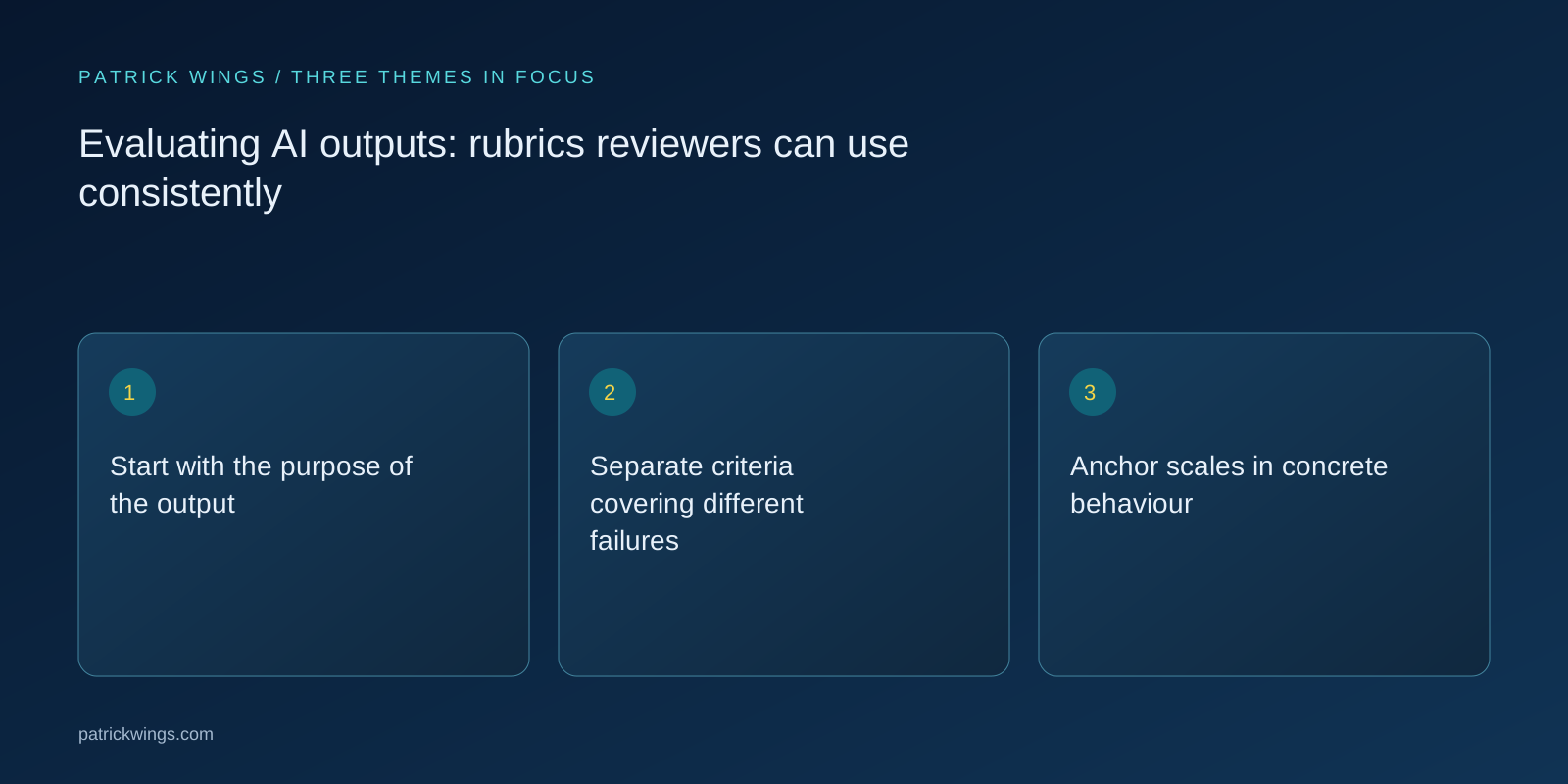
Anchor scales in concrete behaviour
Describe observable behaviour for each level and provide an example. For evidence coverage, an inadequate level might mean a decision-relevant claim lacks a supporting source. A better level requires support for those particular claims. Avoid numerous numerical distinctions reviewers cannot explain. A simple usable, correctable and reject classification can be more informative. Specify how inapplicable criteria are handled so they do not artificially raise or lower overall results. Also explain whether an omitted required element differs from an incorrect one, because those defects can call for different corrective work despite receiving similar scores.
Calibrate through independent first assessments
Give reviewers the same cases without discussing the desired score first. Compare their explanations and referenced passages. If disagreement arises from an unclear definition, revise the rubric. If specialists apply different business rules, resolve the rule first. Do not manufacture agreement by averaging numbers. Retain anchor cases with jointly reasoned assessments. New reviewers can practise on those before assessing operational work. Repeat calibration when products, output types or consequences change substantially and old examples no longer represent the decisions reviewers are actually expected to make in the updated process. Explore this further in the guide Using AI as a judge: calibrate evaluations with people.

Evaluate an explicitly fictional answer
A fictional agent produces a competitor overview with correct product names and a clear structure but describes an unknown contract feature as unavailable. The rubric can recognise good organisation while marking the unsupported negative statement as a consequential factual defect. A valid correction would state that availability is unknown. This hypothetical example shows why language quality should not compensate for missing evidence. It also demonstrates why evaluation need not depend on one reference sentence: several different texts can handle the uncertainty correctly while supporting the same business decision and respecting the same evidence boundary.
Treat rubric revisions as measurement changes
Version criteria and anchor examples. After changing a definition, reassess a common case set before comparing old and new overall results. Record whether improvement came from the system or a changed standard. Use dimensions diagnostically: weak evidence coverage may require better research rather than a different writing style. Watch review effort as well. A rubric nobody can fully apply in everyday work needs a more practical format or explicit review priorities. Do not silently remove precisely the criteria intended to detect consequential errors simply because those checks take more effort than assessing tone or presentation. Explore this further in the guide Testing AI changes: catch regressions before rollout.
INTERACTIVE / FROM READING TO ACTION
Three checkpoints for your implementation
Choose a checkpoint and track your reading progress. Checks are neither saved nor sent and do not score your business.
CHECKPOINT 01
Anchor scales in concrete behaviour
Describe observable behaviour for each level and provide an example.
Explore in the article ↗CHECKPOINT 02
Calibrate through independent first assessments
Give reviewers the same cases without discussing the desired score first.
Explore in the article ↗CHECKPOINT 03
Evaluate an explicitly fictional answer
A fictional agent produces a competitor overview with correct product names and a clear structure but describes an unknown contract feature as unavailable.
Explore in the article ↗Frequently asked questions
How many criteria do we need?
Enough to cover distinct important quality dimensions. Each criterion needs a clear purpose.
Can we calculate an overall score?
Yes, provided individual dimensions and critical rejection conditions remain visible rather than disappearing into an average.
What does low reviewer agreement mean?
It can indicate unclear criteria, missing information or different professional rules; inspect the explanations.
How can I put “Start with the purpose of the output” into practice?
Ask which decision or follow-up work the output must support. A research brief needs traceable evidence and a distinction between observation and inference. A CRM suggestion needs the correct record and field meaning.
What matters when working on “Separate criteria covering different failures”?
Assess factual correctness, evidence coverage, completeness and actionability separately where relevant. A well-supported answer may still address the wrong question. A complete draft may contain an unauthorised commitment.