
THE SHORT ANSWER
During an AI incident, first limit further effects, establish the actual work state and assign responsibility for recovery. Distinguish technical outages from professionally incorrect results and ambiguous changes. Restarting does not automatically repair consequences already created. The process must identify affected work, necessary correction and the conditions under which operations may resume, including tasks that continue running in external systems after the agent itself stops.
To connect individual AI applications with reliable marketing operations, read the pillar guide AI transformation in B2B marketing: from individual prompts to reliable operations.
Define the incident through affected work
Not every slow request is an incident, while a professionally incorrect result can matter even when the technology reports success. Describe triggers such as disallowed updates, incorrectly sent information or systematic source confusion. Assess scope, affected people and possible downstream consequences. Mark uncertainty explicitly rather than treating an early suspicion as the final cause. Record known facts separately from hypotheses. This supports proportionate immediate action and prevents an incorrect initial diagnosis from directing every later investigation toward the wrong component while the actual source of impact continues unchecked elsewhere.
Limit further actions deliberately
Pause the affected route or disable its change capability when additional consequences are possible. Disabling every reading function is not always necessary; the scope should follow the affected area. Check whether the stop actually cancels external actions already in progress. Some jobs continue at the destination. Prevent automatic retries while their effects remain unclear. Record the measure and its time so later investigation can distinguish results created before containment from tasks affected by the interruption itself. Also provide a controlled route for legitimate work that still needs to proceed while the affected automation is unavailable. Explore this further in the guide Retries without duplicate actions: resilient AI workflows.
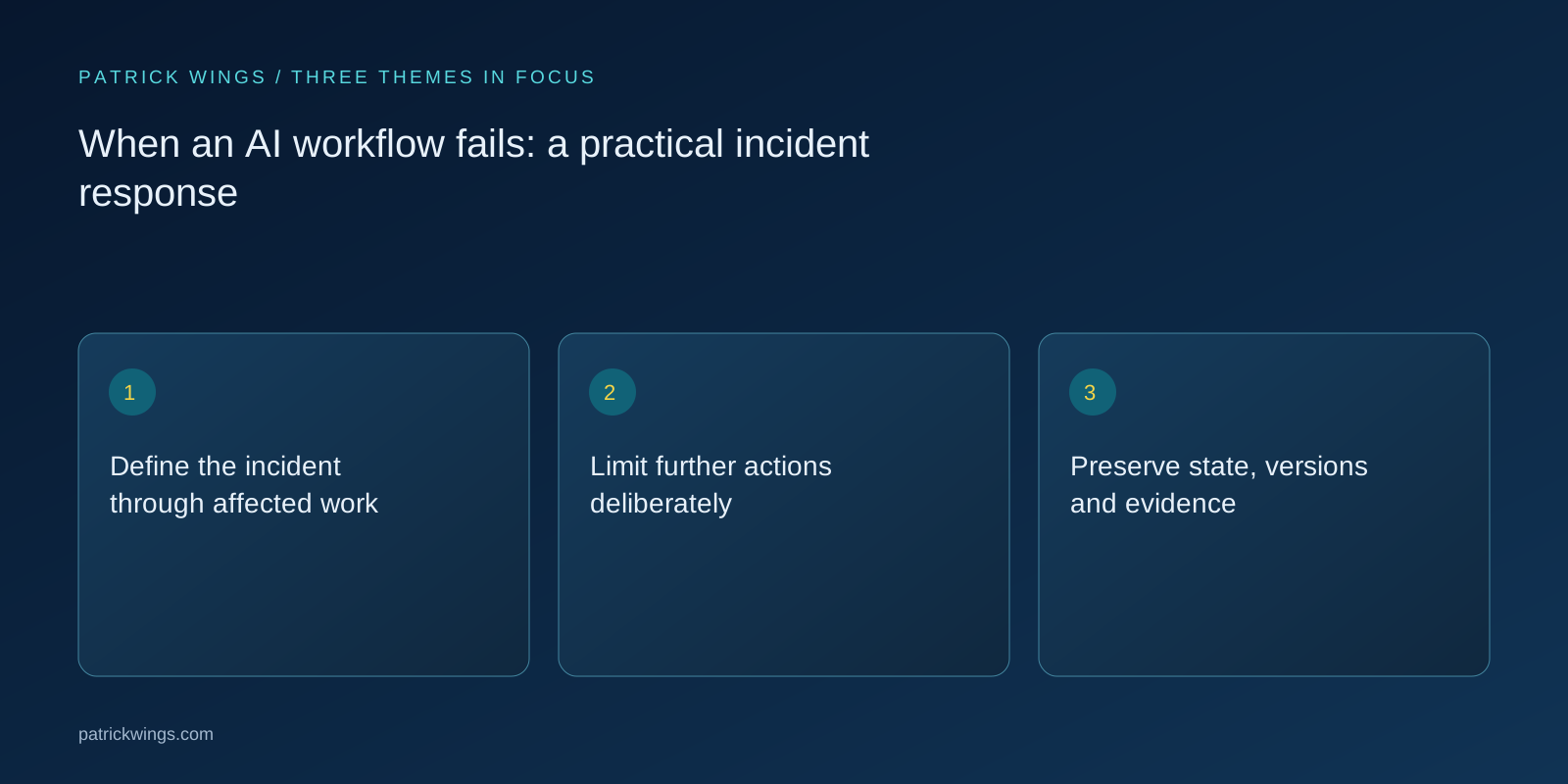
Preserve state, versions and evidence
Retain traceable work identifiers, relevant inputs, tool outcomes and configurations. Protect evidence from unnecessary changes and limit access appropriately. Do not create uncontrolled copies of sensitive data in arbitrary communication channels. Inspect actual destination state and mark unknown side effects. An agent report alone is insufficient. If a CRM field was overwritten, establish its stored value, earlier versions and relationship to downstream activity. This allows the team to determine whether a record correction is enough or whether exports and follow-up tasks also need review. Preserve the distinction between confirmed observations and reconstructed assumptions throughout recovery.
Coordinate diagnosis and recovery
Name an incident coordinator, specialists for affected content and technical integration owners. Maintain a shared current status so parallel efforts do not repeatedly change the same records. Distinguish a temporary operating workaround from permanent remediation. Manual handling may keep work moving while the cause is investigated. Each corrective action needs a verifiable scope and evidence of the resulting state. Avoid hurried bulk changes without record-level relationships. They can destroy original evidence or introduce new differences that later become difficult to distinguish from the incident itself, slowing rather than accelerating reliable recovery. Explore this further in the guide Writing AI runbooks: operate beyond the original builders.

Handle an explicitly fictional source incident
A fictional knowledge agent accidentally uses an outdated regional price list. The team pauses the affected answer path, identifies outputs produced since the source change and has specialists review them. It does not blindly replace every number because some requests concern other markets. After correcting the source, the team tests a comparison case containing both old and new documents. This hypothetical example shows why scoping and case inspection come before a blanket restart. Successfully updating the source does not establish that earlier incorrect answers or subsequent work triggered by those answers have already been repaired.
Resume against explicit acceptance conditions
Check the cause as necessary, containment effectiveness and correction of affected work. Test the original failure and related established paths. Decide on bounded resumption with appropriate additional observation. Record unresolved risks and who owns them. After stabilisation, investigate without blame why existing controls did not prevent or detect the issue. Add concrete changes to tests, the runbook and ownership arrangements. An incident record is useful when another team can reconstruct the process and later verify implementation of the improvements, rather than merely reading that awareness was raised or that people were reminded to be more careful.
INTERACTIVE / FROM READING TO ACTION
Three checkpoints for your implementation
Choose a checkpoint and track your reading progress. Checks are neither saved nor sent and do not score your business.
CHECKPOINT 01
Preserve state, versions and evidence
Retain traceable work identifiers, relevant inputs, tool outcomes and configurations.
Explore in the article ↗CHECKPOINT 02
Coordinate diagnosis and recovery
Name an incident coordinator, specialists for affected content and technical integration owners.
Explore in the article ↗CHECKPOINT 03
Handle an explicitly fictional source incident
A fictional knowledge agent accidentally uses an outdated regional price list.
Explore in the article ↗Frequently asked questions
Should we restart everything immediately?
Not when side effects are uncertain. Preserve state and evidence first and prevent unwanted repetition.
Does a technical fix resolve the whole incident?
Not necessarily. Existing incorrect outputs and follow-up work require separate review and, where needed, correction.
Who decides when to resume?
Named professional and technical owners using explicit testing and recovery conditions.
How can I put “Define the incident through affected work” into practice?
Not every slow request is an incident, while a professionally incorrect result can matter even when the technology reports success. Describe triggers such as disallowed updates, incorrectly sent information or systematic source confusion. Assess scope, affected people and possible downstream consequences.
What matters when working on “Limit further actions deliberately”?
Pause the affected route or disable its change capability when additional consequences are possible. Disabling every reading function is not always necessary; the scope should follow the affected area. Check whether the stop actually cancels external actions already in progress.