
THE SHORT ANSWER
A bilingual workflow preserves the same substantive meaning in two independently readable versions. Establish the source, terminology and responsibilities before translation. Review meaning, conditions and actions in both languages afterwards. Identical sentence structures matter less than semantic parity: both audiences should receive the same commitments, limitations and practical information and be able to use them confidently.
To see how this step fits into your content strategy, read the pillar guide B2B content marketing: From useful expertise to qualified demand.
Establish a definitive source version
Choose the substantive source and define when it is ready for translation. Resolve significant open questions before handover. Mark changing product terms and claims still under review. Give translators the audience, placement and language expectations. Technical guidance needs different choices from a short offer page. If writing continues in parallel, establish traceable change handover. Without it, people translate different versions and later spend review time explaining differences caused by document status rather than language quality or substantive disagreement about the content.
Supply terminology with context
Create a small glossary containing preferred terms, meanings and usage examples. Include expressions that remain unchanged and wording to avoid. A word-pair list is inadequate when meaning varies by context. Clarify roles, technical states and service boundaries in particular. Translators need a named expert for questions. Preserve decisions for later work. This creates consistency without mechanically forcing every sentence to use a term that becomes unclear or inappropriate in that specific context, while still protecting distinctions important to the product or service being described. Explore this further in the guide Building a B2B glossary that explains technical language.
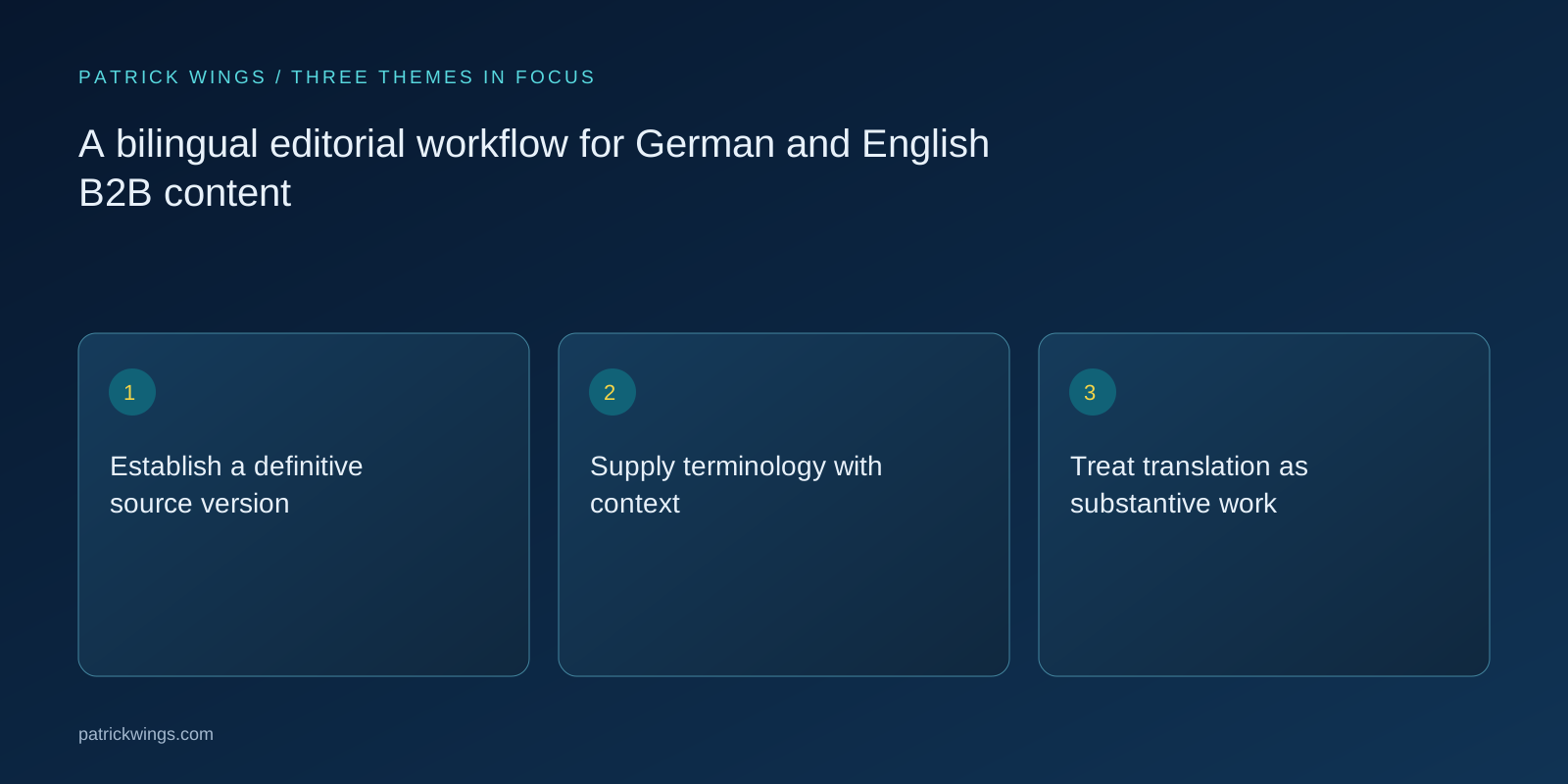
Treat translation as substantive work
Hand over complete context, including diagram labels, form guidance and linked files. Isolated fragments increase the risk of misunderstanding a condition or sequence. Allow idiomatic expression and different sentence lengths. Automated assistance can support a draft but cannot replace accountable review. Check negatives, modal verbs, quantities and timing particularly carefully. “May” and “will” must not become interchangeable promises. Keep unresolved passages visible rather than using an elegant formulation to hide an uncertainty that still needs a specialist's answer before either version can safely be finalized.
Show a hypothetical meaning check
Suppose the German source says an export can be configured after technical assessment. An English version saying “The export will be available immediately” changes both condition and timing. Review first restores the substantive meaning, then chooses natural wording. This hypothetical example establishes no universal translation for an individual word. It shows why semantic parity needs checking at sentence and process level, so both audiences form the same expectations about the service and understand which assessment still has to happen before the stated next step becomes possible.

Review both versions independently
Ask a competent reader to assess each language without consulting the source. Can they explain purpose, prerequisites and next action? Then compare meaning across versions. These checks answer different questions: independent reading catches awkward transfer, while comparison catches shifted commitments. Check date formats, forms of address and local examples as well. Informative headings and explained abbreviations help both audiences. Links and downloads should match the language or clearly disclose that the destination exists only in another language, so readers can decide whether it will be usable for them.
Propagate changes together
Keep related versions with visible status and record which changes need translation. A source correction remains incomplete while the other language retains an outdated promise. Define changes needing renewed expert review and those editors can carry across. Inspect final presentation because longer wording may be clipped in buttons or diagrams. Maintain terminology, change records and ownership together. A sustainable workflow should not require anyone to infer substantive equivalence from publication dates alone; it should make the relationship between the two approved versions explicit and inspectable when later updates arrive. Explore this further in the guide Keeping translated SEO content current together.
INTERACTIVE / FROM READING TO ACTION
Three checkpoints for your implementation
Choose a checkpoint and track your reading progress. Checks are neither saved nor sent and do not score your business.
CHECKPOINT 01
Treat translation as substantive work
Hand over complete context, including diagram labels, form guidance and linked files.
Explore in the article ↗CHECKPOINT 02
Show a hypothetical meaning check
Suppose the German source says an export can be configured after technical assessment.
Explore in the article ↗CHECKPOINT 03
Review both versions independently
Ask a competent reader to assess each language without consulting the source.
Explore in the article ↗Frequently asked questions
Must both texts have the same length?
No. Equivalent meaning and readability matter more than identical word counts.
Which language should come first?
Choose the language with the strongest access to expertise and review, and name the source explicitly.
Is back translation sufficient?
It may reveal issues but does not replace checking readability, context and specific commitments.
How can I put “Establish a definitive source version” into practice?
Choose the substantive source and define when it is ready for translation. Resolve significant open questions before handover. Mark changing product terms and claims still under review.
What matters when working on “Supply terminology with context”?
Create a small glossary containing preferred terms, meanings and usage examples. Include expressions that remain unchanged and wording to avoid. A word-pair list is inadequate when meaning varies by context.